
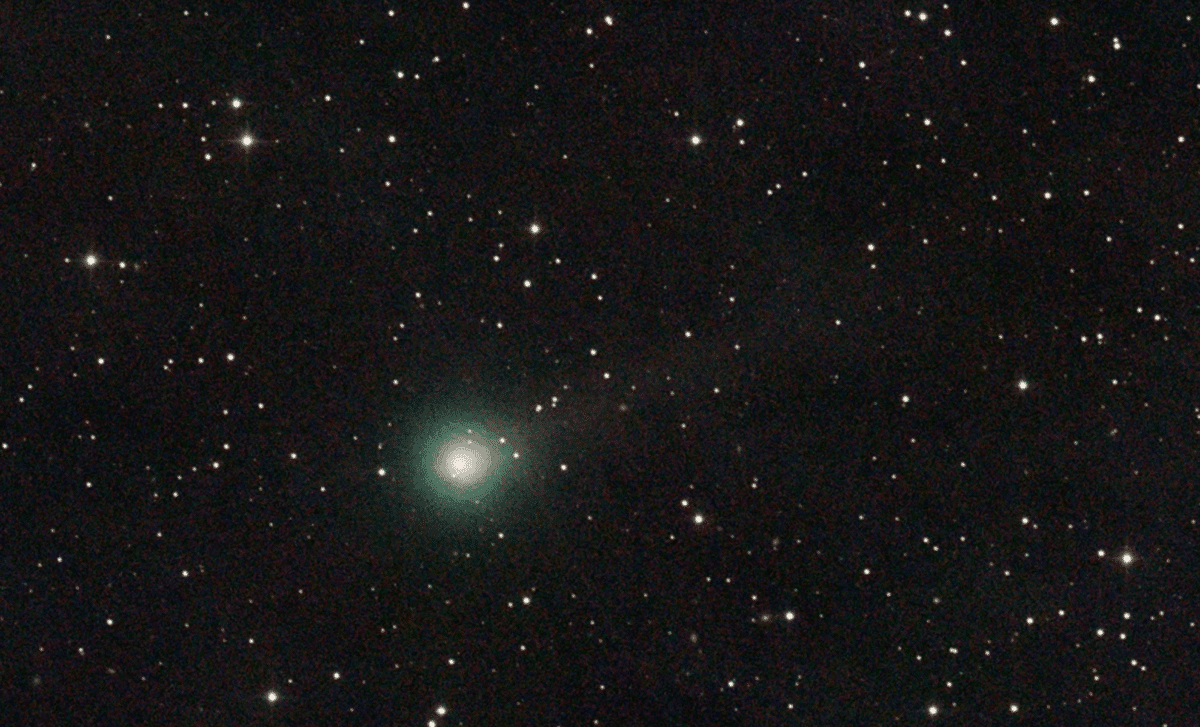
Comet C/2025 A6 (Lemmon) has recently attracted attention as it makes its way toward a close encounter with Earth this October. Known for its striking lime-green glow, this celestial visitor may soon be visible without any optical aid, providing an extraordinary spectacle for sky enthusiasts. Reports from Space.com indicate that Comet Lemmon is forecasted to brighten significantly in the coming weeks, potentially becoming one of the most captivating sights in the night sky this month.
Introducing Comet Lemmon
Comet Lemmon is a nonperiodic comet, which means its orbit is not regular and extends for thousands of years. Discovered on January 3, 2025 by astronomers at the Mt. Lemmon SkyCenter Observatory in Arizona, it was detected as it made its inbound journey toward our solar system’s inner regions. Traveling at a staggering speed of 130,000 mph (209,000 km/h), it will come within approximately 56 million miles of Earth by October 21, 2025, making it a fantastic target for observation this year.
While this is the comet's first public appearance, it has been orbiting the Sun silently for centuries, dwelling mostly in the distant Oort Cloud— a massive reservoir of icy objects on the solar system’s frontier. Its last close passage by the Sun is estimated to have happened around 1,350 years ago. Since its discovery, astronomers and stargazers have been eagerly monitoring its trajectory and behavior.

The Mystery Behind Comet Lemmon’s Green Hue
One standout characteristic of Comet Lemmon is its vivid lime-green coloration, setting it apart from many other comets. This unique color arises primarily due to diatomic carbon (C2), a rare gaseous form of carbon that glows green when energized by sunlight.
A handful of other comets have displayed a similar green tint, such as the notable “green comet” C/2022 E3 that passed Earth in 2023. As reported by Live Science, Lemmon’s coma — the surrounding veil of gas, dust, and ice — is expanding as it nears the Sun, amplifying its brightness and the intensity of its green glow. It is expected to reach an apparent magnitude of 4, potentially making it visible to the unaided eye depending on observing conditions.
For amateur astronomers, this event offers a unique chance to witness a comet’s colors vividly, adding excitement to the approaching cosmic display.
Where and When to See Comet Lemmon
In the Northern Hemisphere, Comet Lemmon will be observable during dawn or shortly after dusk. As it approaches closer, spotting it will become easier, especially with binoculars or a small telescope. Stargazers should focus on the Lynx constellation, situated between the planet Jupiter and the stars of the Big Dipper.
The comet will make its nearest pass by Earth on October 21, at a distance of about 56 million miles—approximately 230 times the distance between Earth and the Moon. It will then proceed toward perihelion, its closest point to the Sun, on November 8. Even if Comet Lemmon falls short of naked-eye visibility, it will still be a remarkable sight with the aid of telescopes or binoculars.
Why Comet Lemmon Deserves Your Attention
Comet Lemmon is not just a beautiful sight but a dynamic astronomical phenomenon. As it draws nearer to the Sun, the coma expands, reflecting more sunlight and causing the comet to shine brighter. Experts anticipate that its tail, made up of ice, dust, and gas, will become longer and more spectacular. Recent solar wind interactions have even generated ripples in its tail, adding to the visual drama.
“This comet is developing very nicely and it is already an impressive object, well-placed for observation in the morning sky,” said Nick James, director of the Comet Section at the British Astronomical Association, according to Spaceweather.com. “It is definitely worth getting up for!” This underscores the growing excitement as Comet Lemmon's arrival nears, encouraging early risers to catch this rare astronomical event.
- Categories:
- News








0 comments
Sign in to Comment