
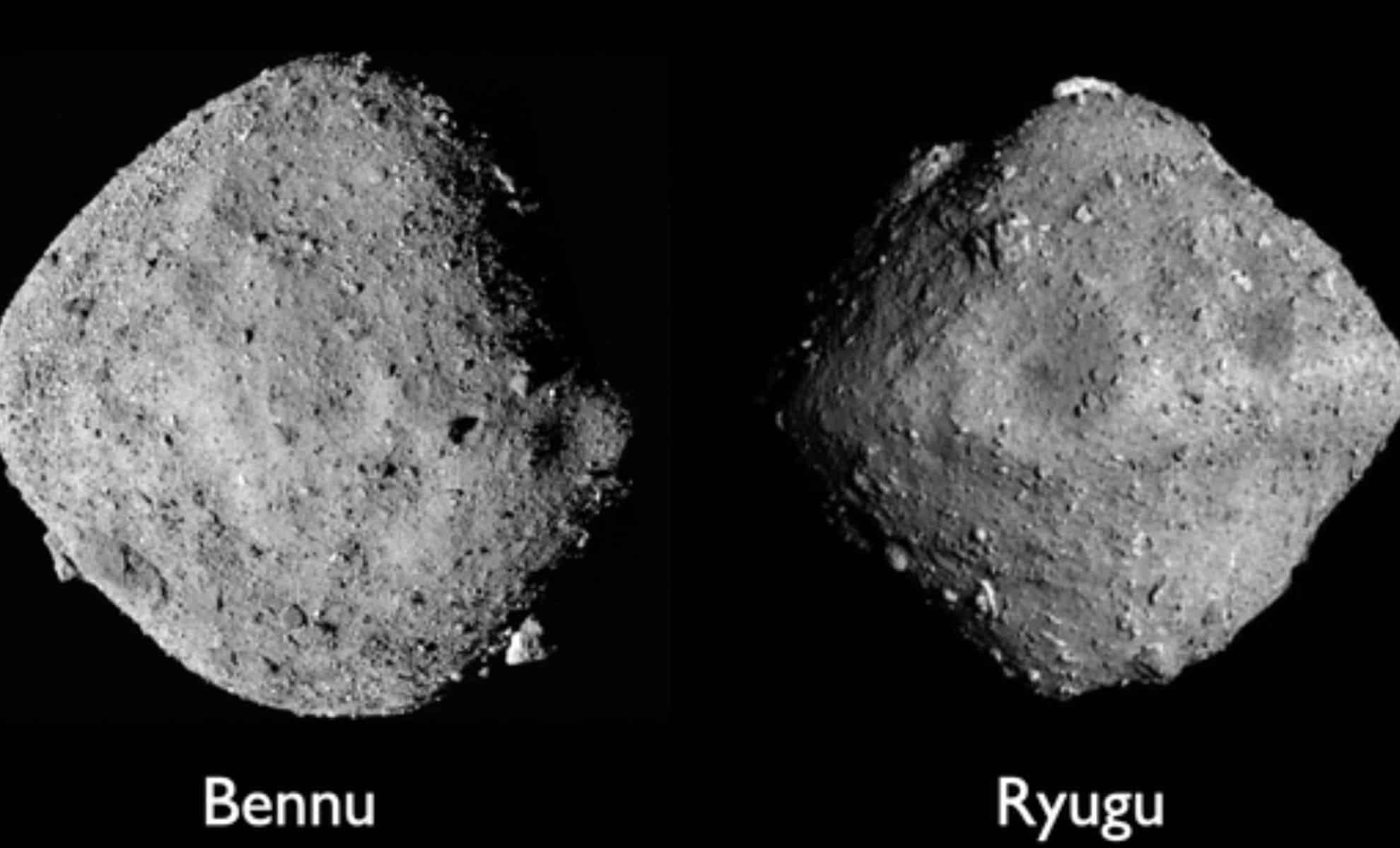
A recent publication in the Planetary Science Journal introduces a compelling theory that the asteroids Bennu, Ryugu, and Polana may share a common ancestral body. The investigation, detailed in “JWST Spectroscopy of (142) Polana: Connection to NEAs (101955) Bennu and (162173) Ryugu”, explores spectral observations from these three space rocks, revealing clues about their possible collective beginning. Utilizing the advanced capabilities of the James Webb Space Telescope (JWST), scientists gathered near-infrared spectral data from Polana, the largest candidate in a familial group of asteroids. They then compared this data with detailed analyses from Bennu and Ryugu, both extensively studied through NASA’s OSIRIS-REx and Japan’s Hayabusa2 missions. Their findings propose that these asteroids likely originated from a singular primordial collision, offering new insights into early solar system processes.
Polana, Bennu, and Ryugu: Uncovering an Asteroid Kinship
Dr. Anicia Arredondo, who led the study, explained, “The early solar system saw major asteroid collisions leading to fragment families, with Polana as the largest remnant.” This hypothesis suggests a gigantic impact event billions of years ago fragmented a larger body into smaller pieces. Among these fragments, Polana has remained relatively intact, while Bennu and Ryugu have since migrated closer to the Sun, undergoing different evolutionary paths.
Armed with sensitive spectral instruments aboard the JWST, the research team scrutinized Polana’s surface properties in unparalleled detail. By contrasting Polana’s near-infrared spectral profile with material returned from Bennu and Ryugu, the scientists extracted pivotal information about their mineralogy and structure. “The data points toward Polana, Bennu, and Ryugu originating from a singular collisional event,” Arredondo noted. This multisource spectral comparison enabled a strong argument for their shared heritage.

Decoding Spectral Signatures: Evidence for a Single Progenitor
The study’s notable discovery lies in the spectral affinity observed among Polana, Bennu, and Ryugu. Despite minor surface variations—attributed to differing weathering or solar influence—they exhibit closely matching compositions. “The resemblance in their spectral fingerprints supports the notion that all three derived from the same progenitor asteroid,” said Arredondo. The researchers analyzed minerals and compounds across the asteroids’ surfaces, reinforcing the connection.
These compositional similarities persist despite the asteroids’ distinct sizes and locations within the solar system. Polana’s comparatively larger size may have helped preserve its original materials, while Bennu and Ryugu’s proximity to the Sun exposes them to stronger solar radiation and more frequent micrometeoroid strikes, driving surface changes. This disparity helps explain the surface evolution seen in the spectral patterns.
Surface Evolution Shaped by Solar Exposure and Micrometeoroid Bombardment
The investigation also examined how environmental differences have sculpted each asteroid’s exterior differently since their fragmentation. Dr. Tracy Becker, co-author of the research, remarked, “Polana, Bennu, and Ryugu have each charted unique courses through the solar system following their shared origin.” Bennu and Ryugu’s closer solar orbits have subjected them to heightened solar radiation and particle impacts, drastically altering their surfaces compared to Polana, which orbits farther out.
“Additionally, Polana’s greater age means it has faced micrometeoroid impacts over a longer timeframe,” Becker added. These continuous small-scale collisions erode asteroid surfaces, modifying their outer layers chemically and physically. Polana’s extended exposure likely led to more pronounced surface changes relative to the younger Bennu and Ryugu. While these differences impact their spectral results, the fundamental composition similarities remain quite clear.
- Categories:
- News








0 comments
Sign in to Comment