

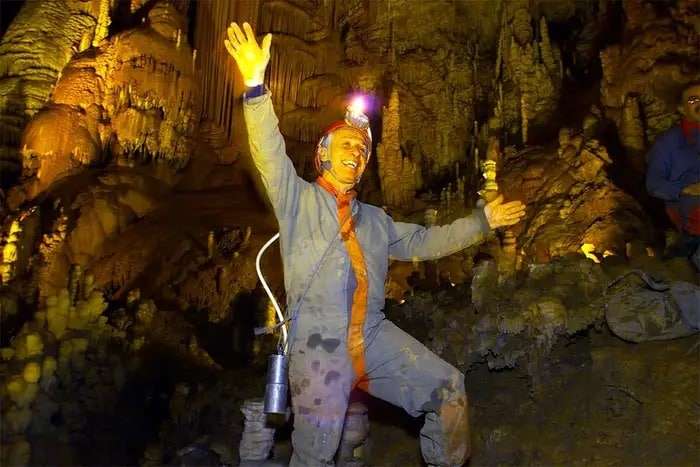
In the summer of 1962, French geologist Michel Siffre ventured deep into a glacier cave nestled in the French Alps, cut off completely from timekeeping devices and any connection to the outside world. Emerging after 63 days, he was disoriented about the date, unable to judge the duration he’d spent underground, and described himself as feeling like a “half-crazed, disjointed marionette.”
What began as a simple geological exploration evolved into a groundbreaking foray into human biology, pioneering the study of chronobiology—the science of our body's internal rhythms. Initially intending to investigate a newly found glacier within the Scarasson cave, situated 130 meters below ground, Siffre planned a brief fifteen-day excursion.
After reconsideration, he realized such a short stay wouldn’t yield meaningful insights. He extended his mission to two months, setting up one of the most daring self-experiments ever undertaken in scientific research.

“I decided to live like an animal,” Siffre told New Scientist in 2018. “Without a watch, in the dark, without knowing the time.”
Enduring Complete Seclusion
The environment was unforgiving—temperatures remained below freezing while humidity soared to 98 percent. Limited by scant supplies, Siffre endured cold and damp clothing, facing continuous discomfort.
“My feet were always wet, and my body temperature got as low as 34°C (93°F),” he said.
With no clock, artificial light cues, or sensory signals to guide him, Siffre had only a radio connection to receive minimal communications, which notably lacked any time references.
Regardless, he meticulously documented his psychological state, sleep cycles, and overall health. Maintaining a detailed journal, he engaged in mental exercises like counting to monitor changes.
The observations he recorded unveiled rare insights into the impact of extreme temporal isolation. Notably, his perception of time markedly slowed—counting to 120 that normally took two minutes stretched to five.
“My psychological time […] compressed by a factor of two,” he explained.
The Body’s Autonomous Timekeeper
Siffre’s most profound conclusion was the discovery that the human body maintains its own innate timing mechanism, distinct from daylight or external cues.
Deprived of sun, clocks, or schedules, his circadian rhythm began to lengthen. Initially, his internal day expanded from 24 hours to roughly 24.5 hours. However, a subsequent experiment ten years later revealed even longer cycles.
“I would have thirty-six hours of continuous wakefulness, followed by twelve hours of sleep,” he noted.
What surprised scientists most was Siffre’s unawareness of these altered cycles.
“I couldn’t tell the difference between these long days and the days that lasted just twenty-four hours,” he said.
Examining his own logs, Siffre found no sign that he consciously recognized the changes. This confirmed that when cut off from environmental signals, humans do not strictly adhere to a 24-hour routine. His experiments were the first to document how internal clocks might become detached from outside influences.
From Experimental Outlier to Foundational Research
Initially, his work faced criticism. Siffre was perceived as a geologist trespassing into biology without formal expertise. Detractors questioned the safety and validity of his methods, especially given concerns about protecting cave ecosystems during prolonged stays.
Nonetheless, his courageous, unconventional self-study laid essential groundwork for the emerging field of human chronobiology. This discipline has since transformed how we understand sleep disorders, shift work, jet lag, and optimal timing for cancer therapies.
The broader significance of his findings caught the attention of Cold War-era agencies invested in peak human performance. With the space race raging and nuclear submarine programs advancing, both NASA and the French armed forces saw considerable value in his research.
“It was the Cold War,” he recalled. “Not only was there a competition between the US and Russia to put men into space, but France had also just begun its nuclear submarine program.”
Given the scarcity of knowledge on human physiology under isolation, Siffre’s work became a crucial resource for military and aerospace scientists.
“NASA analyzed my first experiment in 1962 and put up the money to do sophisticated mathematical analysis,” he said.
Irregular Body Clocks in Isolated Settings
Siffre’s findings were echoed by others who took part in similar cave isolation experiments, some collaborating with him over the years.
Participants commonly experienced bizarre and unpredictable sleep-wake cycles. For example, one individual cycled between 25-hour “days” and 12-hour “nights.” Another slept for an astonishing 33 hours straight, leaving researchers on the surface concerned for his wellbeing.
“It was the first time we’d ever seen a man sleep for that long,” Siffre later said.
Despite the physical hardships and mental strain these studies imposed, Siffre remained devoted to exploring caves. “Caves are a place of hope,” he remarked later.
“We go into them to find minerals and treasures, and it’s one of the last places where it is still possible to have adventures and make new discoveries.”
What began as a geological mission ultimately revolutionized biological science, unlocking novel insights into time perception and the inner workings of the human body.
- Categories:
- Science










0 comments
Sign in to Comment