
For many years, the Lambda Cold Dark Matter (ΛCDM) framework has served as the cornerstone of cosmological understanding, building extensively on Big Bang principles. It posited that the universe expanded from an intensely dense origin, with the stretching of spacetime accounting for the observed Hubble redshift.
This model also incorporated dark matter and dark energy to clarify phenomena such as the cosmic microwave background (CMB) and the unexpected faintness of distant supernovae.
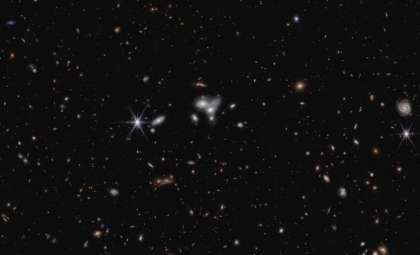
Yet, growing evidence increasingly questions the model's completeness. Observations from the James Webb Space Telescope reveal surprisingly developed galaxies appearing far earlier than anticipated. Other puzzling issues like the “Hubble tension” and the recent influence of dark energy suggest significant gaps in our cosmic blueprint.

A Novel Gravitational Framework
Instead of merely refining the ΛCDM paradigm, some researchers have explored fresh interpretations rooted in general relativity. Beginning in 2011, Jun Ni discovered new solutions to Einstein’s field equations relevant to neutron stars, ideas later extended by Lubos Neslušan, Jorge deLyra, and others. These findings, collectively called the Ni-Neslušan-deLyra configurations, offer a striking alternative view of our cosmos.
Contrary to conventional models, these solutions describe a spherical shell with an empty center, where a repulsive gravitational effect draws matter toward this shell. This structure leads to gravitational redshifts and blueshifts depending on the light’s path, challenging the traditional assumption of flat Minkowski spacetime within such shells.
Addressing the ΛCDM Challenges
Many familiar discrepancies of the ΛCDM, including the Hubble tension and supernova dimming, could be naturally resolved if our observable universe resides within a substantial Ni shell. Positioning the Milky Way near the core in the so-called KBC Void, although inconsistent with the cosmological principle, might align with observations like quasar distribution anomalies.
Within this Ni shell universe, the Hubble redshift could stem from gravitational redshift effects of the shell, instead of solely spacetime expansion. The Hubble tension could reflect varying gravitational influence further from the center, negating the need for dark energy.
Integrating Hybrid Cosmologies
The Ni framework might be combined with ΛCDM in a hybrid model, reminiscent of Rajendra Gupta’s “CCC + TL” approach. Under such a scheme, supernova dimming would result from gravitational redshift induced by the Ni shell, making distant objects appear more remote than they truly are. Yet, the implications of the Ni model might extend well beyond resolving current cosmological puzzles.
Observations of unexpectedly high mass densities in the universe’s infancy suggest it resembles a black hole in terms of mass content. This viewpoint leads to a novel cosmological concept in which spacetime consists of interconnected photonic filaments, an idea introduced by Arto Annila and collaborators. These overlapping photon pairs could underpin the mechanisms of gravity itself.
Could the Universe Be a Black Hole?
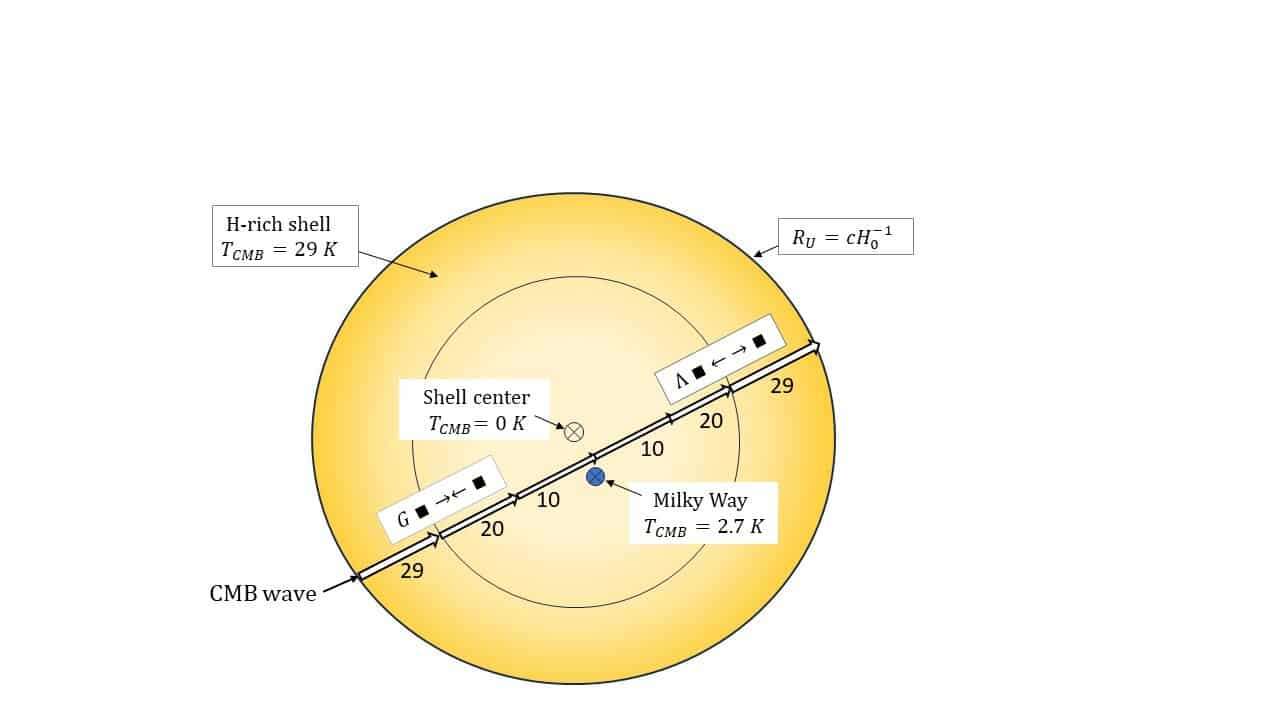
Within this black hole cosmology, all radiation remains confined inside the cosmic interior. The CMB might originate from gravitational energy trapped during the shell’s formation, possibly initiating a gravitational cycle analogous to Einstein’s cosmological constant, Λ.
Gravity in this model arises from CMB photon energy being absorbed in spacetime’s filamentary structure, attracting mass together, while the Λ force returns energy by pushing mass apart. This interaction corresponds with the Ni solutions, where gravitational forces emerge from inward redshifted waves and Λ from outward blueshifted waves.
The Ni shell black hole universe also lends itself to empirical validation. If accurate, the CMB temperature within the shell would be near 29 K, with temperatures dropping close to 0 K near the center. Our present 2.73 K CMB measurement implies the Milky Way is offset from the cosmic center — a hypothesis testable by measuring CMB temperatures at various universe locations.
Rethinking Black Hole Structures
If our universe mirrors a black hole, then all black holes might share a similar shell architecture with gravitational and Λ force cycles. Regardless of their scale, black holes could emit a consistent "maximum luminosity" unaffected by size.
For smaller black holes, sustaining this luminosity would demand proportionally more energy to avoid collapse. In fast-spinning black holes, the Ni shell might transform into a toroidal shape, potentially explaining the intriguing supermassive black hole images captured by astronomers.
- Categories:
- Astronomy ,
- Space







0 comments
Sign in to Comment