
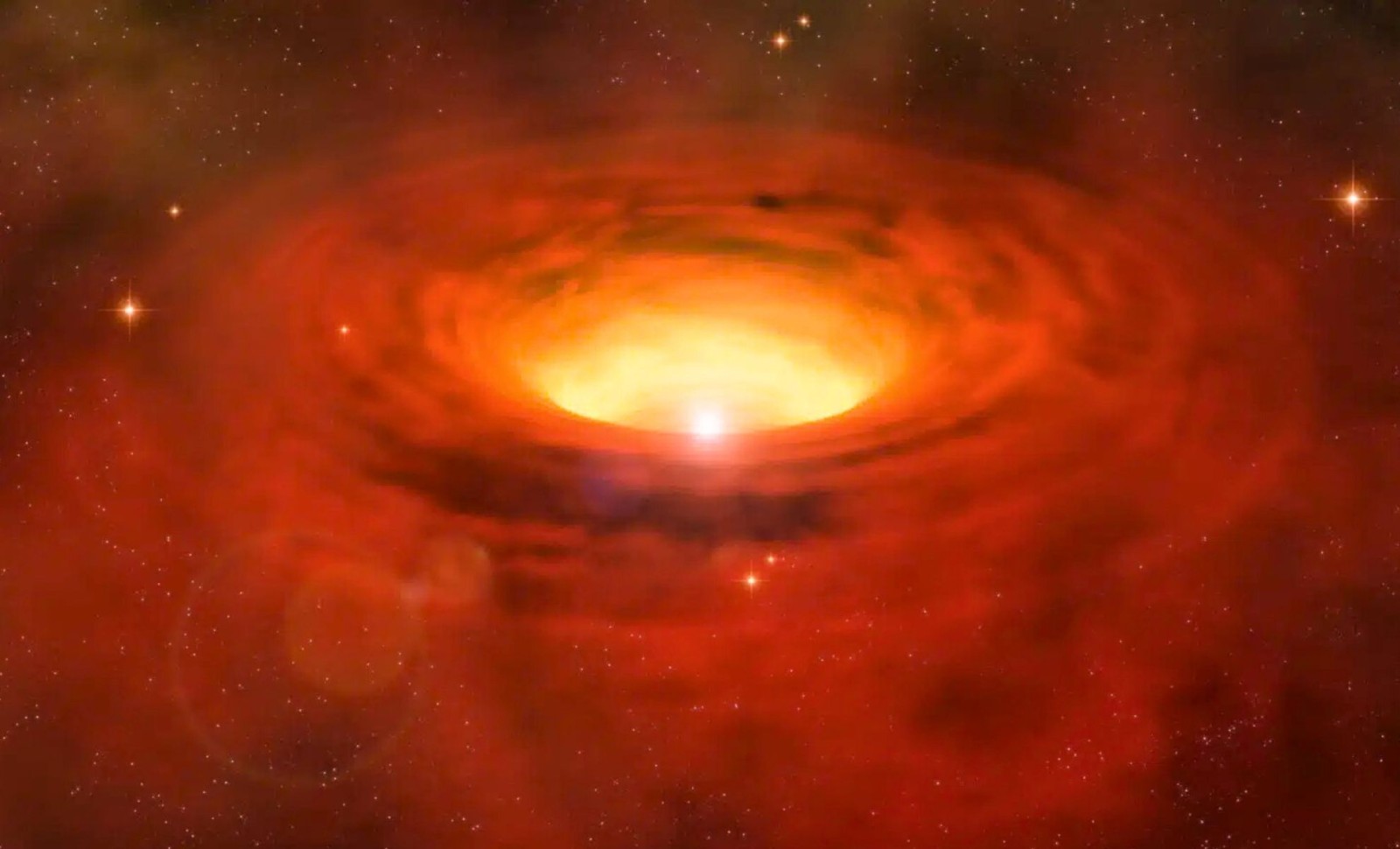
Situated roughly 160,000 light-years away, a mature red supergiant star in a nearby galaxy has become the focus of an extraordinary discovery that challenges current astrophysical understanding.
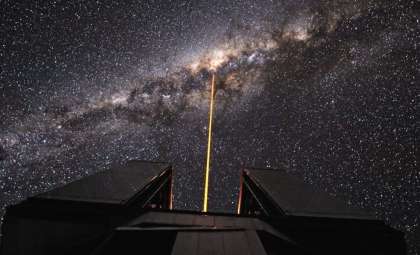
Utilizing the European Southern Observatory’s advanced Very Large Telescope Interferometer (VLTI), astronomers have captured detailed images of WOH G64, marking the first detailed observation of a star beyond our Milky Way. This stellar giant resides within the Large Magellanic Cloud (LMC), a satellite galaxy orbiting the Milky Way, and is approaching the end of its life, likely leading to a supernova.
The findings represent both a technological accomplishment and a scientific enigma: WOH G64 is enveloped in a dense, uneven shroud of hot dust that doesn’t conform to existing theoretical models. Published in Astronomy & Astrophysics, these insights could significantly alter our knowledge of the tumultuous final phases experienced by massive stars.

Additionally, observations have revealed a surprising and rapid decrease in the star’s near-infrared brightness over the past ten years, indicating swift and not yet fully comprehended changes in its immediate surroundings. Scientists are now investigating whether this is evidence of an unstable mass-loss event or interactions with a hidden binary partner.
Breaking New Ground: First High-Resolution Image of an Extragalactic Star
Astronomers employed the VLTI’s GRAVITY instrument to secure a near-infrared image of WOH G64 at an exceptional 1 milliarcsecond resolution, unveiling its innermost dust formation region in remarkable detail. The observations, conducted in late 2020, represent the first successful interferometric imaging of a red supergiant star located outside our galaxy.
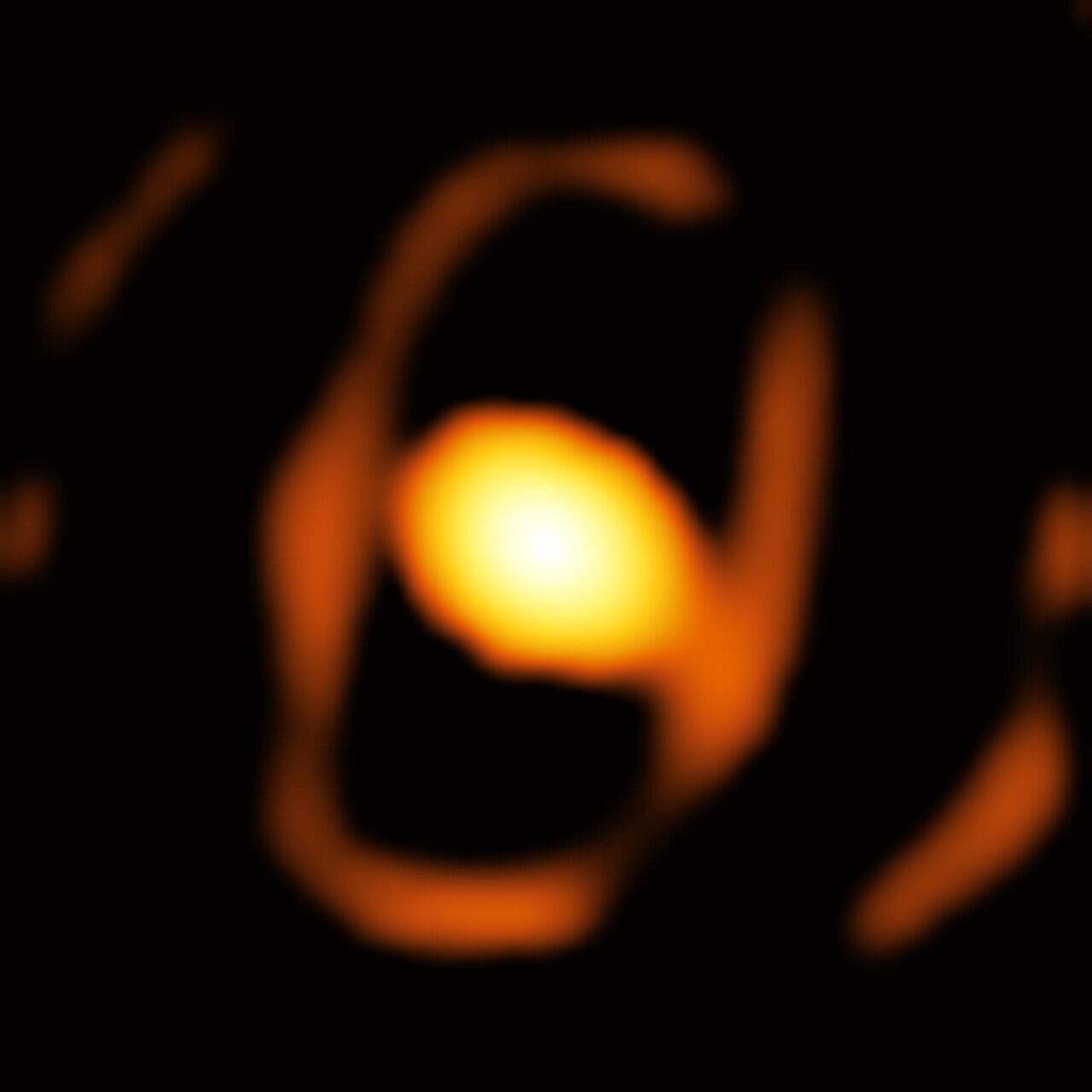
The image reveals a compact and elongated emission region roughly 13 by 9 times larger than the star’s radius. The research team notes, “elaborate imaging displays elongated compact emission,” which contradicts earlier expectations of a uniform spherical or doughnut-shaped dust shell.
Crucially, this dusty region shows dimensions of approximately ~4 milliarcseconds by 3 milliarcseconds along its major and minor axes respectively, while the central star itself has become nearly undetectable in the near-infrared spectrum. The scientists compared their findings with historical models based on MIDI (2005-2007) and Spitzer data, uncovering major inconsistencies, particularly regarding the star’s brightness at 2.2 microns.
Unexpected Dimming and Emergence of Heated Dust
Beyond morphological differences, WOH G64 appears to have experienced a marked change in its spectral characteristics from 2009 to 2016. Previously, the star’s spectrum exhibited typical red supergiant markers, such as water vapor absorption. However, more recent observations—including those from GRAVITY, X-shooter, and the REM telescope—demonstrate a steadily increasing near-infrared continuum.
The team attributes these changes to the rapid creation of hot dust in the star’s immediate vicinity, which now obscures the star’s direct light. This dust is likely made up of iron-bearing silicates or aluminum-deficient silicates and drives the rising infrared emission alongside the disappearance of molecular absorption features.
“The compact emission captured by GRAVITY and the near-infrared spectral shift suggest recent hot dust formation close to the star,” the researchers explain. This dust is thought to exist within 1 to 2 times the star's radius, absorbing or deflecting much of its outgoing infrared light.
Interestingly, the mid-infrared range (8-13 μm) has remained largely unchanged since 2005, according to fresh VISIR observations taken in 2022. This indicates that while the innermost dust shell is evolving, the outer circumstellar dust remains steady.
Clues Pointing Toward Binary Interaction
The elongated emission pattern suggests the potential presence of a bipolar outflow or effects caused by an undetected companion star. Although no companion has been directly observed, the dust’s asymmetrical distribution and the star's brightness variations align with models of non-spherical material loss.
Previous work, including that of Ohnaka et al. (2008), proposed a pole-on torus-shaped dust shell to explain the star’s appearance. Yet, the latest VLTI findings reveal a much lower stellar brightness than predicted, supporting the hypothesis of a recently formed, denser dust layer in the intervening years.
The researchers also highlight that the stellar core does not manifest as a sharp point source in the reconstructed images. While this may result from intense dust obscuration, it also leaves room for speculation that an additional object could be affecting the observed dust configuration.
Unraveling the Mysteries of Massive Star Demise
WOH G64 now offers astronomers a unique opportunity to study a massive star on the verge of collapse in real time. Its unpredictable behavior emphasizes how little is still definitively known about these stars’ final evolutionary phases—even for ones with extensive multi-wavelength monitoring.
Though standard models propose that red supergiants lose mass gradually through symmetrical stellar winds, data from WOH G64 suggest instead a complex, sporadic mass-loss process, possibly influenced by a hidden binary or internal stellar instabilities not fully captured in current models.
The observed rapid formation of hot dust close to the star hints at a sudden shift in the star’s mass-loss mechanics, though what initiates this remains a mystery. The star’s fading visible light over the past decade also points to a significant increase in circumstellar dust extinction, tied to this newly detected dust-producing episode.
- Categories:
- Space








0 comments
Sign in to Comment