
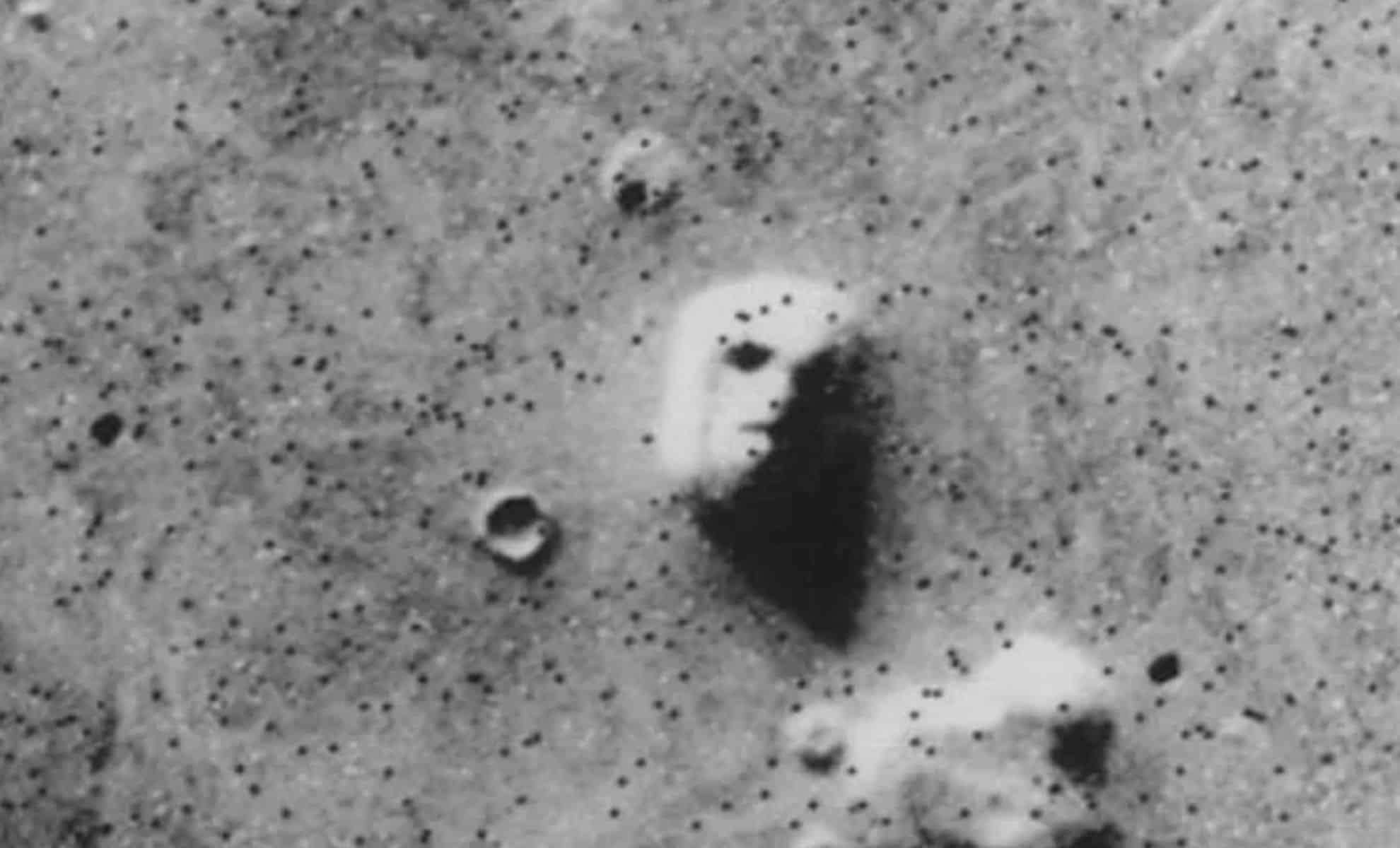
Back in 1976, NASA’s Viking 1 Orbiter captured a series of images from Mars that ignited a lasting enigma in planetary science: the so-called Face on Mars. Located in the Cydonia region, this unusual landform resembled a human face with distinct eyes, nose, and mouth features seemingly gazing toward Earth. This unsettling image quickly became a media sensation and sparked extensive speculation. Some believed it was a relic fashioned by an ancient Martian civilization, while others thought it offered proof of alien intelligence. Yet, as imaging technology progressed, the true nature of the formation gradually came into focus.
The Viking 1 Orbiter and the Origin of the Mars Face Phenomenon
In 1976, Viking 1’s mission included capturing detailed visuals of Mars to support upcoming explorations. Among its photos, one of the Cydonia region stood out due to its uncanny semblance to a human visage — featuring shapes that resembled eyes, a nose, and a mouth. This visual illusion sparked intense public and scientific interest, prompting widespread narratives about a potential ancient Martian society.
While NASA researchers found the shape intriguing, they warned against quick assumptions. The perspective and lighting conditions at the time caused the unnatural facial appearance. This marked the start of a prolonged debate; NASA maintained that the effect was caused by shadows and terrain alignment, a conclusion later supported through better-quality imagery.

Pareidolia: Why Humans See Faces in Random Patterns
The key to understanding the Face on Mars lies in the psychological effect called pareidolia. Human brains have evolved to rapidly identify faces, a skill critical for social interaction and survival. Consequently, our perception tends to interpret ambiguous shapes as faces, even when none actually exist.
This cognitive bias accounts for why the Mars face captivated so many. Once the mind registers a face-like form, it becomes extremely difficult to ignore. Pareidolia also explains why people perceive faces in everyday objects, such as clouds or rock contours. In Mars’ case, this propensity fueled unrealistic claims about deliberate sculpting despite the absence of supportive evidence.
How Modern Imaging Resolved the Mars Face Enigma
The mystery was clarified with advanced technology. In 1998, NASA’s Mars Global Surveyor (MGS) conducted a comprehensive survey, delivering significantly sharper images of the Cydonia region. These revealed that the “face” was merely a natural mesa, shaped over millennia by erosion and wind activity.
Photos from the Mars Global Surveyor clearly demonstrated that the face-like attributes were illusions created by the interplay of light and shadow combined with the Viking orbiter’s photographic angle and limited resolution. The facial features were simply geological structures rather than artificial constructs. This evidence put the debate to rest, even though the cultural intrigue surrounding the Mars face endures, continuing to inspire curiosity about the Red Planet.
- Categories:
- News










0 comments
Sign in to Comment