
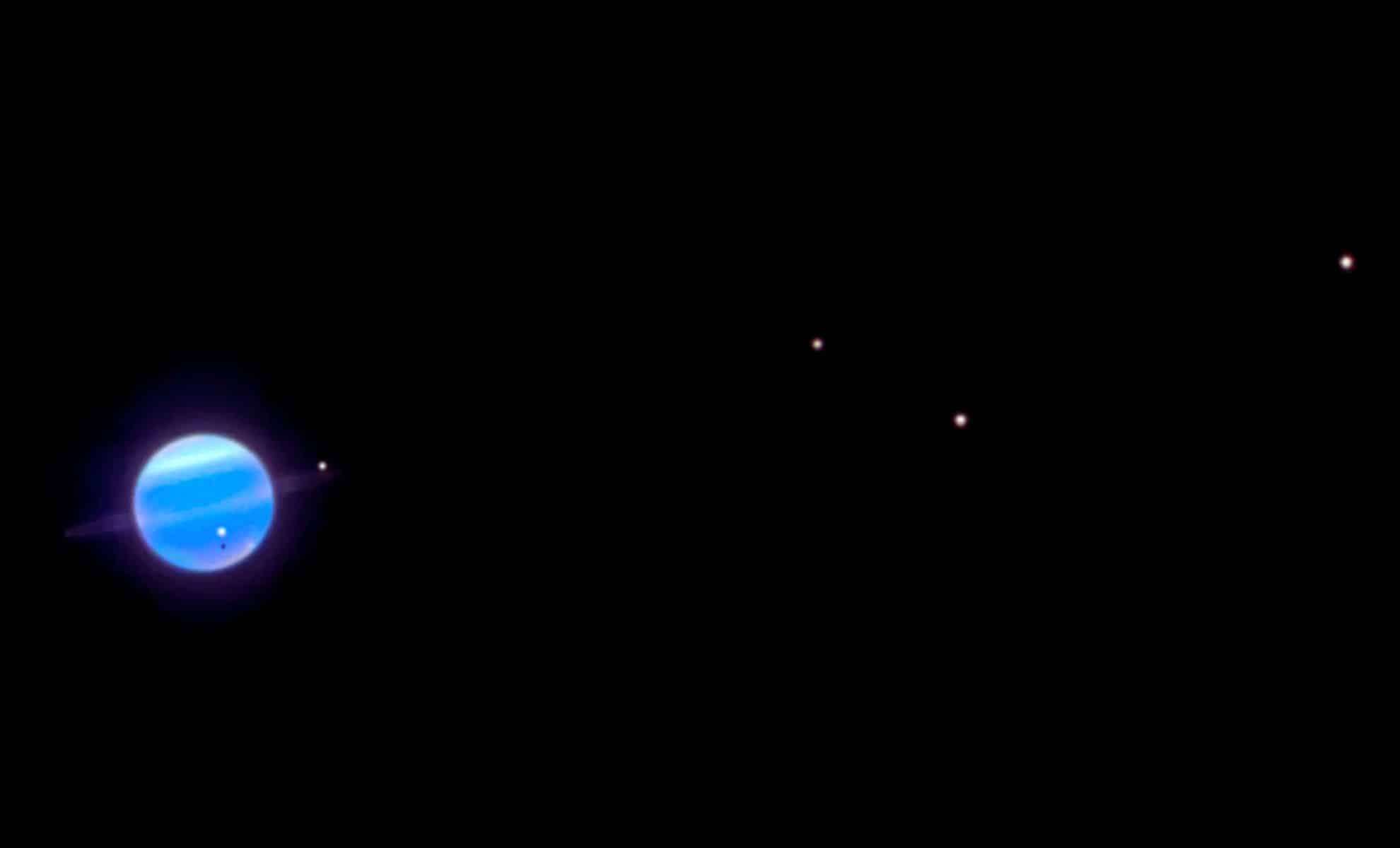
A novel investigation has revealed astonishing insights into the moons orbiting Uranus, overturning prior assumptions about their interaction with the planet’s magnetic field. Utilizing the cutting-edge ultraviolet capabilities of the Hubble Space Telescope, researchers discovered that the “dark hemispheres” of Uranus’ major moons are not where we thought they would be—appearing on the sides opposite to previous expectations. Presented at the 246th meeting of the American Astronomical Society, these new observations show that the moons’ leading faces are darker than anticipated, defying long-held models.
This breakthrough could revolutionize our comprehension of how Uranus’ moons respond to the planet’s magnetic environment, potentially reshaping our broader view of the behavior of distant moons within the solar system.
Reversed Darkness: A Surprising Lunar Discovery
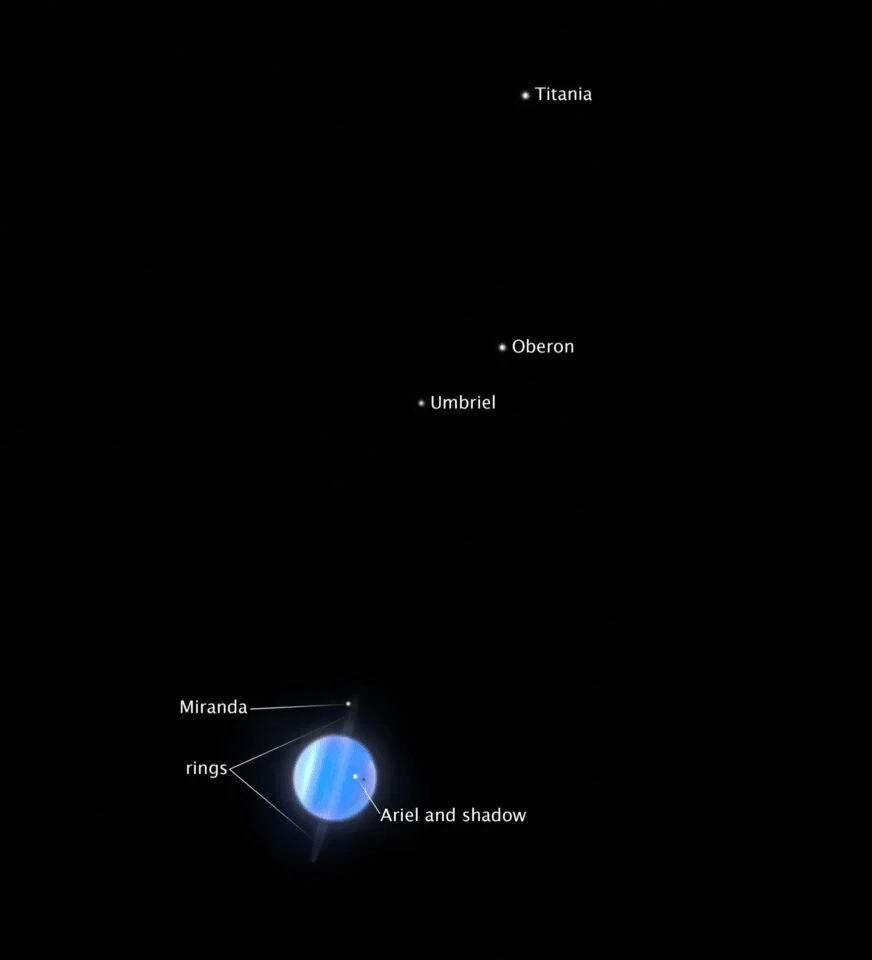
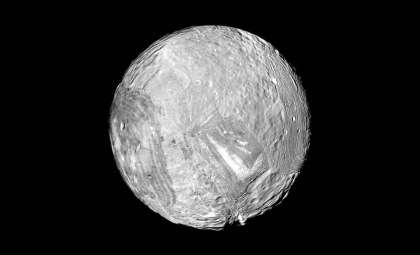
The moons of Uranus—Ariel, Umbriel, Titania, and Oberon—have fascinated researchers due to their intriguing features. These icy satellites are gravitationally locked to Uranus, consistently showing one side toward the planet, much like Earth's moon. Scientists traditionally expected the forward-facing hemispheres (the leading sides) to be brighter, with the trailing sides darkened by interactions with Uranus’ magnetic field.

Contrary to this assumption, Richard Cartwright, a planetary scientist at Johns Hopkins University, led a study revealing that none of these moons exhibit brighter leading sides. Surprisingly, Titania and Oberon’s trailing sides are actually brighter. This finding challenges the notion that trapped electrons from Uranus' magnetosphere darken the trailing hemispheres.
The Enigmatic Magnetic Field of Uranus
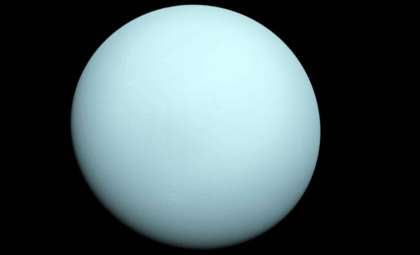
As Richard Cartwright states, “Uranus is unusual, so predicting how its magnetic field impacts its moons has always been challenging.” Uranus holds a complex magnetic field inclined by 59 degrees relative to the orbital planes of its satellites, differing significantly from Earth’s simpler magnetic structure.
Moreover, Uranus is tilted at an extraordinary angle of 98 degrees, causing it to rotate on its side as it orbits the Sun. This unique orientation leads to complex interactions between the planet’s magnetic field and its moons as they traverse its magnetosphere. The unexpected data imply that Uranus’ magnetic influence on its moons differs from former scientific expectations. This discrepancy suggests alternative explanations, such as a weaker magnetic influence or a more turbulent magnetic environment than previously assumed.
Introducing Dust Shielding: A New Perspective
The researchers propose a fresh hypothesis—dust shielding—to explain the brighter trailing sides of Titania and Oberon. This theory suggests that tiny dust particles, accumulated over millions of years due to meteor impacts, coat the moons’ leading edges. These dust layers may act like a protective screen, analogous to how a windshield deflects insects during a drive, preventing some radiation from darkening those surfaces.
“This could be one of the first instances of detecting a material exchange occurring among Uranus’ moons,” explains Bryan Holler, co-investigator and support scientist at the Space Telescope Science Institute. Similar processes have been noted among the moons of Jupiter and Saturn. The build-up of dust on these leading hemispheres might clarify why the trailing sides exhibit increased brightness, offering new clues into the complex surface dynamics of these icy satellites.
Oceans Hidden Beneath the Ice?
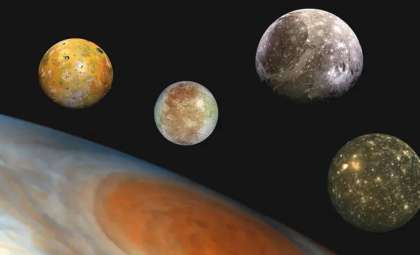
Beyond the puzzling brightness patterns, the study hints at the possibility that some Uranian moons may harbor or have harbored subsurface oceans. Drawing analogies with moons like Europa, Ganymede, and Enceladus—which are believed to contain liquid water oceans beneath icy shells—this discovery adds excitement to the potential habitability of Uranus’ satellites.
Data from the Hubble Space Telescope alongside observations from the James Webb Space Telescope, which is entering its own Uranian exploration phase, may soon provide firmer evidence regarding these hidden oceans. Researchers remain optimistic that future findings will unveil the true nature and secrets of these distant icy worlds.
- Categories:
- News




0 comments
Sign in to Comment