
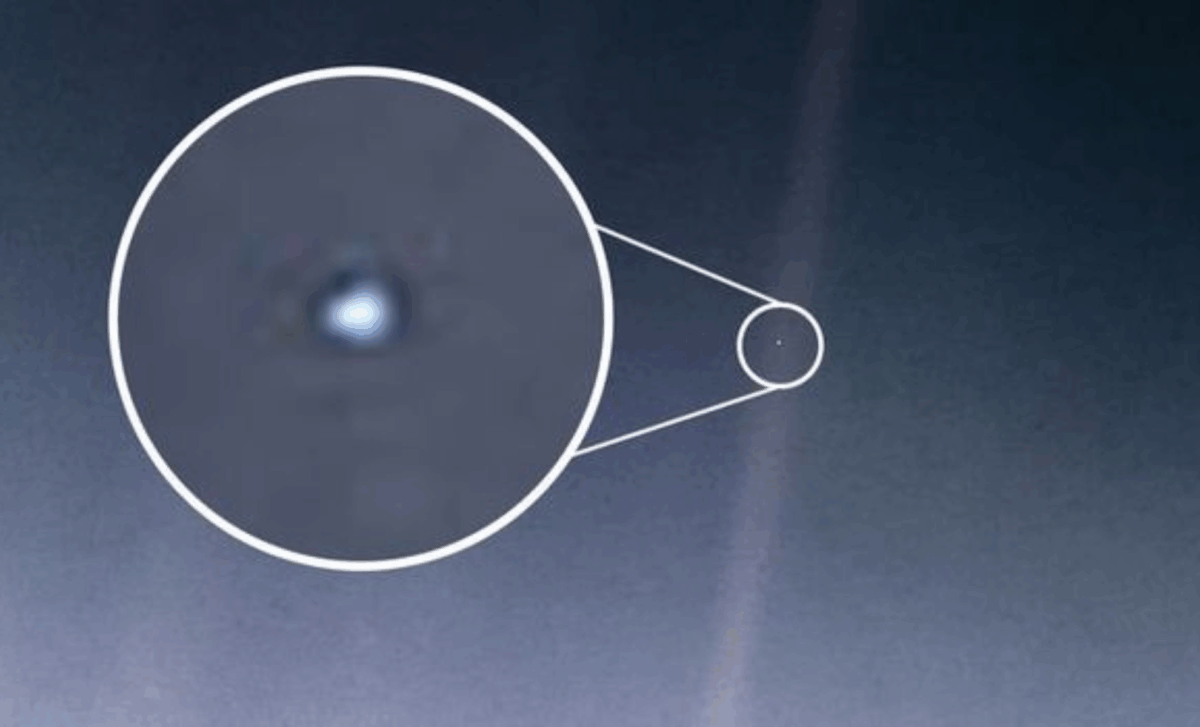
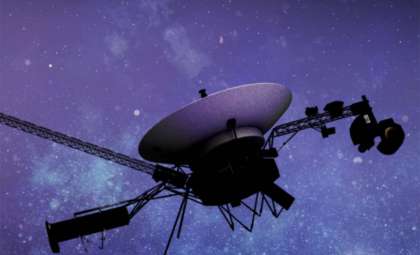
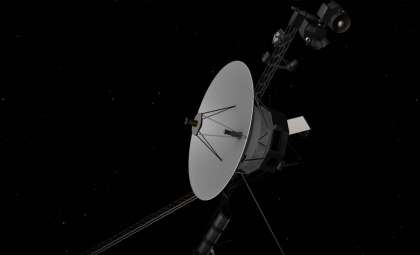
In November 2026, humanity will witness an extraordinary feat as Voyager 1 becomes the first artificial object to be located a full light-day away from Earth. Launched in 1977, this pioneering spacecraft has ventured farther than any human creation, symbolizing the immense scale of space and the gradual yet determined advance of human exploration beyond our planetary neighborhood. Insights shared by IFLScience highlight the importance of this landmark and what lies in Voyager’s path forward.
Reaching a Light-Day: A Landmark in Space Exploration
Voyager 1 has spent nearly 50 years traversing interstellar space, steadily extending our reach into the cosmos. By late 2026, it is set to reach approximately 25.9 billion kilometers from Earth, a distance so vast that light requires an entire day to travel between Earth and the spacecraft. This milestone is a powerful testament to the enormity of the universe we inhabit.
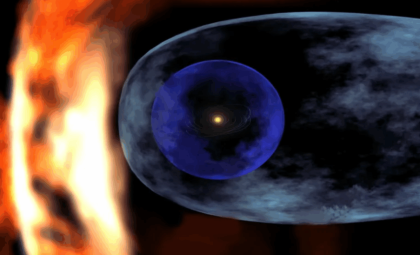
Currently, Voyager is situated about 169.5 astronomical units (AU) from Earth, placing it well beyond the Sun’s heliosphere and fully immersed in interstellar space. Traveling at roughly 61,198 kilometers per hour, Voyager continues its slow but consistent voyage. Even at this pace, extending the communication light time to a full 24 hours will require over a year, illustrating the tremendous distances involved in cosmic travel.

The Oort Cloud: Voyager’s Approaching Horizon
Voyager 1's trajectory is not just an escape from the solar system—it aims toward a mysterious and distant zone known as the Oort Cloud. This hypothesized spherical shell of icy bodies forms what NASA describes as:
“The distant Oort cloud marks the gravitational edge of the Solar System, in a vast region of undiscovered objects.”
Although the Oort Cloud has yet to be observed directly, it is considered to be the source of comets with long orbital periods, which may pass near the Sun only once in their lifetimes.
As detailed in IFLScience’s report, Voyager will eventually traverse the Oort Cloud, a journey lasting thousands of years. Estimates suggest it will need about 300 years to reach the cloud’s inner boundary and potentially as much as 30,000 years to exit it entirely. These immense periods offer perspective on both how far Voyager has come and the vastness that still lies ahead.
NASA also points out that the largely uncharted Oort Cloud could contain unknown objects, some possibly surpassing planetary sizes, influencing the behavior of comets and adding mystery to this remote region of space. The unknowns beyond our telescopic reach continue to captivate and humble us.
Voyager’s Encounters with Stars: An Ongoing Journey
While currently 169.5 AU from Earth, Voyager will not be alone forever in its travels through the galaxy. According to NASA, “It took 35 years to reach interstellar space, but it will take 40,000 years for Voyager 1 to be closer to the star AC +79 3888 than our sun.” Also called Gliese 445, this star will pass within 1.7 light-years of Voyager roughly 40,000 years from now, a significant but distant interaction on cosmic timescales.
This encounter marks just the beginning of Voyager’s prolonged passage through the Milky Way. Over tens of thousands to hundreds of thousands of years, the probe will drift past other stars, albeit rarely and over immense spans of time. NASA notes that statistically, Voyager will intermittently approach stars within specific ranges, but these events will remain very sparse.
Having advanced beyond the point where it will ever return near Earth, Voyager will continue its journey toward Gliese 445 for the next 40,000 years, carrying the legacy of humanity into deep interstellar space.
The Golden Records: A Timeless Message from Earth
One of Voyager’s most enduring legacies is the Golden Record—a symbolic message crafted for potential extraterrestrial civilizations. This gold-plated copper disc, 12 inches in diameter, carries a rich collection of sounds and images representing Earth’s diversity. Created under the guidance of Carl Sagan and his team, it serves as a time capsule, embodying humanity’s culture and achievements at the dawn of space exploration.
Though Voyager may never return to our planet, the Golden Record remains a silent envoy, carrying human stories across the cosmos. This artifact could endure for billions of years, outlasting our planet’s natural transformations. To future finders, it will be a mysterious and precious artifact from a civilization that dared to extend its reach beyond its home world.
- Categories:
- Space





0 comments
Sign in to Comment