
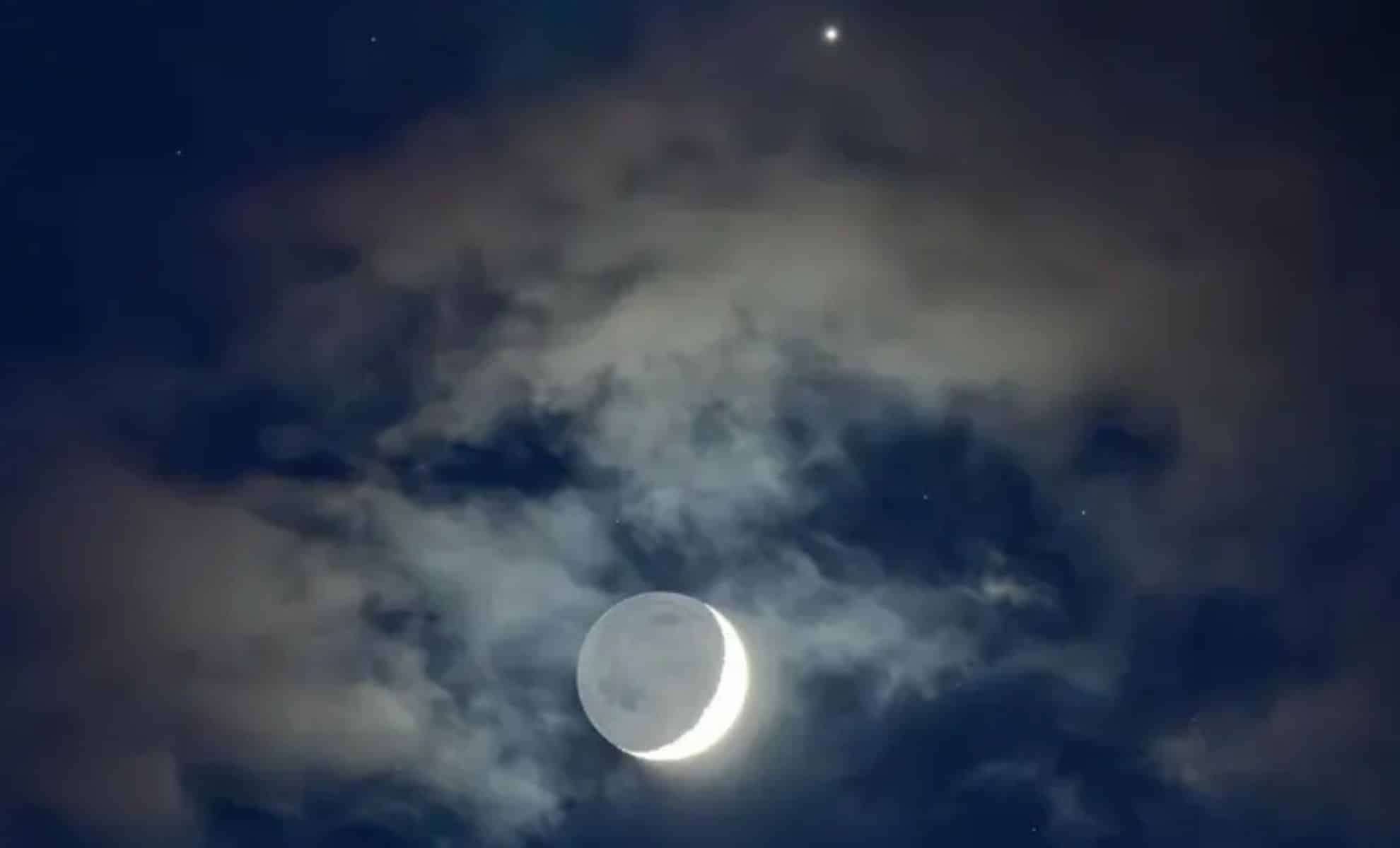
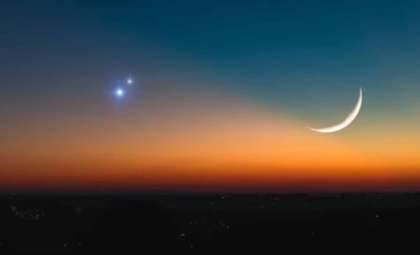
Observers of the night sky are about to witness a dazzling spectacle as Venus, famously known as the “Evening Star,” edges closely beside a slender crescent moon. This captivating pairing will be especially prominent throughout the Western Hemisphere, creating an enchanting visual effect where the moon appears as a softly illuminated sphere near Venus’s radiant shine.
This beautiful celestial encounter, featuring the two brightest nighttime objects, will be visible for approximately three hours following sunset on Saturday, February 1, 2025. Even those who don’t often glance skyward will find this sight utterly compelling.
This occasion represents the final intimate evening conjunction of Venus and the Moon for this astronomical cycle, as Venus will slowly fade into the sunset’s glow during March, vanishing from the evening sky until spring 2026.

Timing and Viewing Tips for the Venus-Moon Conjunction
For stargazers in the Americas, the prime opportunity to see this phenomenon is shortly after sundown on Saturday, February 1. The moment of closest proximity between the two will differ based on your region:
- Eastern Time (ET): 7:25 PM
- Central Time (CT): 6:25 PM
- Mountain Time (MT): 5:25 PM
- Pacific Time (PT): 4:35 PM
At these times, Venus will be positioned roughly 2.5 degrees above and to the right of the Moon—a notably close span on the celestial stage. The Moon will be softly lit with just 15% illumination, enhancing the scene’s visual appeal.
Viewers in Europe, South America, and Australia may notice a slight difference in Venus’s placement relative to the Moon, caused by parallax and the Moon’s swift motion across the sky.
Maximize Your Experience: Viewing Recommendations
To fully enjoy this stunning night sky event, consider these suggestions:
- Choose a Dark Spot: Escape the glare of urban lighting to fully appreciate the stars’ sparkle.
- Bring Binoculars or a Telescope: While visible unaided, these tools reveal Venus’s crescent shape and intricate lunar crater details.
- Gaze Westward: The pair will appear in the western sky, gradually setting below the horizon.
- Capture the Moment: A tripod and long exposure can beautifully preserve the Moon’s glow alongside Venus’s brilliance in photos.
The Celestial Mechanics Behind the Sighting
Despite their apparent closeness, the Moon and Venus are separated by vast distances. Venus is nearing Earth and shines at its brightest, making it a standout object in the night sky.
The crescent Moon is illuminated partly by sunlight reflected off Earth, producing a phenomenon called Earthshine. This causes the Moon’s shadowed side to faintly glow, adding an ethereal quality to the pairing.
Leonardo da Vinci famously described Earthshine as the “old Moon in the young Moon’s arms.” This effect will be especially prominent during the conjunction, heightening the event’s allure.
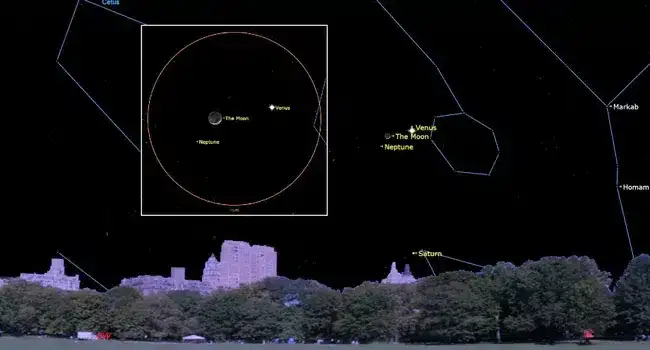
Important Details About the Venus-Moon Event
Spotting Venus in Daylight: A Unique Opportunity
For those in the Pacific Time Zone, the closest Venus-Moon approach occurs nearly an hour before sundown, offering a rare chance to observe Venus in daylight.
To try:
- Face the southwest about an hour before sunset and locate the thin crescent Moon.
- Look just to the Moon’s right; Venus will appear as a faint white dot against the blue sky.
- If Venus isn’t immediately visible, binoculars can help, though once located, it may be seen with the naked eye.
Why This Marked Event is Your Last Chance for a While
This event stands as the final close evening meeting of Venus and the Moon for this period. After February, the two will drift farther apart, with Venus steadily sinking into the sunset’s glow.
By the end of March, Venus will vanish from evening view, not returning until spring 2026 when it reappears in the morning sky.
This weekend represents the last opportunity in two years to witness this captivating duo so closely paired after dark.
- Categories:
- News







0 comments
Sign in to Comment