
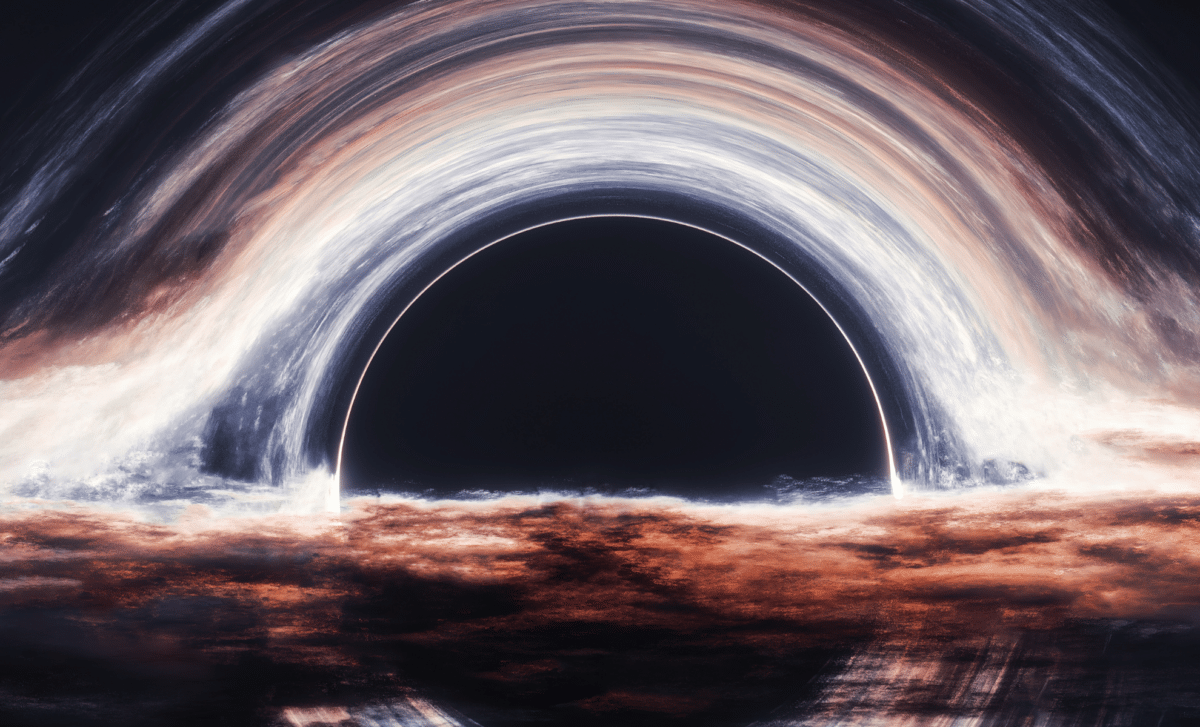
Researchers have uncovered an extraordinarily large and ancient black hole that challenges existing ideas about how such massive cosmic entities come to be. Discovered by Boyuan Liu and his team at the University of Cambridge through observations with the James Webb Space Telescope (JWST), this black hole resides within the galaxy Abell 2744-QSO1. Weighing approximately 50 million times the mass of our Sun, it inhabits a region nearly empty of stars, suggesting it could represent one of the earliest examples of a primordial black hole formed soon after the Big Bang.
A Star-Empty Black Hole Challenges Traditional Cosmology
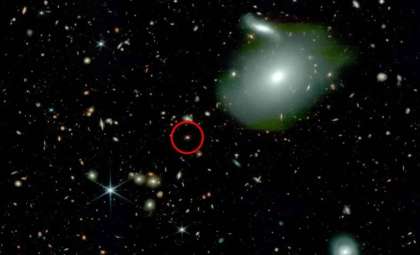
The galaxy Abell 2744-QSO1, seen as it was roughly 13 billion years ago, presents an unusual scenario. Despite containing a massive black hole, the surrounding space is notably lacking the stars typically expected around such objects. This observation contradicts prevailing theories, which propose that stars emerge first, eventually collapsing or feeding black holes over time.
“This is puzzling because standard models say that star formation occurs before or simultaneously with black hole development,” explains Liu.

The findings point toward an extraordinary possibility: this black hole might have emerged prior to any star formation, implying a formation process very different from widely accepted astrophysical views.
A promising explanation gaining attention is the primordial black hole concept, first suggested by Stephen Hawking. According to this theory, such black holes originated directly from intense density fluctuations in the immediate aftermath of the Big Bang, bypassing the typical stellar lifecycle altogether.
Although once considered speculative, this idea is now receiving renewed investigation.
“With these new observations that normal [black hole formation] theories struggle to reproduce, the possibility of having massive primordial black holes in the early universe becomes more permissible,” Liu continues.
In the early, dense cosmos, such a black hole might have rapidly expanded through mergers without needing stars to collapse first.
Simulations Support a Primordial Black Hole Origin
Published on arXiv, this research utilizes sophisticated computer models that simulate how massive black holes could exist in areas with few stars shortly after the Big Bang. These models reinforce the idea that primeval density variations could directly produce black holes instead of stellar collapse.
A major challenge has been matching the observed enormous mass—about 50 million solar masses—with primordial black hole theories, which usually suggest smaller black holes. Nevertheless, emerging models indicate these objects could have formed early and merged rapidly in the tightly packed universe of that era.
“This black hole is 50 times more massive,” notes Liu, highlighting the disparity with typical primordial predictions. “Given primordial black holes are expected to cluster closely, they might have merged swiftly, creating such supermassive objects.”
This clustering may have fostered the rapid mergers needed to produce supermassive black holes like the one in Abell 2744-QSO1. If confirmed, it would drastically reshape our view of early cosmic development, suggesting black holes may have had a key role in forming nascent galaxies.
Repercussions for Black Hole Formation Theories
This discovery carries profound consequences for cosmic evolution theories. Classical models describe Population III stars—the universe’s first, metal-free stars—that eventually collapse into black holes. These then grow by accretion and merging, leading to the supermassive black holes observed at galaxy centers.
However, the black hole in Abell 2744-QSO1 appears to be too massive and too ancient to fit well within this scenario.
“While not conclusive, this opens an intriguing, important possibility,” Liu remarks regarding the primordial black hole hypothesis. If black holes can form separately from stars, longstanding astrophysical assumptions must be reconsidered to account for the early universe’s structure formation.
Additional observations with the JWST and upcoming telescopes will be essential to verify whether Abell 2744-QSO1 harbors a primordial black hole or if another novel mechanism is responsible.
Broader Implications for Cosmology
This potential primordial black hole revitalizes one of the most intriguing questions in physics: could primordial black holes comprise some or all of the universe’s elusive dark matter? If sufficiently abundant, they might account for missing cosmic mass.
Even if they are not the dark matter solution, their presence would reshape the timeline of cosmic evolution, galaxy formation, and the conditions of the early universe.
At minimum, Abell 2744-QSO1 represents an enigmatic phenomenon challenging existing paradigms and highlights the ability of observatories like JWST to explore fundamental cosmic mysteries.
- Categories:
- Astronomy



0 comments
Sign in to Comment