

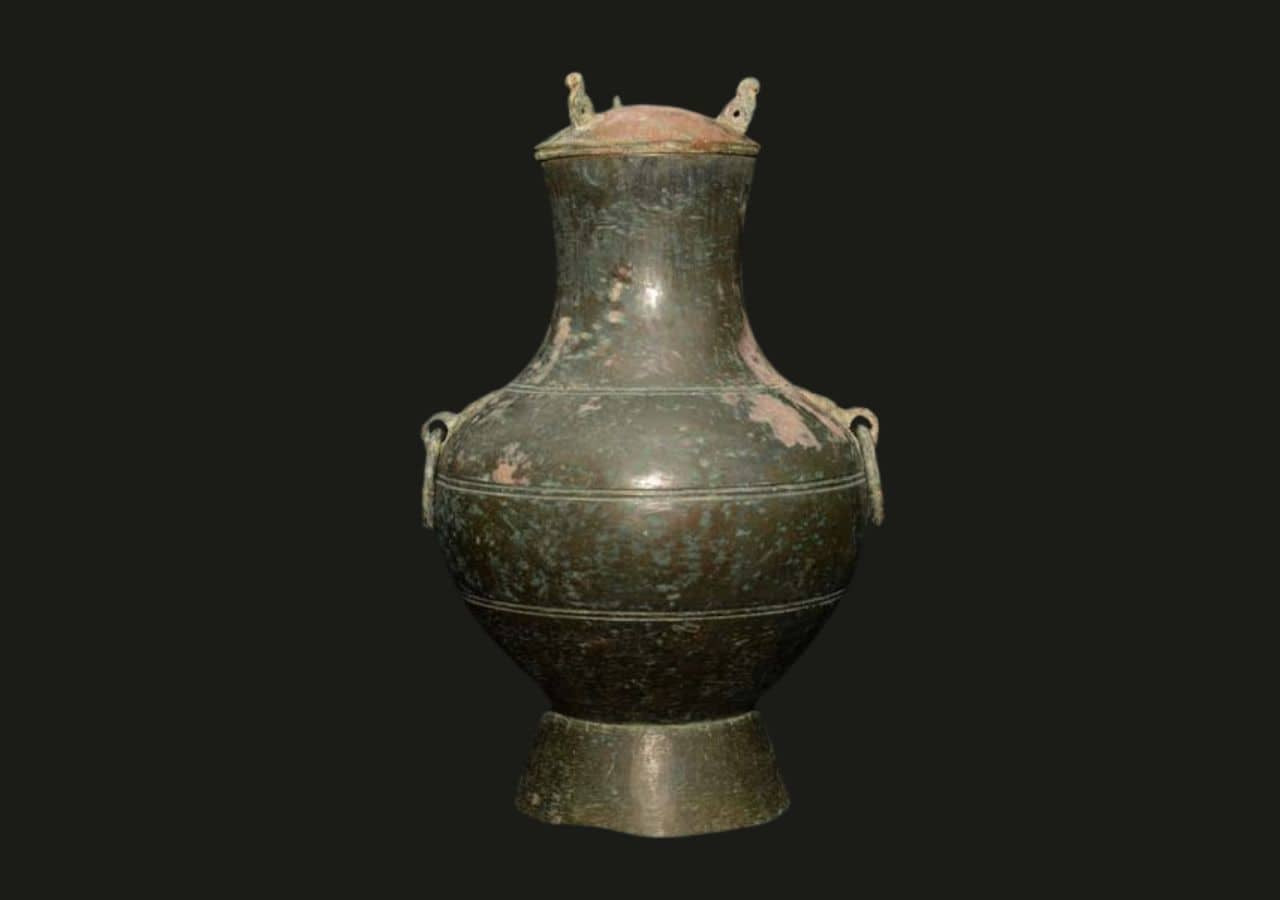
Inside a tomb near the Great Wall of Qin, archaeologists uncovered a bronze bottle with a garlic-shaped mouth that had remained sealed for over 2,300 years. Discovered at the Shanjiabao cemetery in Ningxia, China, vessel M39:5 contained approximately 3,740 milliliters of pale blue-green liquid—enough for 15 contemporary cups. Remarkably, the liquid showed no odor and had not evaporated or leaked into the soil throughout the entire Warring States period, dating from 547 to 221 BC.
The bottle’s preservation was due to its seal: a textile stopper inside the neck and an external coating of organic-tempered mud. This dual barrier prevented air and moisture from penetrating the vessel for millennia. Within, the liquid proved to be an ancient fermented alcoholic drink, a beer crafted from cereals by the Qin civilization.
Discovery at a Frontier Cemetery
A collaborative research group from several Chinese institutions detailed their results in the Journal of Archaeological Science: Reports. The tomb M39 is located roughly 1.5 kilometers south of the Qin Great Wall within a burial site comprising 183 tombs, 179 of which belonged to the Qin state. This area likely served as a communal burial ground for military personnel and civilians stationed along the frontier defense line.

The bottle’s distinctive garlic-head mouthpiece hinted at its contents, as this style was typical of Qin-era vessels used for alcoholic beverages. To confirm, researchers collected samples of the liquid and sediment inside and subjected them to advanced analytical tests.
Advanced Chemical Analysis Confirms Authenticity
Initial examination via Fourier-transform infrared spectroscopy revealed organic compounds, which were analyzed using a rapid discriminant model comparing the ancient brew with modern aged liquids, indicating the substance was alcoholic. More detailed investigations employed ultrahigh-performance liquid chromatography-triple quadrupole-time of flight tandem mass spectrometry (UPLC-Q-TOF-MS) and high-resolution orbitrap mass spectrometry to explore the residues’ metabolomic profile.
These scans identified over 2,400 distinct chemical compounds. Soil controls contained significantly fewer compounds, eliminating the possibility that the liquid was groundwater infiltrating the vessel. The researchers concluded, “the liquid preserved in vessel M39:5 was not simply infiltrated groundwater, but an authentic ancient organic residue.”
The compounds fell into 24 chemical categories including amino acids, fatty acids, and carbohydrates. The prominence of lactic acid alongside a low presence of tartaric acid suggested the beverage was cereal-based rather than fruit-derived. The authors explicitly stated: “The liquid was a cereal-based alcoholic beverage and not fruit wine.”
Microfossils Reveal Ingredients and Fermentation
To pinpoint the grains and fermentation agents, researchers examined microfossils extracted from the sediment under microscopic analysis. The starch grains matched broomcorn millet and members of the Triticeae tribe, which includes wheat and barley.
Remarkably, the sediment held 8,571 yeast cells, indicating intentional use of fermentation starters rather than incidental microbial contamination. This composition aligns with qu, a traditional Chinese fermentation starter made by inoculating grains or herbs with molds. “The discovery of thousands of yeast cells in the ancient Shanjiabao cereal-based alcoholic beverage may indicate the superior performance of the starter used by the Qin people,” the team noted.
This brewing formula, which combined broomcorn millet, wheat or barley, and a qu starter, is not found in texts from other regions. The presence of these grains matches the broader agricultural pattern in northern China where millet dominated, contrasting with the rice-based brewing customs of southern areas.
The Characteristics and Role of Qin Beer
The ancient beer likely differed from modern clear brews, exhibiting a thicker, cloudier, and more nutrient-rich consistency, similar to fermented porridge. The fermentation process might have naturally occurred, with local ingredients shaping its distinct, sour flavor due to elevated lactic acid levels.
Within Tomb M39, the beer bottle functioned as a ritual offering, reflecting beliefs that food and drink provisions were necessary for the afterlife. The careful sealing and quantity suggest that Qin brewing craftsmanship and preservation methods were widespread beyond just the aristocracy.
The research was supported by China’s National Key R&D Program and the Archaeological Talent Promotion Program. Overall, the study provides concrete archaeological proof of Qin beer production techniques, diverse grain usage, and effective sealing technologies.
- Categories:
- Science







0 comments
Sign in to Comment