
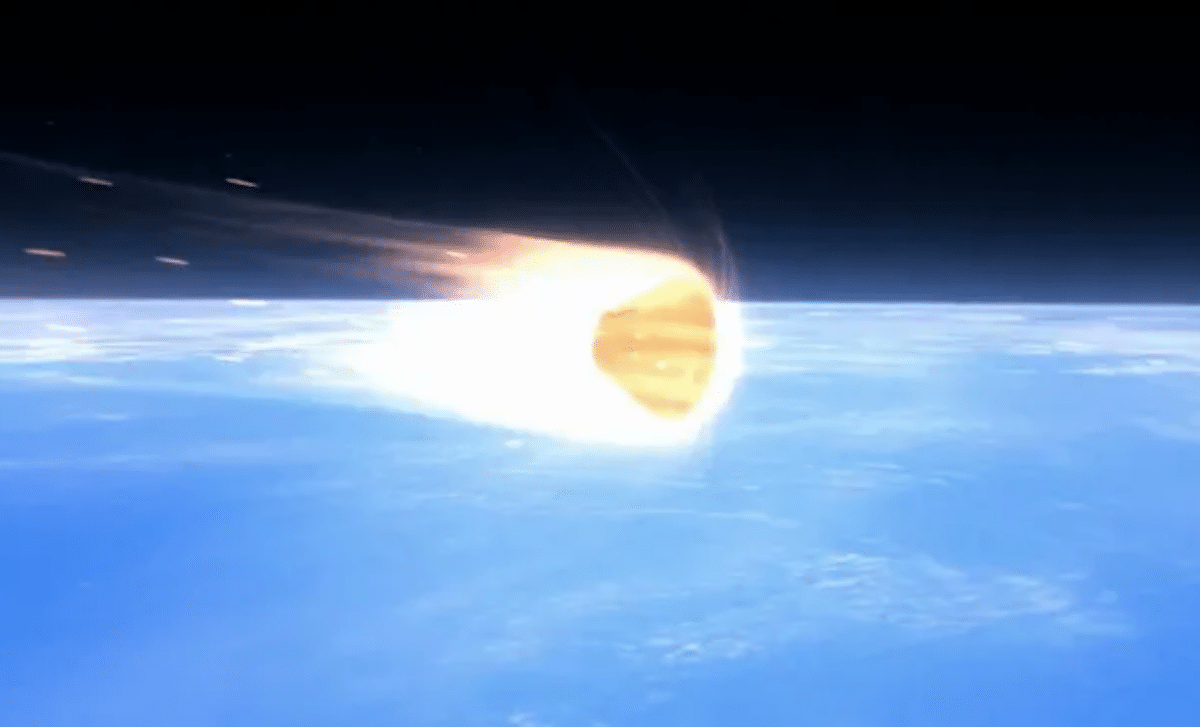
Scheduled for April 10, 2026, NASA’s Artemis 2 mission will witness astronauts Reid Wiseman, Victor Glover, Christina Koch, and Jeremy Hansen re-enter Earth’s atmosphere at an astonishing velocity of 23,840 mph. This milestone represents a pivotal step in NASA’s Artemis program, aiming to bring humans back to the Moon and eventually further into space. The mission hinges on the Orion capsule’s heat shield, a key component engineered to withstand intense thermal stresses during descent. As detailed by Space.com, the heat shield will be rigorously tested by the extreme conditions generated as the spacecraft hurtles back to Earth.
Hazards of Re-Entering Earth’s Atmosphere at High Velocity
The astronauts of Artemis 2, presently orbiting the Moon, approach the most precarious segment of their voyage as they prepare to return home. Traveling at a breathtaking pace of 23,840 mph (38,367 km/h), they will endure severe thermal and mechanical forces. The collision of the spacecraft with atmospheric particles will produce temperatures soaring to 5,000°F (2,760°C), enough to melt many substances. The Orion capsule’s heat shield must absorb and radiate away this heat to keep the crew safe.
This daring descent is far from routine; it’s an elevated risk challenge crucial for the success of upcoming missions, especially the broader objective of lunar landings. With speeds rivaling those of bullets and heat sufficient to liquefy most materials, the heat shield’s performance is vital to the astronauts’ survival. Any malfunction here could have fatal consequences.

Lessons Learned from Artemis 1
The December 2022 Artemis 1 mission featured an uncrewed test of the Orion capsule's re-entry systems. While successful overall, it exposed critical weaknesses in the heat shield design. During atmospheric descent, trapped gases within the shield caused detachment of sections of Avcoat, the heat-resistant coating. As reported by Space.com, this degradation compromised heat shield integrity, leading NASA to rethink its approach to Artemis 2’s re-entry.
Initially, Artemis 2 was set to utilize “skip maneuvers”—bouncing off the atmosphere to gradually reduce speed. However, the observed heat shield damage during Artemis 1 raised concerns about this technique’s safety. Consequently, NASA opts for a more direct descent trajectory, entering Earth’s atmosphere at a steeper angle to shorten exposure to the most damaging phase of re-entry.
Refined Engineering: A Sharper Atmospheric Entry for Artemis 2
Drawing from Artemis 1’s insights, NASA’s engineering team is optimizing the re-entry pathway for Artemis 2’s homeward journey. The Orion spacecraft will penetrate the atmosphere at a steeper angle, reducing the duration spent in extreme thermal and velocity conditions and diminishing risks to the heat shield.
Despite the more abrupt entry, the heat shield will still endure tremendous stress. The intense friction will create a blazing plasma sheath surrounding the capsule, temporarily severing radio communications with mission control—a critically tense moment for ground teams awaiting confirmation that the vehicle remains intact.
Once descending to around 26,500 feet (8,077 meters), a sequence of parachutes will deploy. Initial small forward-bay-cover chutes will slow the capsule, followed by larger drogue chutes stabilizing its descent. Finally, at 9,500 feet (2,896 meters), the main parachutes will open, decelerating the craft to below 20 mph (32 kph) for a controlled splashdown in the Pacific Ocean.
Heat Shield: The Essential Guardian
The centerpiece of this re-entry ordeal is the heat shield—a sophisticated structure composed of titanium reinforced by 186 individual Avcoat blocks. Each block measures approximately 1.5 inches in thickness and is engineered to withstand the searing heat and intense forces encountered during atmospheric entry. Its capability to absorb and dissipate thermal energy is fundamental to astronaut safety.
NASA’s heat shield technology has undergone decades of development, evolving significantly since the Apollo era to accommodate new mission demands. For Artemis 2, the system must manage a faster, far more intense re-entry than previous moon missions, requiring adjustments in both spacecraft design and heat-resistant materials.
Final Phase: Crew Recovery Operations
Upon gentle descent under parachutes, recovery personnel will mobilize. Helicopters based on the USS John P. Murtha will locate and extract the crew from the floating Orion capsule. The recovery teams are well-prepared, having completed 12 simulated Underway Recovery Tests (URTs) along with Artemis 1’s actual recovery, ensuring readiness for this crucial extraction.
The splashdown in the Pacific will be supported by flotation devices keeping the capsule buoyant until crews reach the astronauts. A successful retrieval marks a vital achievement for the Artemis program and sets the stage for future lunar exploration missions.
- Categories:
- Nasa










0 comments
Sign in to Comment