
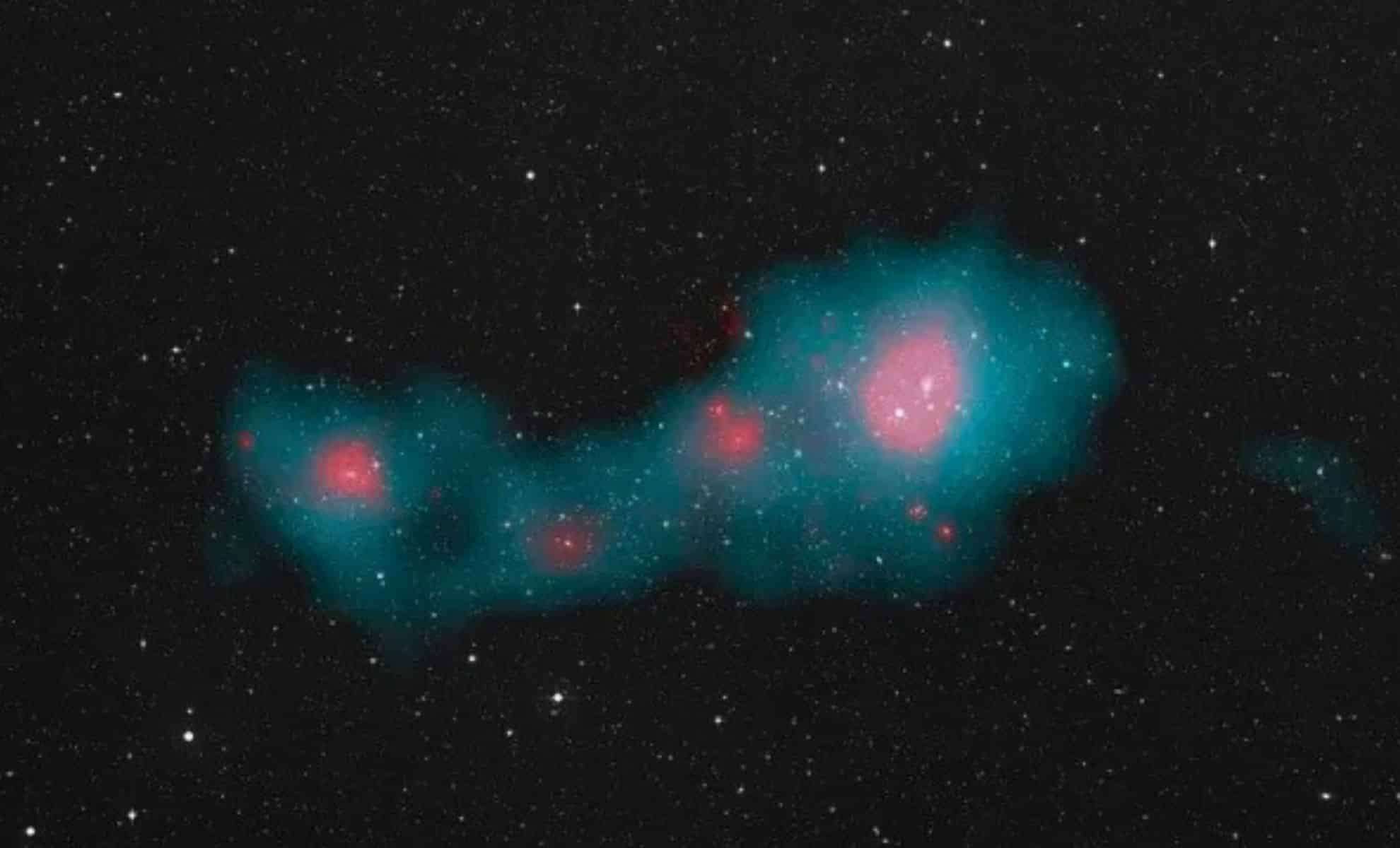
Scientists have uncovered an extraordinary cosmic formation—a gigantic network of galaxies spanning an astonishing 1.3 billion light-years, establishing it as the largest structural entity ever identified in the universe. Dubbed Quipu, inspired by the ancient Incan knot-based counting system, this immense galactic filament possesses an estimated mass of 200 quadrillion times that of our Sun and stretches over 13,000 times the Milky Way's diameter.
Introducing Quipu: A Cosmic Megastructure Revealed
Quipu transcends the definition of a mere supercluster; it is a vast assembly of interconnected galaxy clusters and filaments forming an extensive cosmic web that spans more than a billion light-years. Unlike conventional galaxy clusters bound tightly by gravity, Quipu features a central elongated filament with several branching threads, mirroring the design of intertwined cords.
Remarkably, Quipu was identified not through standard detection methods but because it was clearly distinguishable in sky maps displaying galaxy clusters within a narrow redshift range. Researchers observed that Quipu’s structure stood out prominently, highlighting its exceptional prominence in the cosmic landscape.

A New Cosmic Scale: Giants Among Giants
Prior to this finding, the universe’s most enormous known structures included:
- Laniākea Supercluster – The galactic supercluster encompassing the Milky Way, spanning about 500 million light-years.
- Shapley Supercluster – Known for its dense concentration and immense mass, previously thought to be the largest.
- Hercules-Corona Borealis Great Wall – An enormous galaxy assembly roughly 10 billion light-years away, extending up to 10 billion light-years, though its existence remains a subject of debate.
Quipu, alongside four recently uncovered formations, exceeds the Shapley Supercluster’s size, offering fresh perspectives on the universe's large-scale matter distribution.
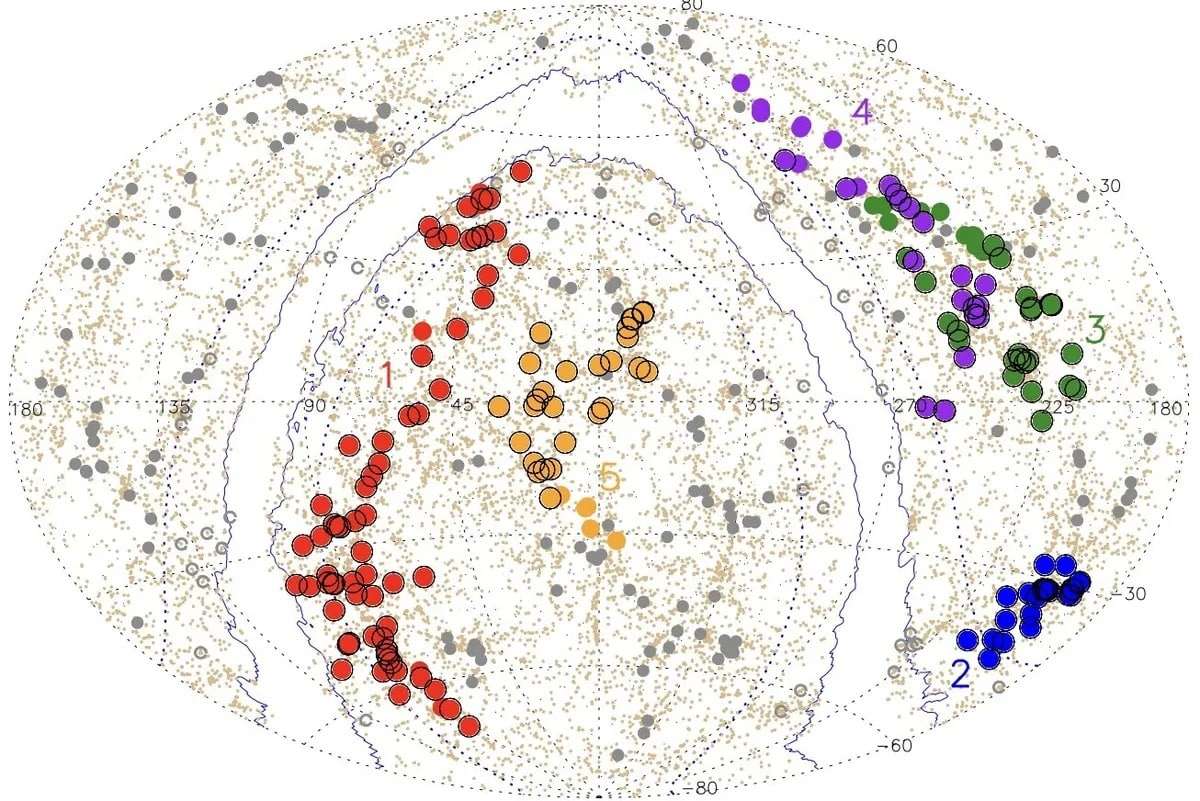
The five newly identified superstructures are:
- Quipu (red) – Holding the record as the largest filamentary feature observed.
- Serpens-Corona Borealis superstructure (green) – Another extensive formation traversing these constellations.
- Hercules supercluster (purple) – A highly concentrated galactic region exerting considerable gravitational pull.
- Sculptor-Pegasus superstructure (beige) – A sprawling structure linking these notable constellations.
- Shapley Supercluster (blue) – Once the leading cosmic giant, now surpassed by Quipu and its new peers.
Collectively, these five superstructures comprise roughly 45% of all known galaxy clusters, 30% of observable galaxies, and a quarter of the universe's entire matter content. They occupy about 13% of the observable cosmos, making them pivotal in the narrative of cosmic evolution.
Tracing Quipu: The Techniques Behind Its Discovery
The identification of Quipu was made possible by an advanced survey of redshifts, targeting galaxy clusters within redshift values from 0.3 to 0.6. Redshift measures the universe's expansion effect on light, with higher values indicating greater distance and older formations. Earlier large-scale studies primarily focused on redshifts less than 0.3, which limited detection of more distant, grander structures.
By extending observations to higher redshifts, researchers uncovered Quipu and several other colossal frameworks, suggesting that even more immense formations might be awaiting discovery deeper in the cosmos.
Understanding Redshift: Opening a Door to the Distant Universe
Redshift results from the universe’s expansion stretching the wavelengths of light toward longer, redder wavelengths. By analyzing these shifts, astronomers determine the distances and speeds of galaxies, enabling the creation of intricate three-dimensional maps of the universe's structure.
The Temporary Nature of Cosmic Giants
Although Quipu’s scale is monumental, it is not permanent. The cosmos continues its expansion, causing enormous filaments like Quipu to eventually disperse. While gravity currently holds these structures together, accelerating dark energy will gradually pull them apart, pushing galaxies further from one another over billions of years.
What Lies Ahead for Quipu and the Cosmic Web
- Over the next billions of years, Quipu will disintegrate into smaller galactic clusters due to cosmic expansion.
- Galaxies comprising Quipu will separate, becoming isolated island universes.
- Future astronomers (if present) may find such superstructures undetectable as the cosmic web fades away.
The Future of Cosmic Exploration: Searching for Even Larger Structures
While Quipu currently holds the title as the universe’s largest known assembly, astronomers anticipate discovering even more enormous structures deeper in space. With advances in telescopes like the James Webb Space Telescope and the forthcoming Euclid mission, redshift surveys may extend beyond 1.0, potentially unveiling galaxies and formations that stretch hundreds of billions of light-years.
This groundbreaking find, published recently on arXiv, challenges prior models of large-scale cosmic structures and provokes new questions about the universe’s formation and development. For now, Quipu remains a remarkable testament to the vastness and intricacy of the cosmos—an interconnected lattice spanning billions of light-years and revealing glimpses of the universe’s ancient past.
This article has been repurposed from original source material. Please note the content may have been edited for clarity and length. For additional details, contact the original source.
- Categories:
- Astronomy ,
- Science ,
- Space





0 comments
Sign in to Comment