
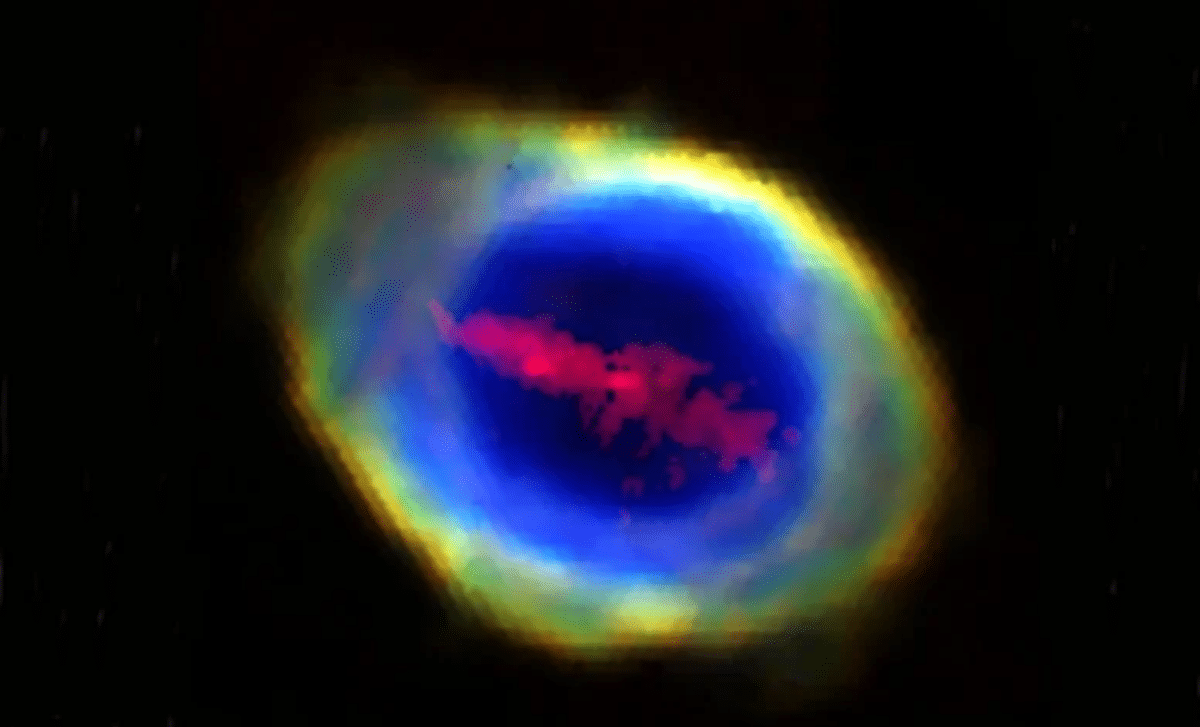
The Ring Nebula has long fascinated astronomers with its luminous, intricate patterns, but a surprising new find has deepened the intrigue surrounding this well-known celestial object. Researchers have detected a slim, elongated filament of ionized iron nestled within the gaseous cloud.
This novel structure challenges existing models of planetary nebulae and the complex events during a star's final evolutionary stages. Utilizing the advanced capabilities of the WEAVE instrument, scientists have gained fresh insights into stellar death and elemental formation, possibly unlocking fresh perspectives on how stars evolve and disperse their elements throughout the cosmos.
Unveiling a Massive Ionized Iron Filament in the Ring Nebula
Renowned as one of the night sky’s most recognizable nebulae, the Ring Nebula rests roughly 2,600 light-years away in the Lyra constellation. This planetary nebula is essentially the glowing remnants of a star that has expelled its outer layers after its main sequence life ended. A recent publication in Monthly Notices of the Royal Astronomical Society reveals an extraordinary find: a narrow, extensive bar of ionized iron previously undetected. This structure stretches about 500 times farther than Pluto’s orbital radius around the Sun and has a mass comparable to that of the planet Mars.

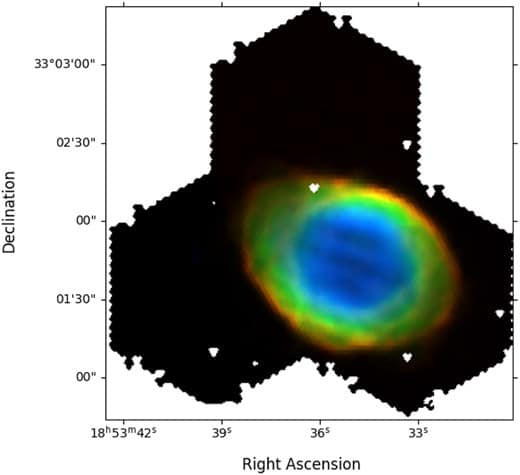
Employing the WEAVE (WHT Enhanced Area Velocity Explorer) instrument attached to the 4.2-meter William Herschel Telescope, the team achieved unprecedented spectral resolution of the nebula. They mapped the chemical composition point-by-point, enabling the detection of this unexpected iron filament. Dr. Roger Wesson, the project’s principal investigator from UCL’s Department of Physics & Astronomy and Cardiff University, described the breakthrough.
“Even though the Ring Nebula has been studied using many different telescopes and instruments, WEAVE has allowed us to observe it in a new way, providing so much more detail than before. By obtaining a spectrum continuously across the whole nebula, we can create images of the nebula at any wavelength and determine its chemical composition at any position.”
The identification of this ionized iron bar may shed light on how stars eject their material and the formation mechanisms behind such extraordinary gaseous structures.
Revolutionizing Nebular Research with the WEAVE Instrument
The introduction of the WEAVE instrument to the William Herschel Telescope marks a significant advancement in the analysis of planetary nebulae. Unlike traditional imaging and spectroscopy techniques, WEAVE’s optical fiber array can simultaneously collect spectral data from multiple locations, offering highly detailed chemical mapping of the entire nebula.
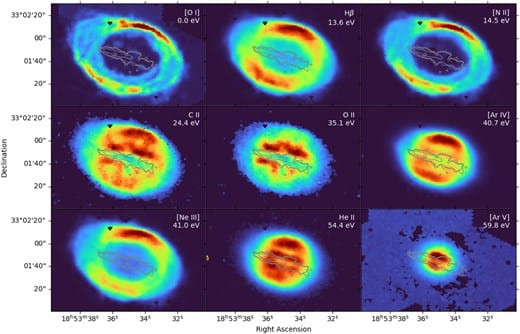
Dr. Wesson emphasized that despite extensive prior studies of the Ring Nebula, WEAVE unveiled details never before seen.
“When we processed the data and scrolled through the images, one thing popped out as clear as anything – this previously unknown ‘bar’ of ionized iron atoms, in the middle of the familiar and iconic ring,” Wesson remarked.
This discovery enriches our grasp of the nebula’s intricacies while highlighting WEAVE’s promising role in future astronomical investigations.
Looking ahead, researchers are eager to leverage WEAVE's broad optical range capabilities to potentially detect similar hidden structures in other planetary nebulae, expanding our knowledge of stellar remnants.
Investigating the Origins of the Iron Filament: Planetary Remnant or Stellar Ejection?
The origin of the ionized iron filament is still undetermined, with several hypotheses under consideration. One scenario proposes that the iron traces back to a rocky planet engulfed and vaporized as the nebula’s central star expanded during its red giant phase. Stars like the Sun swell dramatically before shedding their envelopes, and if a planet existed within that radius, its core iron could be dispersed within the nebula’s gas.
Alternatively, the structure might represent a unique mode of material ejection by the dying star, a phenomenon not yet fully comprehended. As noted by Professor Janet Drew from UCL Physics & Astronomy,
“We definitely need to know more – particularly whether any other chemical elements co-exist with the newly-detected iron, as this would probably tell us the right class of model to pursue. Right now, we are missing this important information.”
Understanding the formation of the iron filament may reveal vital clues about the interactions between dying stars and their surroundings, enhancing our comprehension of planetary nebula genesis.
- Categories:
- Space





0 comments
Sign in to Comment