
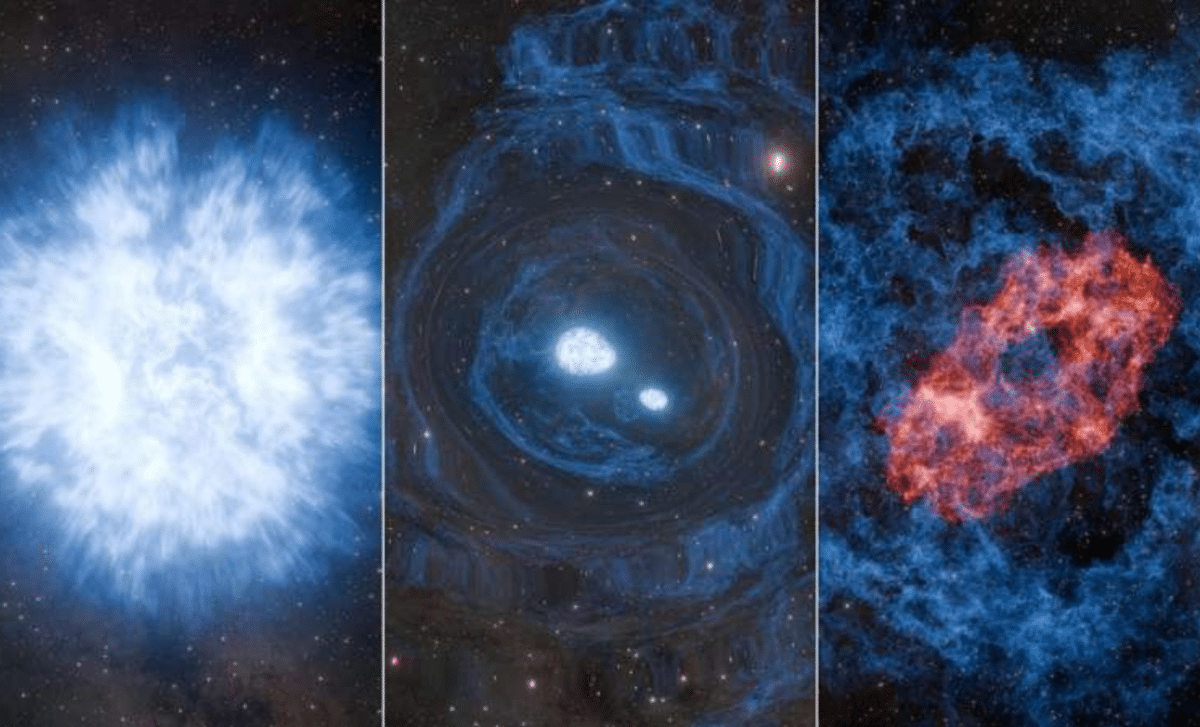
Astronomers have potentially identified an entirely new type of cosmic explosion dubbed a “superkilonova”, which merges features of both supernovae and kilonovae. This remarkable event was first spotted in August 2025 and initially classified as a typical kilonova, but subsequent study uncovered traits that challenged this interpretation. The detailed analysis, available in The Astrophysical Journal, reveals how gravitational wave signals combined with electromagnetic observations led to the proposal of this unprecedented stellar explosion category.
An Intriguing and Unusual Astronomical Event
The research, featured in The Astrophysical Journal, began after a gravitational wave detection on August 18, 2025, captured by the LIGO and Virgo collaborations. The event, labeled AT2025ulz, is believed to originate from two neutron stars merging. Neutron stars, the dense cores left behind after massive stars explode as supernovae, are known for their extreme density and strong gravity. Initially, the excitement stemmed from the resemblance to the famous 2017 kilonova event, GW170817, detected via both gravitational waves and light. But as astronomers monitored AT2025ulz, unexpected behaviors emerged.
“At first, for about three days, the eruption looked just like the first kilonova in 2017,” says Mansi Kasliwal, a professor of astronomy at Caltech and director of the Palomar Observatory. “Everybody was intensely trying to observe and analyze it, but then it started to look more like a supernova, and some astronomers lost interest. Not us.”
Add Cosmo Herald as a Preferred Source

This transition from an ordinary kilonova toward characteristics resembling a supernova encouraged the team to intensify their observations, suspecting they were observing a new astrophysical phenomenon.
Evidence Indicating a Supernova-Like Explosion
Unlike kilonovae that typically produce a brief, red-tinted glow from heavy elements like gold and platinum formed during neutron star mergers, AT2025ulz exhibited a different light pattern over time. Initially, its red glow matched expectations, but after several days, the emission brightened and shifted toward a blue spectrum, displaying hydrogen signatures.
Hydrogen presence, a hallmark of supernovae but absent in prior kilonova observations, suggested a more complex process at work. While supernovae are immensely powerful and often arise from massive stars exploding, they rarely produce the strong gravitational waves detected by LIGO. Therefore, the gravitational wave data from AT2025ulz sparked intense curiosity about the event’s true origins.
“While not as highly confident as some of our alerts, this quickly got our attention as a potentially very intriguing event candidate,” says David Reitze, the executive director of LIGO and a research professor at Caltech. “We are continuing to analyze the data, and it’s clear that at least one of the colliding objects is less massive than a typical neutron star.”
The data imply an unusual scenario where possibly a lighter-than-normal neutron star took part in the merger, influencing the event's unique features.
Introducing the Concept of a “Superkilonova”
The research group, headed by Kasliwal and colleagues, proposed the concept of a “superkilonova”: a stellar event combining features of a supernova with those of a kilonova. This phenomenon might involve a neutron star merger occurring shortly after a supernova explosion, complicating the observational signature.
The unusual spectral shift and hydrogen detection could be explained by a recent supernova explosion masking the kilonova emission, resulting in complex light patterns.
“The only way theorists have come up with how to birth sub-solar neutron stars is during the collapse of a very rapidly spinning star,” says Brian Metzger, a team member from Columbia University. “If these ‘forbidden’ stars pair up and merge by emitting gravitational waves, it is possible that such an event would be accompanied by a supernova rather than be seen as a bare kilonova.”
Understanding the formation of neutron stars with less than solar mass may be crucial in decoding the nature of these possible superkilonovae.
- Categories:
- News





0 comments
Sign in to Comment