

Breakthroughs in asteroid analysis have unveiled an unprecedented discovery: 63 previously unknown young asteroid families, enriching our comprehension of the solar system’s evolving structure. This revelation emerged from an innovative study featured in Icarus, employing cutting-edge clustering algorithms to detect these groups. It expands on prior research, including a critical 2025 paper in Icarus that analyzed data from 1.25 million asteroid trajectories to identify new family groupings.
Identification of 63 New Young Asteroid Groups
Uncovering 63 novel young asteroid families marks a substantial advancement in planetary astronomy. Unlike ancient families formed during the early solar system, these are the byproducts of more recent major collisions between sizable asteroids, comets, or planetesimals. Such impacts shatter the bodies into fragments that maintain similar orbital paths, defining these families. The study estimates these groups are typically under 10 million years old, with the majority likely younger than 1 million years.
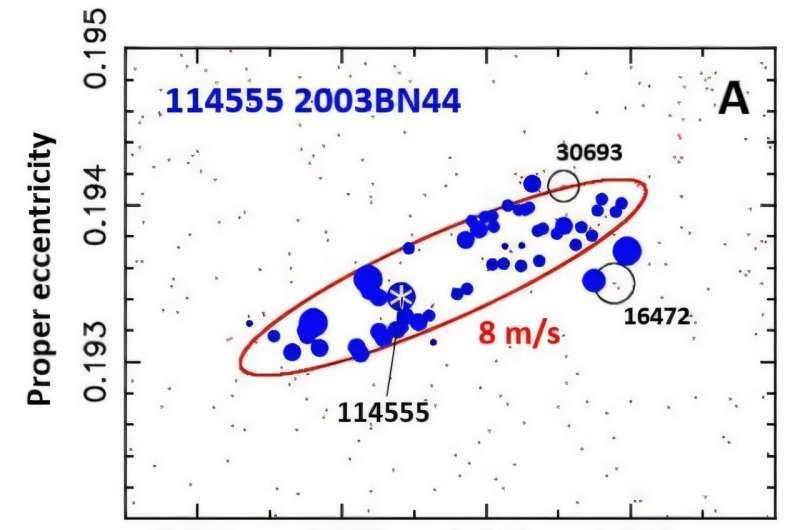
Researchers applied an intricate five-dimensional Hierarchical Clustering Method (HCM) to examine the orbits of 1.25 million asteroids. This technique sifted through orbital elements such as the semimajor axis, eccentricity, and inclination, pinpointing subtle clustering patterns. This expanded the catalog of known young asteroid families from 43 to over 100 in total.

Characteristics of Newly Found Young Asteroid Families
These young families are distinguished by their recent formation—typically less than 10–15 million years old—and their shared orbital features. They are generated when a large celestial object breaks apart after a significant collision, producing fragments that orbit the Sun together. Studying these families offers crucial insights into solar system evolution post-formation.
The majority of these new families consist primarily of S-type asteroids, which feature silicate and nickel-iron compositions, as opposed to the more widely distributed C-type asteroids, rich in carbonaceous material. Notably, about 54% of the newly identified groups reside within older, established families, indicating that asteroid clusters can evolve with new sub-families forming from fresh fragmentation events.
Overcoming the Difficulties in Detecting Dim, Young Asteroids
Detecting these young asteroid families poses significant challenges owing to their faint appearance and the limitations of present-day telescopic technologies. As the authors highlight, “It is expected that most new young families should have very few members, because these member asteroids are faint and at the limit of our current telescopic capabilities. In this sense, the identified members represent the tip of the iceberg, and many more members will probably be found in the future.” Consequently, while this study identified 63 new families, numerous others likely remain hidden, awaiting future observational improvements.
Present telescopes can only capture the brightest and most accessible asteroids in these families. With the advent of more sensitive instruments, astronomers anticipate discovering additional faint and distant members, broadening our understanding of asteroid population dynamics.
Asteroid Families: Unlocking Meteorite Origins
Understanding asteroid families is vital for tracing the roots of meteorites. As smaller fragments within a family collide over time, some eventually reach Earth's surface as meteorites. Investigating these families helps decode the chemical makeup and origin of meteorite material. Scientists aim to map meteorites back to their parent asteroid families to better understand the early solar system’s history.
The influx of young families, many less than one million years old, enriches this research field, offering insights into the evolution of asteroid clusters over relatively short timescales. These findings also illuminate the conditions prevalent in the solar system when large impacts and fragmentation events were more frequent.
- Categories:
- News




0 comments
Sign in to Comment