
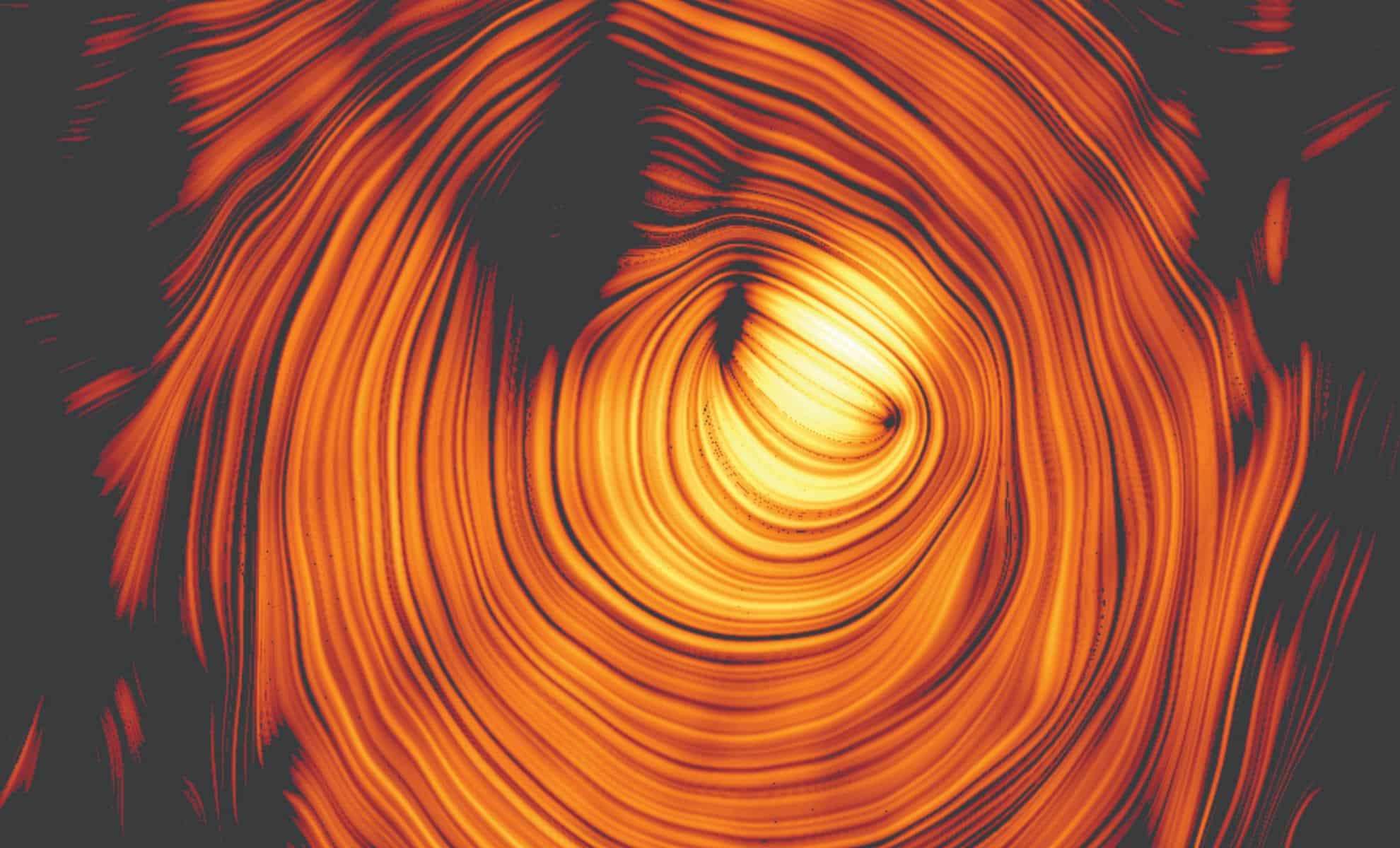
In August 2025, researchers published a landmark study in Astronomy & Astrophysics that uncovered remarkable details about the jet emitted by the blazar PKS 1424+240. This object is recognized as one of the universe's most intense sources of gamma rays and neutrinos, previously presenting a long-standing enigma. The findings reveal a structure evocative of the legendary “Eye of Sauron,” a striking and mysterious pattern deep in outer space. Covered in a Phys.org article, the research promises to reshape how scientists comprehend the interplay between supermassive black holes, particle jets, and high-energy emissions. Here, we delve into the study’s highlights, the advanced techniques employed, and the exciting prospects for future cosmic exploration.
Unveiling the Mystique of the “Eye of Sauron”
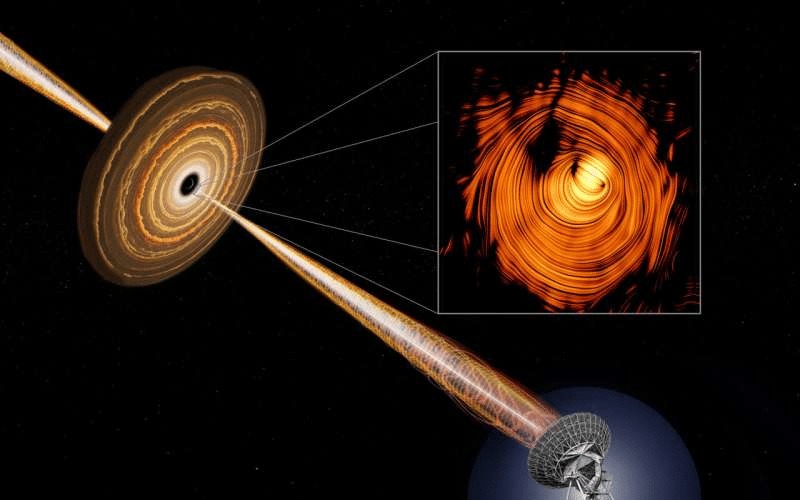
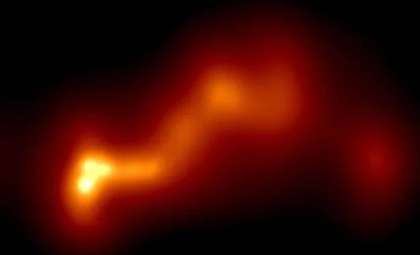
The Very Long Baseline Array (VLBA) captured an extraordinary image of the jet from PKS 1424+240. Located billions of light-years away, this blazar had already been established as the brightest known neutrino source among blazars. Yet, its unexpectedly slow radio-wave motion posed a puzzle, defying the assumed link between jet velocity and brightness. This mystery propelled astronomers to undertake a comprehensive study using the VLBA’s global array of radio antennas to produce the most detailed view possible.
Study lead Yuri Kovalev, Principal Investigator of the MuSES project at the Max Planck Institute for Radio Astronomy, described the results as “absolutely stunning.” The jet's almost direct alignment with our vantage point exposed a nearly flawless toroidal magnetic field pattern. “Never before have we observed such a clean toroidal magnetic field focused right towards Earth,” Kovalev said. This alignment has provided astronomers with a rare glimpse into the jet’s core, revealing intricate structural and dynamic properties.

The Enigma of Slow Apparent Jet Speed and Relativistic Illusions
One of the most confounding characteristics of PKS 1424+240’s jet was its apparently sluggish velocity. Commonly, the brightest gamma-ray and neutrino jets are fast-moving and pointed directly toward Earth. Yet, at radio frequencies, this jet’s movement seemed much slower than anticipated, challenging traditional explanations for its energetic emissions.
Co-author Jack Livingston clarified that the near-perfect orientation of the jet toward Earth greatly amplifies its brightness through relativistic boosting. “The alignment increases the jet’s luminosity by a factor of 30 or more,” Livingston noted. Due to effects predicted by special relativity, emissions intensify as the jet aligns closely with our line of sight. However, this also causes a projection effect, creating an illusion of reduced speed despite the jet’s actual rapid motion. This insight was crucial in resolving the jet’s energy paradox.
Magnetic Field Geometry and Cosmic Particle Acceleration
The investigation’s breakthrough included mapping the magnetic field structure encasing the jet via polarized radio wave measurements. The team identified a helical or toroidal magnetic shape crucial for accelerating particles to extreme energies. This magnetic arrangement is fundamental to understanding how jets driven by supermassive black holes energize particles within active galactic nuclei.
Kovalev emphasized that this discovery verifies a major theoretical prediction: “This finding confirms that supermassive black hole systems accelerate not only electrons but also protons, which are responsible for high-energy neutrino production.” The result sheds light on black holes’ critical influence over the universe’s most energetic phenomena.
MOJAVE Program: Years of Persistent Exploration
This breakthrough marks a significant achievement for the MOJAVE project (Monitoring of Jets in Active Galactic Nuclei with VLBA Experiments), an extensive effort to observe relativistic jets in active galaxies using the VLBA. Through this network, astronomers obtain unparalleled imagery of distant jets, uncovering details of the powerful processes within these cosmic giants.
Anton Zensus, Director of the Max Planck Institute for Radio Astronomy and a co-founder of MOJAVE, expressed enthusiasm about the progress: “When MOJAVE started, linking remote black hole jets directly to cosmic neutrinos seemed like science fiction. Today, our observations have brought this connection into reality.” Zensus’s comment highlights the pivotal role MOJAVE plays in advancing knowledge of the universe’s most intense sources.
- Categories:
- News








0 comments
Sign in to Comment