
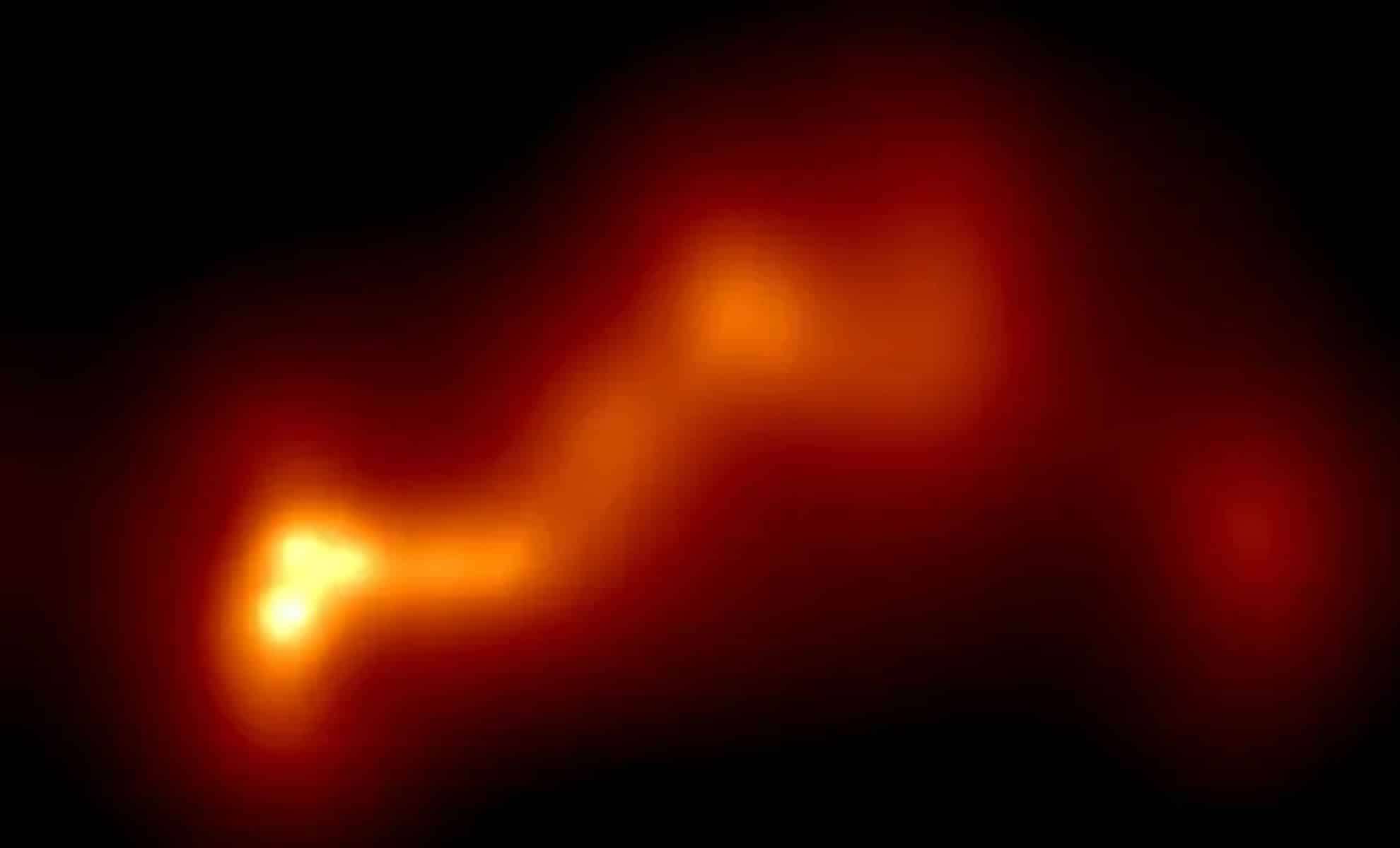
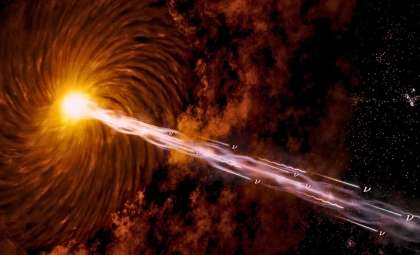
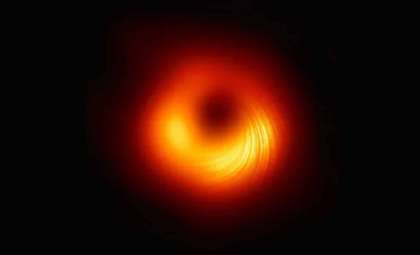
Astronomers have obtained the clearest image yet of a potent jet emanating from the supermassive black hole powering the blazar known as OJ 287. The strikingly bent jet offers strong clues that this distant object — roughly four billion light-years away — may harbor the most intense binary black hole configuration ever observed.
A Unique Blazar Phenomenon
A blazar is a kind of quasar seen almost directly along its jet axis, causing it to shine far brighter than many other cosmic sources. Quasars represent the luminous centers of galaxies, where supermassive black holes consume surrounding material. This matter forms an extremely hot and dense accretion disk that emits light across the cosmos, while intense magnetic fields funnel charged particles into jets traveling close to the speed of light.
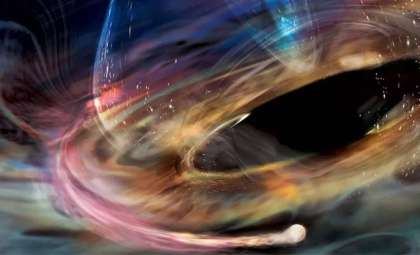
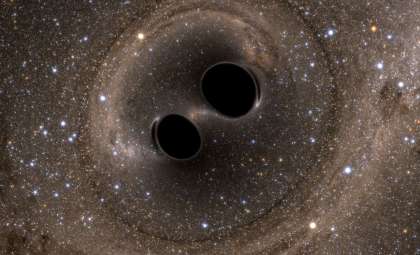
OJ 287 stands out by defying typical patterns. Its brightness has been recorded for 150 years, revealing two separate cycles: one roughly 60 years long and another repeating every 12 years. Researchers attribute the shorter cycle to a secondary black hole, about 150 million solar masses, orbiting a primary black hole with an estimated mass of 18.35 billion suns.

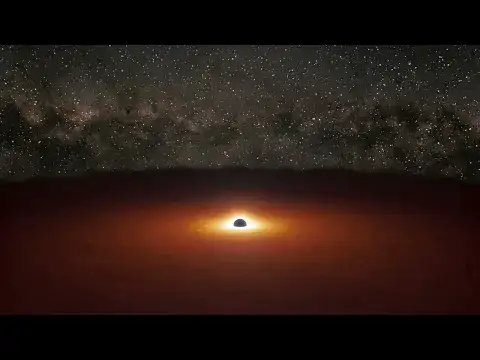
Every dozen years, this smaller companion penetrates the accretion disk surrounding its colossal partner, momentarily turning OJ 287 into a double quasar as the secondary black hole generates its own transient accretion disk and jet.
The Curved Jet and Its Implications
This discovery emerged from an unprecedented radio observation effort involving the Very Long Baseline Array (VLBA) in the U.S. and the Russian RadioAstron satellite. Operating together between 2014 and 2017, they formed a virtual telescope five times Earth’s diameter, enabling them to examine a region only one-third of a light-year wide.
The images revealed the jet bends sharply at three locations. Lead scientist Efthalia Traianou from Heidelberg University remarked, “The new images reveal details in OJ 287’s structure never before seen.” Additionally, the jet’s direction twists by roughly 30 degrees near its base, likely due to gravitational effects from the secondary black hole.
This gravitational influence may explain the jet’s unusual wobble and its explosive flares. A shockwave within the jet produces an intense gamma-ray stream detected by NASA’s Fermi Space Telescope and the Swift mission. Some jet sections appear to reach temperatures of 10 trillion °C, though this extreme measurement results from relativistic beaming, where objects moving near light speed are seen as far more brilliant and hotter.
A Portal into Gravitational Wave Exploration
Traianou noted, “This galaxy’s exceptional traits position it perfectly to deepen studies of merging black holes and the resulting gravitational waves.” Although the colossal pair in OJ 287 will eventually merge, this is not expected soon.
Meanwhile, their gradual orbit emits low-frequency gravitational waves that current detectors cannot yet capture. Instead, scientists rely on pulsar timing arrays that track pulsars’ precise radio emissions to detect minuscule waves caused by passing gravitational ripples.
The upcoming European Space Agency’s Laser Interferometer Space Antenna (LISA), launching in the 2030s, promises the ability to observe supermassive black hole mergers directly—including systems like OJ 287.
- Categories:
- News






0 comments
Sign in to Comment