
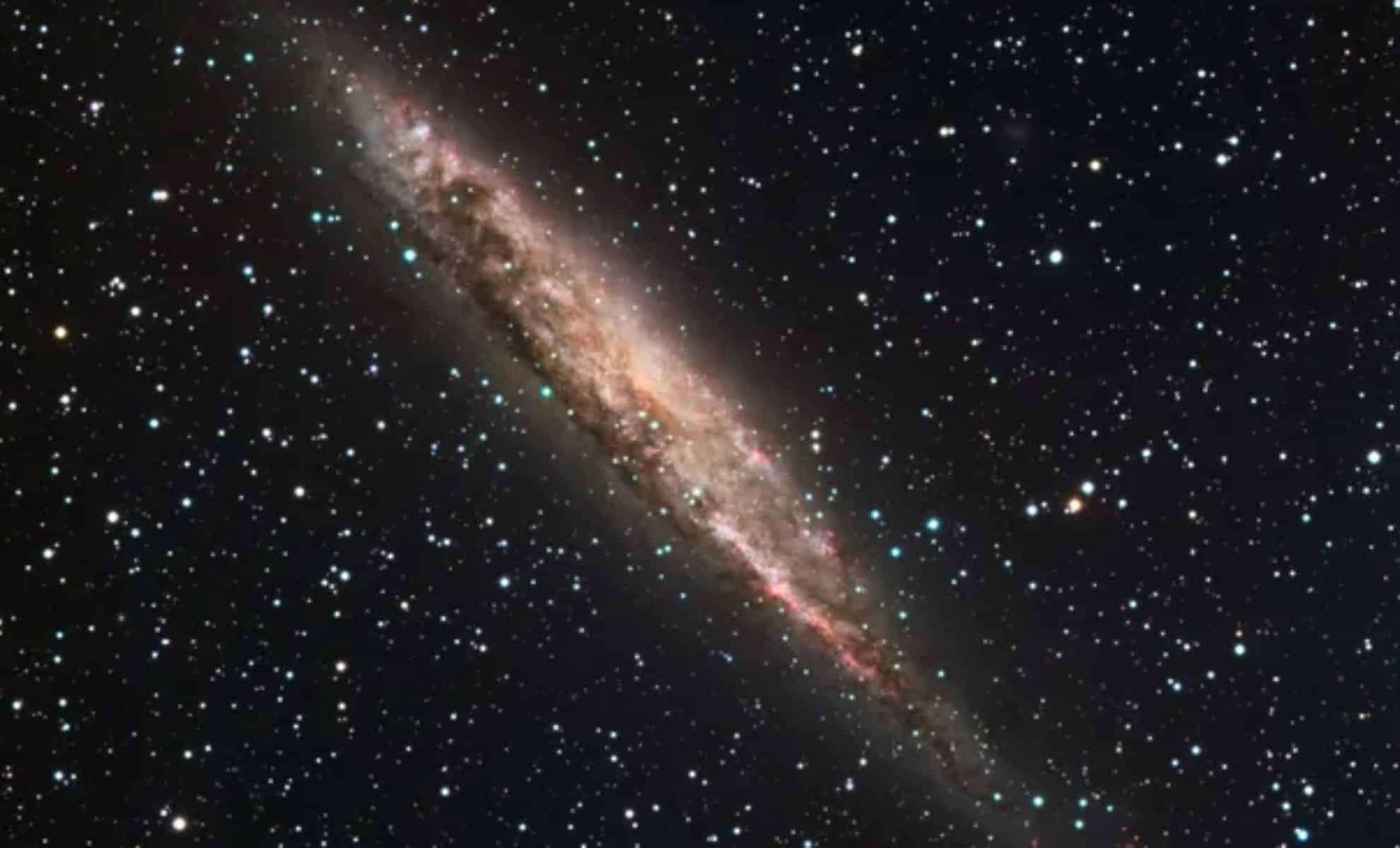
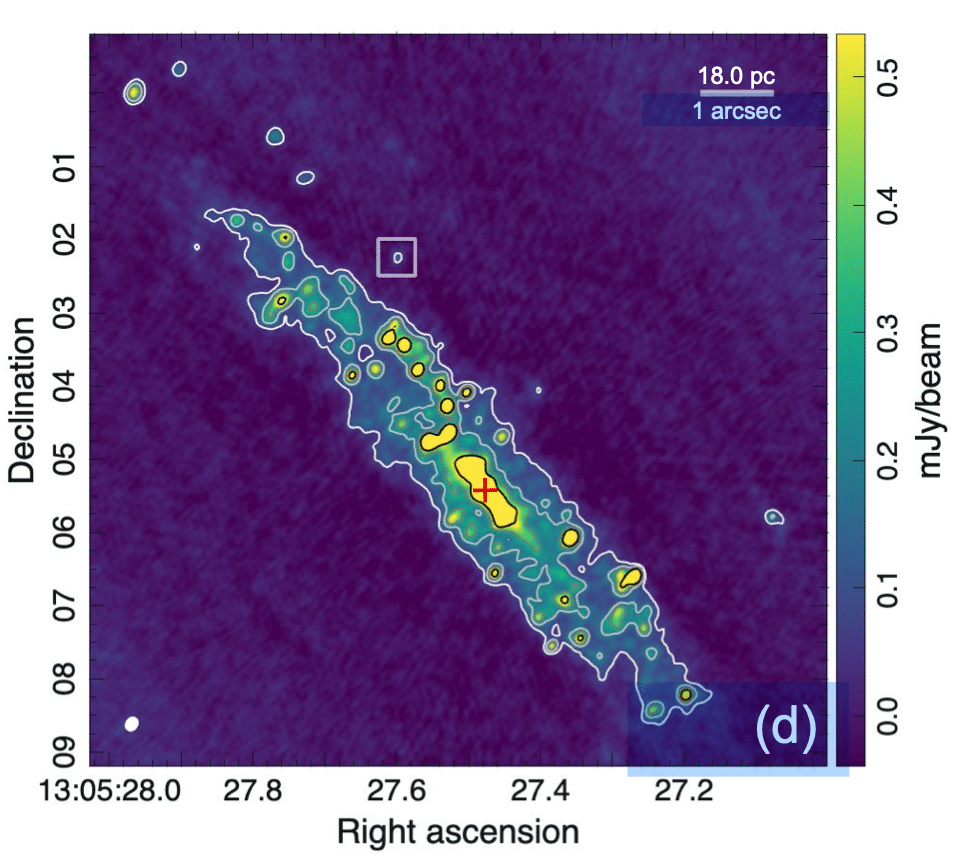
Astronomers have recently identified an extraordinary and puzzling astrophysical object within the NGC 4945 galaxy, located approximately 11 million light-years from our planet. This intriguing source, named “Punctum,” has ignited significant interest and discussion in the scientific community. The discovery was spearheaded by Elena Shablovinskaia of the Instituto de Estudios Astrofísicos at Universidad Diego Portales in Chile utilizing observations from the ALMA (Atacama Large Millimeter/submillimeter Array) telescope. Detected exclusively at millimeter wavelengths, Punctum challenges current astrophysical classifications. As noted in coverage on Space.com, Shablovinskaia remarked, “Outside of the realm of supermassive black holes, Punctum is genuinely powerful,” highlighting the object's exceptional nature. Further insights can be found in the research paper “Punctum: A Powerful Mysterious Astrophysical Object in NGC 4945”, which delves deeper into its implications.
Understanding the Nature of Punctum
Located in the edge-on spiral galaxy NGC 4945, Punctum emits a remarkable level of energy, outshining many other known celestial bodies. Shablovinskaia elaborated on its intense luminosity: “when you put it into context, Punctum is astonishingly bright — 10,000 to 100,000 times more luminous than typical magnetars, around 100 times brighter than microquasars, and 10 to 100 times brighter than nearly every known supernova, with only the Crab Nebula surpassing it among star-related sources in our galaxy.” Such comparisons emphasize the unprecedented brightness of Punctum and suggest intriguing questions regarding its origins and characteristics.
Unlike most astronomical objects observed across a broad range of wavelengths, Punctum has been detected solely in millimeter radio waves. This unique trait adds another layer of mystery, implying a highly energetic core. Its unusual emission profile defies easy categorization.

Exploring Synchrotron Radiation and Magnetic Field Dynamics
Researchers suggest that the millimeter-wavelength emissions from Punctum may stem from synchrotron radiation—produced when charged particles accelerate near light speed along magnetic fields, releasing powerful electromagnetic waves. Such emissions typically originate in compact astrophysical sources with well-ordered magnetic configurations, as larger objects tend to have more chaotic fields that diminish polarization.
Notably, Punctum’s millimeter emission exhibits high polarization, indicating a structured magnetic environment. This has prompted scientists to consider the possibility of Punctum being a magnetar, an extremely magnetic neutron star. Yet, its extraordinary brightness and intensity at these wavelengths exceed the expectations for magnetars, complicating this attribution. The object's compactness combined with its intense luminosity adds further challenges to classification. Shablovinskaia commented, “At the moment, Punctum truly stands apart — it doesn’t fit comfortably into any known category,” underscoring its uniqueness.
Is Punctum an Unidentified Class of Cosmic Phenomenon?
While sharing some features with other astrophysical objects, Punctum doesn't neatly align with existing categories. For example, bright millimeter emissions are observed from supernova remnants like the Crab Nebula, but these are expansive structures spanning many light-years. Punctum, conversely, is a compact source, strongly indicating it is not a supernova remnant. Persistent brightness across observations further argues against it being a transient event such as stellar flares or outbursts.
The possibility that Punctum represents an entirely novel astrophysical entity grows increasingly plausible. Its distinctive energy output, polarized emissions, and compact form point to a phenomenon previously undetectable due to earlier technological limitations. As Shablovinskaia noted, “nothing like this has appeared in any previous millimeter surveys, largely because, until recently, we didn’t have anything as sensitive and high-resolution as ALMA.” This discovery could mark the unveiling of a new class of cosmic objects.
The James Webb Space Telescope’s Role in Future Investigations
Upcoming observations using the James Webb Space Telescope (JWST) may be key to unraveling Punctum’s mysteries. JWST’s powerful infrared instruments and exceptional resolution could detect emissions in infrared wavelengths, providing vital clues about Punctum’s composition. The presence of infrared or dust emissions could refine current models and insights concerning this enigmatic object.
Shablovinskaia highlighted JWST’s potential to determine if Punctum’s emissions originate solely from synchrotron processes or if other mechanisms, like dust or emission lines, are involved. With JWST’s unprecedented observational capacity, astronomers are optimistic it will shed light on Punctum’s true nature. Until such data is available, Punctum remains an intriguing cosmic puzzle.
Punctum’s Impact on Astronomy
The arrival of Punctum onto the astronomical scene exemplifies how advancements in observational tools continue to unveil secrets of the universe. ALMA’s sensitivity, combined with JWST’s forthcoming capabilities, promises to revolutionize the detection and understanding of unusual cosmic phenomena. Findings like these challenge existing astrophysical paradigms and expand the horizons of the field.
Ultimately, Punctum symbolizes the vast unseen mysteries scattered across the cosmos. Its detection is a reminder that exploration and new technology are essential for uncovering the unknown. Whether Punctum is an extraordinary example of a known object or an entirely new type of celestial entity, it has already reshaped how astronomers approach the universe.
- Categories:
- News







0 comments
Sign in to Comment