
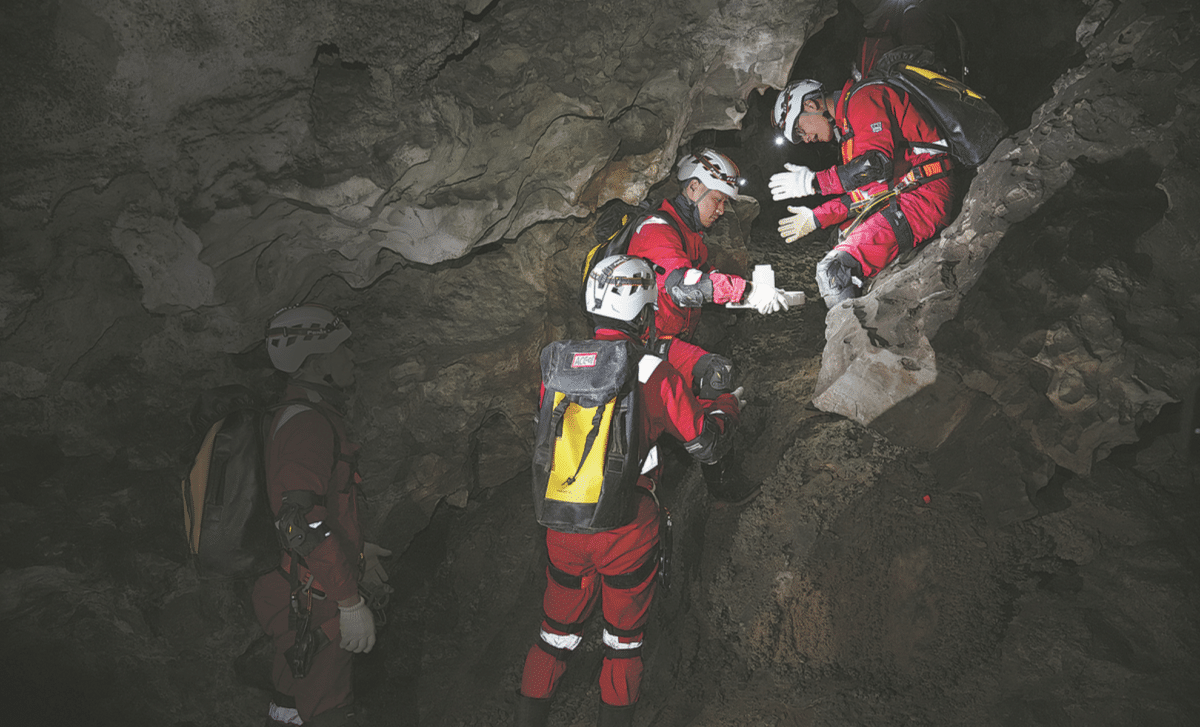
A group of twenty-eight Chinese astronauts have just concluded an intense cave expedition crafted to simulate the extreme mental and physical demands of space missions. According to CGTN, the training took place in a secluded cave network within Chongqing Municipality, where participants endured near-total darkness, freezing conditions, and complete isolation. Removed from any spacecraft or traditional simulators, this mission represents one of the toughest terrestrial training scenarios ever undertaken by China's space agency.
Enduring Six Days in a Cold, Dark Cave
For six days and five nights, astronauts lived and conducted operations inside the natural cave environment, where temperatures held steady at 8°C (46°F) and humidity soared to 99%. Challenging conditions tested their limits as they completed cave mapping exercises, environmental data collection, mock space-to-ground communications, and logistics tasks while facing continual physical and psychological strain.
Twenty-eight Chinese astronauts have taken a cave-training mission in deep mountains of southwest China's Chongqing Municipality to better endure extreme environments. #SpaceChinahttps://t.co/c22geXr2n7
— CGTN (@CGTNOfficial) January 17, 2026Add Cosmo Herald as a Preferred Source

The cave’s severe terrain—featuring narrow corridors, steep drops, and slippery walkways—was only half the challenge. The crushing psychological impact of utter darkness and isolation heightened the difficulty. Veteran astronaut Zhu Yangzhu from the Shenzhou-16 crew reflected on his experience:
“While crawling slowly, I tried to enjoy and savor the pleasure in the process. This way I could offset the difficulties in the psychological environment and the sense of pressure. Later, I even suggested turning off all the lights. Then it was truly pitch-dark, where you couldn’t see your fingers. In that state, we could feel our own heartbeat and breath. That allowed one to experience the extreme quietness in space.”
This immersive scenario, devoid of light and sound, replicates the disorienting factors space travelers face during extended missions. It adds important value beyond standard simulations by challenging astronauts to cope with intense psychological stress.
Leadership, Cooperation, and Communication Under Strain
Survival alone wasn’t the goal; the training emphasized effective leadership, teamwork, and communication under pressure. Teams were tasked with maintaining functionality despite worsening conditions. Song Lingdong, an astronaut on the Shenzhou-19 flight, commented on how the experience forged closer bonds:
“Throughout our training, although the external environment was quite harsh, it actually stimulated our compatibility as a team, brought us even closer and made us more passionate in the work. We all wanted to complete the mission soon and do the work well,” Song said.
The exercise demanded collaborative effort resembling that needed onboard space stations or planetary landers. Commanders were tested in managing safety and mission success simultaneously. For instance, Tang Hongbo, the Shenzhou-17 mission commander and this training leader, explained:
“This time I was the commander, and encountered many challenges and difficulties. Firstly, it was all dark underground and it was extremely cold. Secondly, it was pitch dark, where you couldn’t see your own hands. Thirdly, it was a challenge to our safety. As I was the commander and I must be responsible for everyone’s safety, I felt immense pressure on me about that.”
Commanders bore the responsibility for both mission objectives and crew safety, navigating hazardous terrain with limited visibility and high risks.
Authentic Preparation for Future Space Endeavors
The China Astronaut Research and Training Center (CARTC) dedicated years to locating the perfect cave site. CGTN reports that the final location in the Wulong District was selected following evaluations of over ten sites across seven provinces, with a focus on geological safety, training challenge, and suitability for life support. The chosen cave provided a unique mix of physical hurdles and sensory deprivation akin to space conditions.
Liu Yang, China's first female astronaut and participant in both the Shenzhou-9 and Shenzhou-14 missions, spoke movingly about the training’s conclusion:
“When we walked out of the cave mouth, it truly felt like the moment our spacecraft’s re-entry module lands on Earth safely, and everyone exits the cabin. We were all excited and thrilled,” she said. “In our past missions, it was the moment to report back to our motherland that we accomplished the mission. This time, with all our team members safely out, we could report to the training commander our success.”
This realistic scenario underscores China’s serious commitment to readying astronauts not only for technical challenges but also for the emotional rigors of extended deep-space journeys. Missions planned for the Moon or Mars will require crews to endure isolation and confined conditions, making such training essential.
Future Directions in Chinese Astronaut Training
CARTC has announced plans to include cave exercises in upcoming astronaut training rounds, especially for those who missed the current session. As China's ambitions with the Tiangong Space Station and beyond grow, intense simulations such as this one will become foundational for preparing crews.
Using Earth's natural harsh environments to mimic off-world conditions is a growing approach internationally. China’s program highlights its innovative methods to enhance astronaut preparedness by fusing physical challenges with mental toughness training, bolstering readiness for the unpredictable conditions beyond Earth's atmosphere.
- Categories:
- Space




0 comments
Sign in to Comment