

By the end of the 21st century, more than 2.3 million Europeans may die due to extreme heat if greenhouse gas emissions remain unchecked, reveals a comprehensive new study published in Nature Medicine. This extensive analysis, conducted by the London School of Hygiene & Tropical Medicine, examined 854 urban areas across 30 European nations, marking one of the most detailed evaluations of mortality connected to climate shifts on the continent to date.
The report evaluates the overall health consequences linked to temperature fluctuations, encompassing both heat-induced and cold-induced deaths, from 2015 through 2099. The findings are stark: while some locations might experience fewer deaths related to cold, the surge in heat-related fatalities drastically overshadows those benefits. Without strong climate action, Europe faces a significant rise in deaths driven by warming temperatures.
Using data from 19 global climate models combined with demographic forecasts, the study estimates that under the most severe emissions scenario (SSP3-7.0), roughly 2,345,410 additional fatalities could occur. This projection holds even after accounting for population trends and improvements in healthcare. These findings come amid a backdrop of intensifying heatwaves across Europe—2023 was recorded as the warmest year ever documented, with 2024 predicted to surpass it, according to Copernicus Climate Change Service.

Southern Europe Faces the Brunt as Temperatures Rise Faster Than Global Average
The hardest hit regions will be in Southern and Central Europe, with cities such as Barcelona, Rome, Naples, and Athens expected to experience the sharpest increases in deaths linked to heat. Barcelona alone may witness over 246,000 climate-related deaths by century’s end. These regions contend with already elevated temperatures, rapid growth of urban areas, and aging populations, all contributing to heightened vulnerability.
Throughout the Mediterranean region, nations like Spain, Italy, and Greece will likely confront more frequent and deadly compound heatwaves—periods of extremely hot days followed by warm nights, which impair rest and increase cardiovascular stress. The island country of Malta emerged as particularly vulnerable, with projections indicating 268 excess deaths per 100,000 residents, exceeding twice the regional average for Southern Europe.
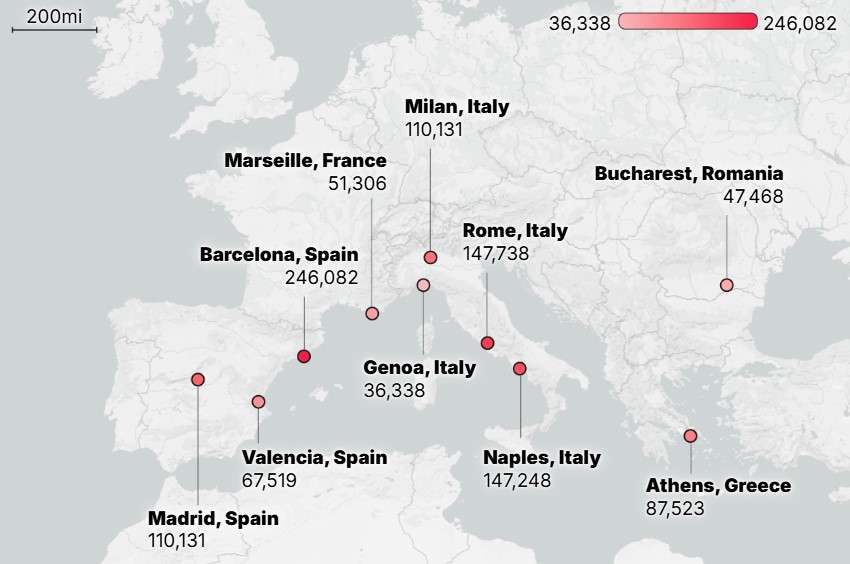
Conversely, some areas in Northern Europe, including Sweden, Ireland, and Finland, may experience a temporary reduction in temperature-related deaths due to milder winters. However, researchers warn this interval is short-term. By the late 21st century, even northern cities like Helsinki and Stockholm are projected to witness rising heat-related mortality as heat extremes intensify.
Mitigation Efforts Help but Fall Short Under High Emission Scenarios
The research also evaluated the potential of adaptation strategies—such as expanding urban green spaces, improving building insulation, and increasing air conditioning availability—to lower mortality. While these interventions can provide some benefit, especially under less extreme emission pathways (SSP1-2.6 and SSP2-4.5), they cannot fully counteract the projected spike in deaths under the worst-case emissions scenario.
Even assuming a 50% decrease in heat-related risk—a level exceeding most current national achievements—Europe would still face hundreds of thousands of additional fatalities. As co-lead author Dr Pierre Masselot explains, “Reversing the trend would require a 90% risk reduction, which is unrealistic based on present data.”
While some countries like Switzerland and Sweden have made noticeable strides in heat adaptation, others—including Greece, the UK, and Czechia—have seen little or no progress, according to the study's supplementary data.
The team’s models accounted for population changes such as aging and isolated the effects of climate warming from demographic growth. Consequently, these excess deaths are directly attributable to rising temperatures, not just shifts in population dynamics.
Robust, City-Level Models Provide Clear and Concerning Insights
Departing from earlier studies that relied on broad national estimates, this analysis used city-specific temperature-mortality relationships customized for five different age groups. It incorporated data from 19 bias-corrected climate models, demographic statistics from the Wittgenstein Centre, and epidemiological evidence published in The Lancet Planetary Health.
The researchers conducted 500 Monte Carlo simulations per scenario to factor in uncertainty, generating confidence ranges that were especially broad in high-warming cases. Under SSP3-7.0, cumulative heat-related deaths could peak at 4.7 million, though the central estimate remains just over 2.3 million.
“This is not alarmist rhetoric. These projections are grounded in empirical evidence, and the real health burden may be even greater,” stated Dr Antonio Gasparrini, senior author and head of the EHM Lab at LSHTM. “Our models did not factor in other climate risks like wildfires, tropical cyclones, or spikes in air pollution, all anticipated to rise.”
- Categories:
- Science













0 comments
Sign in to Comment