
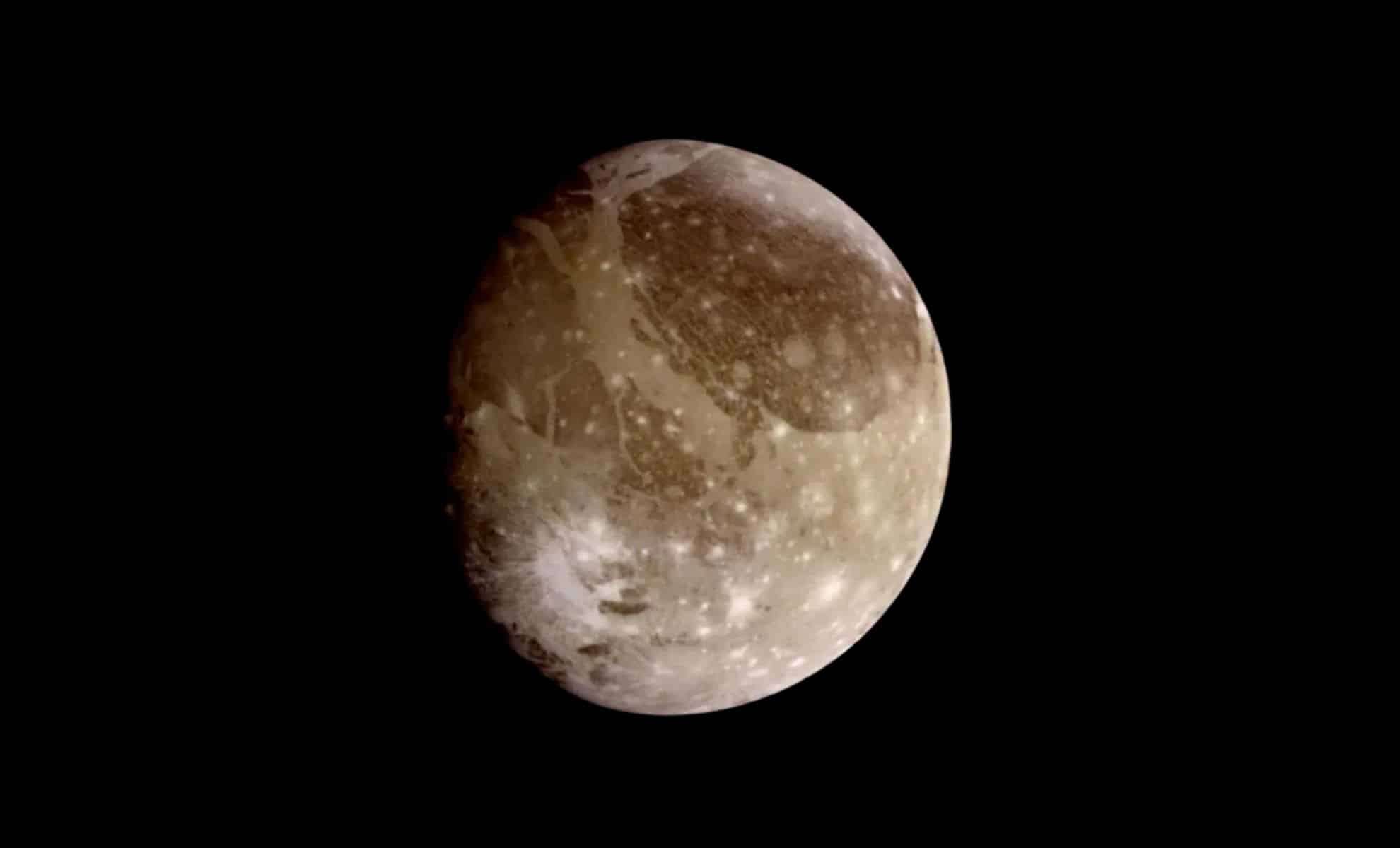
A recent theoretical proposal introduces a groundbreaking approach in the quest for dark matter—utilizing the icy surface of Ganymede, Jupiter’s biggest moon, as a natural sensor to detect massive dark matter particles. Physicist William DeRocco from the University of Maryland detailed this concept in a paper published on arXiv in August 2025. The theory suggests that unusual impact marks on Ganymede’s frozen crust might be remnants of interactions with giant dark matter objects. With missions like NASA’s Europa Clipper and ESA’s JUICE heading to the Jovian system, scientists may soon have the means to investigate these intriguing features.
Utilizing a Natural Cosmic Observatory for Hidden Matter
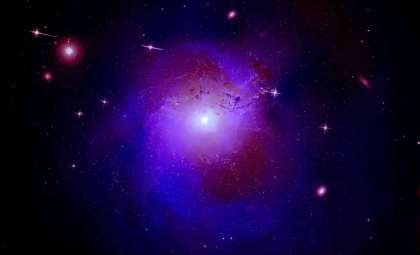
Dark matter constitutes approximately 85% of all matter in the cosmos, yet evades detection by electromagnetic radiation, revealing itself only through gravity. Conventional detectors such as LUX-ZEPLIN and XENONnT are designed to sense lightweight dark matter candidates like WIMPs (Weakly Interacting Massive Particles) and operate deep underground. However, DeRocco’s model highlights an entirely different regime: extraordinarily large dark matter particles, possibly asteroid-sized.
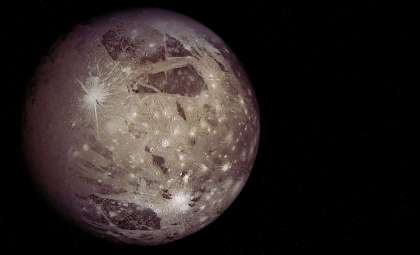
These colossal dark matter entities would interact so seldom with normal matter that detecting just one would require a planetary-scale detector. Enter Ganymede, the solar system’s largest moon, with a diameter of 5,268 kilometers and a largely inactive geological surface that conserves collision evidence over eons. It might silently archive traces of these rare cosmic encounters.

Characteristics of a Dark Matter Collision
DeRocco’s computer models indicate that if such massive dark matter particles collided with Ganymede, their impacts would differ drastically from typical asteroid strikes. Instead of scattering debris, these particles would penetrate deeply beneath the surface, generating deep, narrow craters with longevity—coined “dark matter craters”—which exhibit unique mineralogical signatures.
Given Ganymede’s subsurface liquid ocean layer, such collisions might transport rare chemical components from the ocean floor towards the surface, creating unusual surface compositions and structural irregularities. Unlike ordinary impact sites, these craters would be distinctively isolated with smooth edges and absent of typical ejecta. Instruments equipped with ground-penetrating radar, possibly aboard JUICE or Europa Clipper, may be able to detect vertical columns of melted ice piercing through Ganymede’s icy shell.
How Upcoming Space Probes Could Test the Hypothesis
The proposal’s timing aligns well with upcoming space exploration: ESA’s JUICE mission and NASA’s Europa Clipper will both reach Jupiter’s system within the next decade. While these missions are not purpose-built to find dark matter, their advanced high-resolution imaging and radar scanning capabilities could be adapted to search for the unique crater types predicted by DeRocco.
Bradley Kavanagh, an astrophysicist based at the University of Cantabria, described the approach as unconventional but achievable. He noted that these hypothetical particles might be bound by robust forces within an unexplored “dark sector.” Though their existence is speculative, employing Ganymede as a natural lab offers a fresh perspective on dark matter detection.
Evaluating The Strengths and Criticisms
Despite the thorough and imaginative theoretical analysis, DeRocco’s hypothesis encounters the persistent obstacle common to all dark matter research: no direct observational proof yet exists. Critics point out that the concept relies on speculative dark sector physics which have no established counterparts in the Standard Model.
However, in a field where experimental null results predominate, pushing boundaries remains vital. As astrophysicist Zachary Picker expressed to New Scientist, “No terrestrial experiments can detect a bowling ball-sized dark matter particle or objects the scale of a fridge or car because such impacts are far too infrequent.”
New Scientific Directions for Space Exploration
This proposal highlights an evolving mindset in planetary and cosmological research. Whereas space missions traditionally emphasize geology, chemistry, and habitability, recognizing celestial bodies like Ganymede as potential natural cosmic detectors could integrate various scientific disciplines—from astronomy to particle physics and planetary science.
If JUICE or Europa Clipper discover anomalies aligning with DeRocco’s predictions, it might offer the first glimpses of a dark universe long hypothesized but never observed. Conversely, null findings would help narrow theoretical possibilities and sharpen the focus of future dark matter studies.
- Categories:
- News








0 comments
Sign in to Comment