
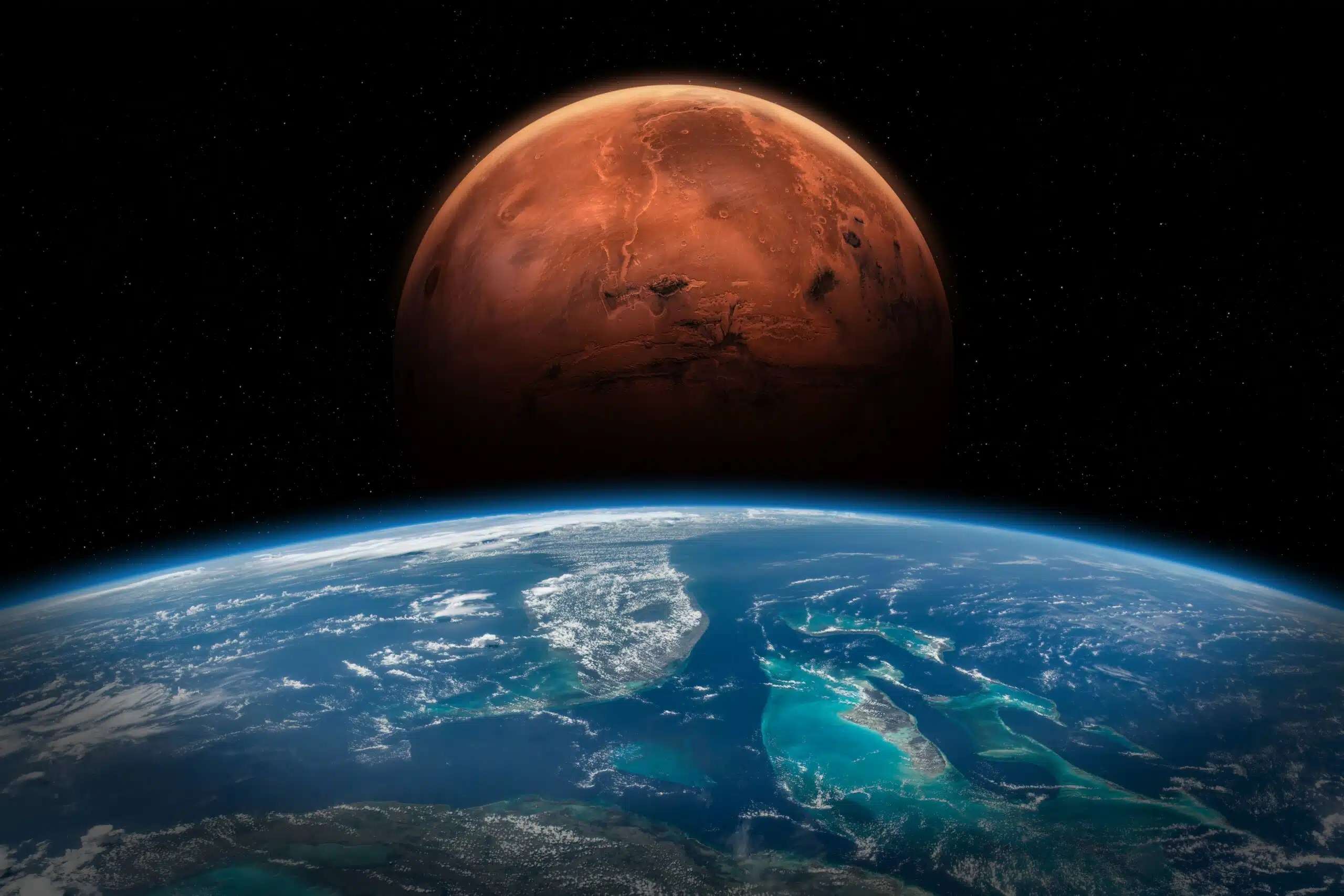
Our understanding of life’s origins on Earth might need a rethink. Recently featured in The Conversation, a compelling hypothesis suggests life’s earliest building blocks may have developed on Mars before being transferred to Earth aboard ancient meteorites. Though speculative, this idea gains traction through studies of planetary formation and microbial resilience, prompting fresh questions about Earth’s biological beginnings.
Did Mars Host Life Before Earth? The Timeline That Supports This Idea
Mars and Earth formed almost simultaneously, respectively around 4.6 and 4.54 billion years ago. Both worlds endured massive melting events triggered by huge impacts early on. However, Earth suffered a unique collision with a Mars-sized protoplanet named Theia, an impact that spawned the Moon but may have eradicated any early life forms.
Meanwhile, Mars may have experienced a calmer developmental history. Scientific evidence points to the presence of liquid water, a protective atmosphere, and possibly hydrothermal vent systems on early Mars—factors conducive to life’s chemical origins. This raises the intriguing possibility that life could have first emerged on Mars before Earth became hospitable.

The Mars-Earth Life Connection: Revisiting a Long-Standing Hypothesis
Life beginning on Mars and subsequently seeding Earth fits within the broader panspermia hypothesis, a concept explored in scientific circles for decades. The recent article in The Conversation draws on planetary formation evidence alongside genetic data related to LUCA, the last universal common ancestor of all terrestrial life.
LUCA’s genetic traits suggest adaptation to high heat and intense ultraviolet radiation, environments found around hydrothermal vents or hot springs present on both worlds. Should Earth have been sterilized by the Theia impact, the article posits that LUCA’s forerunners could have survived on Mars and later journeyed to Earth.
This scenario isn’t merely theoretical. Multiple computational studies and lab investigations demonstrate that some microorganisms, particularly spore-forming varieties, can endure space travel protected inside meteorite fragments. Such rocks, blasted off Mars by asteroid impacts, can take months or years to traverse space before landing on Earth, undertaking a daunting voyage that might nonetheless be feasible.
The Challenges of Traveling from Mars to Earth
Even if life originated on Mars, surviving the transit through space entails extraordinary challenges. Microbes would need to withstand the violent ejection from Mars, endure extreme cold and cosmic radiation during interplanetary travel, and survive the fiery re-entry through Earth’s atmosphere without being destroyed.
Although this trip is extremely harsh, extremophilic microorganisms reveal surprising endurance. Certain bacterial species can resist vacuum, drying, and intense radiation, especially when encased in rocks or in spore form. Missions like the Japanese Tanpopo project have proven microbial persistence in Earth's orbit, making the notion of interplanetary microbial hitchhiking more credible.
Nevertheless, the author of the article remains cautiously optimistic. Given the extreme trial of such a journey, it may still be more plausible that life arose on Earth itself, but the possibility of a Martian origin can't be dismissed entirely.
Why Has Earth’s Life Not Spread Across the Solar System?
If microbial life could move from Mars to Earth, then why hasn’t life from Earth traveled outward to other planets over billions of years? This puzzling asymmetry is highlighted towards the article’s conclusion. If interplanetary transfer is feasible, it raises questions why Earth-based microbes aren’t found scattered beyond our planet.
One explanation might be Earth’s stronger gravity and atmosphere, which make ejecting material at escape velocity far more difficult. Another factor could be that human-launched spacecraft are only recently dispersing Earth microbes into space, so insufficient time has passed for them to establish elsewhere.
Regardless, the apparent absence of Earth-origin microorganisms on other planets adds complexity to the discussion. With ongoing Mars expeditions and growing astrobiology research, the enigma about the true birthplace of life remains an active scientific frontier.
- Categories:
- Science





0 comments
Sign in to Comment