
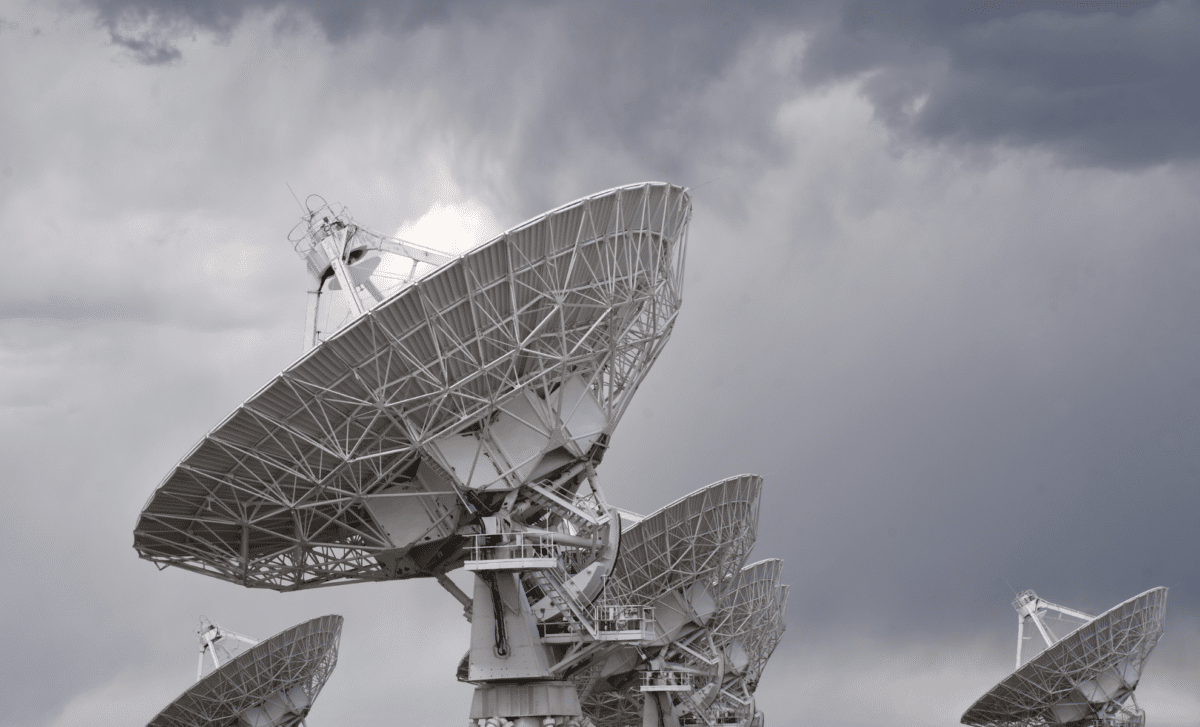
For more than sixty years, researchers involved in the Search for Extraterrestrial Intelligence (SETI) have been vigilantly monitoring the universe for evidence of intelligent life beyond Earth. Despite exhaustive scans, silence predominates, prompting new theories about the elusive nature of alien transmissions. A recent paper published in The Astrophysical Journal introduces a compelling possibility: space weather effects surrounding stars may disrupt or distort extraterrestrial signals, obscuring them from our detection capabilities.
How Space Weather Interferes with Signal Detection
Space weather encompasses the electromagnetic perturbations triggered by phenomena such as coronal mass ejections (CMEs) and stellar winds that propel charged particles and plasma into space. These events profoundly affect radio waves journeying across interstellar distances, especially narrowband signals, which SETI prioritizes due to their distinct frequency profiles. Although alien transmissions might be broadcast within a compact frequency band to stand out from cosmic background noise, space weather disturbances can cause these signals to spread across wider frequency ranges, blurring their clarity and making them difficult for Earth-based radio telescopes to identify.
“SETI searches are often optimized for extremely narrow signals,” Vishal Gajjar of the SETI Institute explained in a statement. “If a signal gets broadened by its own star’s environment, it can slip below our detection thresholds, even if it’s there, potentially helping explain some of the radio silence we’ve seen in technosignature searches.”
Add Cosmo Herald as a Preferred Source

These insights shed light on why decades of SETI efforts have yet to yield detectable alien signals. It suggests that the challenge may not be the absence of transmissions but rather the distortive nature of energy emissions from host stars scrambling these signals before they reach our instruments.
The Impact of Coronal Mass Ejections on Signals
CMEs are substantial ejections of solar plasma and magnetic fields emerging from a star’s corona into surrounding space. These events can dramatically influence space weather conditions within a stellar system, thereby affecting any potential extraterrestrial radio signals. The expelled charged particles induce a process known as diffractive scintillation, which disperses radio waves over an expanded range of frequencies and diminishes signal strength. Consequently, a narrowband transmission originating from an exoplanet might become indecipherable once it arrives on Earth.
Research led by Vishal Gajjar and Grayce Brown, featured in The Astrophysical Journal, utilized solar system data to analyze the degree to which CMEs affect interstellar signal propagation. Their findings indicate that these stellar storms could degrade signal quality to the point where even cutting-edge radio observatories might fail to detect them. If alien societies are aware of such interference, they may choose to broadcast during periods of reduced stellar activity, otherwise their signals could be masked by intense space weather, accounting for our persistent cosmic quiet.
Adapting SETI’s Search Strategy
Beyond pinpointing the challenge, the researchers suggest new tactics for enhancing SETI’s effectiveness. Gajjar and Brown emphasize the importance of comprehending how space weather modifies the characteristics of narrowband signals. “By quantifying how stellar activity can reshape narrowband signals, we can design searches that are better matched to what actually arrives at Earth, not just what might be transmitted,” said Brown.
“By quantifying how stellar activity can reshape narrowband signals, we can design searches that are better matched to what actually arrives at Earth, not just what might be transmitted,” said Brown.
This understanding allows astronomers to refine detection techniques that consider space weather effects previously underestimated or overlooked. Their simulations focusing on both sun-like and red dwarf stars reveal that as many as 70% of stars cause signal frequency broadening exceeding 1 Hz, and nearly 30% lead to broadening beyond 10 Hz. Particularly around red dwarf stars, known for their volatile activity, this effect is most pronounced. Incorporating these factors into search algorithms could substantially improve chances of intercepting extraterrestrial messages.
Testing the Influence of Space Weather via Simulations
To validate their hypothesis, the team modeled SETI observations involving over a million nearby sun-like and red dwarf stars, integrating empirical solar activity data. Their results demonstrated that during episodes of intense stellar disturbances like CMEs, signal frequencies might broaden by over 1,000 Hz, rendering the signals invisible to SETI’s narrowband filters. This discovery highlights the necessity of evolving search methodologies to include broader frequency ranges and dynamic signal profiles.
This research also points toward practical improvements in how SETI scans the skies. By adjusting to space weather’s influence on signal integrity, astronomers can target frequencies more likely to evade distortion and thus increase the likelihood of detecting genuine alien transmissions. This presents a promising advancement in the ongoing quest to find evidence of extraterrestrial technological activity.
- Categories:
- Science








0 comments
Sign in to Comment