
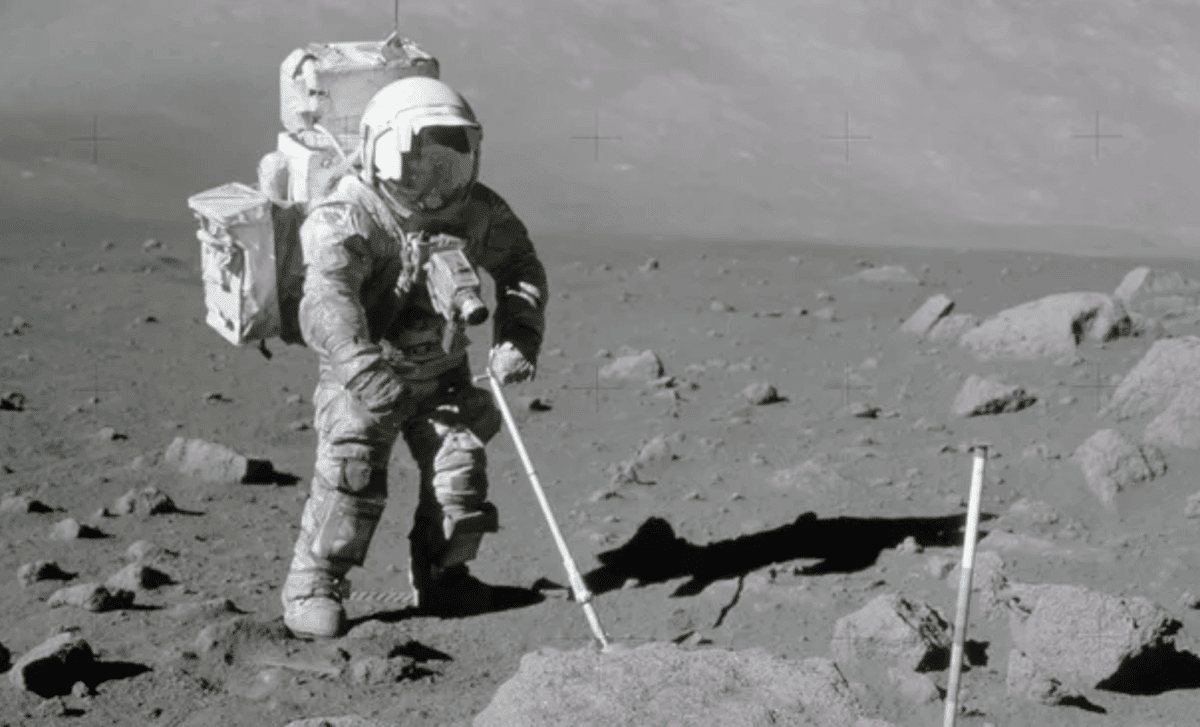
Researchers have made a startling discovery inside lunar samples gathered more than 50 years ago. A minuscule fragment from the Moon, preserved since the Apollo 17 mission, has unveiled a hidden secret that could rewrite our knowledge of the Moon’s origins. This remarkable breakthrough, recently documented in JGR Planets, sheds new light on events that trace back to the dawn of the Solar System.
Unveiling a Lunar Enigma
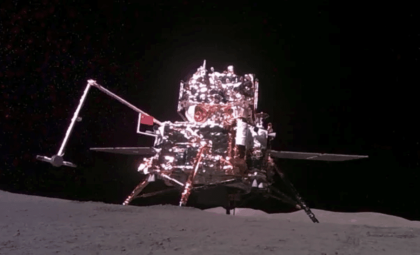
NASA’s Apollo 17 mission, the final crewed expedition to the Moon, returned with a diverse collection of lunar materials. One particular sample was carefully sealed in a helium environment and left untouched for decades, reserved for future scientific study. Once examined with cutting-edge technology, this sample revealed a puzzling feature that astonished planetary scientists.
Planetary expert James Dottin and his team at Brown University focused on microscopic grains of troilite, a compound made of sulfur and iron, retrieved from the Apollo 17 assortment. Through advanced mass spectrometry, the researchers identified unique sulfur isotope signatures within these grains. The isotope patterns turned out to be completely unexpected, offering new perspectives on the Moon’s geological evolution.

“My first thought was, ‘Holy shmolies, that can’t be right,'” said Dottin. “So we went back to make sure we had done everything properly, and we had. These are just very surprising results.”
The isotope ratios in the troilite grains did not align with any known terrestrial or lunar samples. These surprising results point to a more intricate geologic past for the Moon than previously thought. Published in JGR Planets, this study challenges existing models of lunar origin and could dramatically reshape our understanding of early Solar System processes.
Unique Sulfur Isotopes Offer Insight into Lunar History
The discovery centers on an unusual sulfur-33 isotope distribution in the analyzed sample. Until now, scientists assumed that sulfur isotopes within the Moon’s mantle were nearly identical to those on Earth. This new data contradicts that assumption in a fundamental way.
Dottin noted, “Before this, it was thought that the lunar mantle had the same sulfur isotope composition as Earth.”
Instead, the team found isotope combinations previously unseen, prompting questions about lunar formation processes during its molten phase. One hypothesis is that sulfur isotopes may have been lost to space as the Moon’s magma ocean cooled, causing fractionation that altered the isotope ratios. This theory involves the Moon’s early atmosphere and volcanic activity that influenced sulfur distribution.
Implications of Theia Impact Theory on Lunar Composition
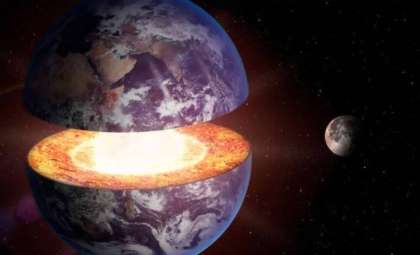
Beyond isotope anomalies, the findings hint toward a deeper question about the Moon’s birth. The dominant origin theory posits the Moon formed after a colossal impact between Earth and a Mars-sized body called Theia. Debris from this collision eventually coalesced into the Moon. Yet, the sulfur isotope evidence suggests the Moon harbors material that did not originate from Earth alone.
“So this idea of some kind of exchange mechanism on the early Moon is exciting,” Dottin explains.
If some matter from Theia remains present in lunar rocks, this could provide rare direct evidence of material exchanged during that ancient collision, opening new research directions into planetary formation and Solar System history.
The study disputes the notion that all lunar sulfur came solely from Earth’s mantle, suggesting instead a multifaceted scenario involving interactions between early Earth, Theia, and the proto-Moon.
Broader Impact on Lunar and Terrestrial Geology
Finding this sulfur isotopic anomaly in lunar samples could have wide-ranging implications for how we understand planetary geology. Unlike Earth, which hosts dynamic plate tectonics that recycle surface materials into the interior, the Moon lacks such processes. As Dottin observes, “On Earth, we have plate tectonics that does that, but the Moon doesn’t.”
This raises an intriguing possibility: might the Moon have developed its own early system of material exchange despite no plate tectonics? If so, this could dramatically alter our understanding of lunar geological history and the environment of the early Solar System.
- Categories:
- Science




0 comments
Sign in to Comment