
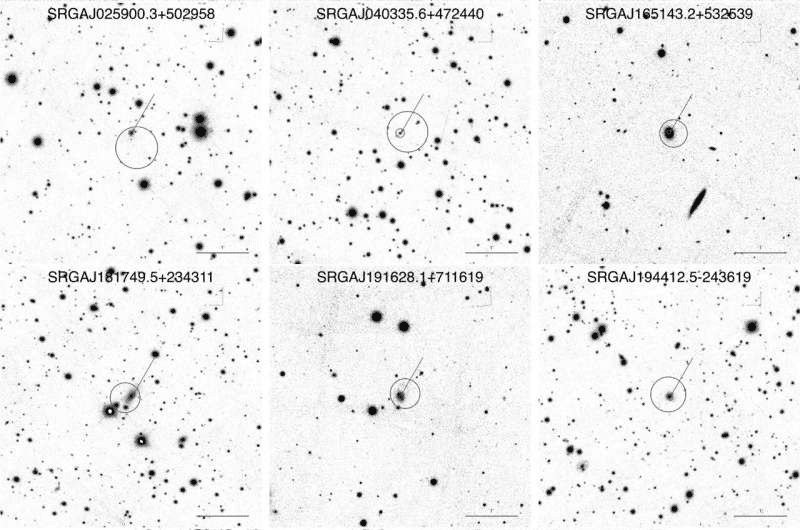
A group of researchers from the Russian Academy of Sciences have utilized the Spektr-RG (SRG) observatory to uncover 11 previously unknown active galactic nuclei (AGNs) by analyzing X-ray emissions across the cosmos. Detailed in a study published in Astronomy Letters in 2024, this achievement significantly enriches the catalog of these energetic galactic centers. Their paper, titled “New Active Galactic Nuclei Detected by the ART-XC and eROSITA Telescopes During the First Five SRG All-Sky X-ray Surveys,” offers new insights into the extreme processes governing galactic nuclei.
This advance was driven by data from the ART-XC instrument aboard the SRG, which enabled the team to identify sources not previously classified as AGNs. These results are set to deepen our comprehension of how galaxies evolve and the critical role played by supermassive black holes within them.
Insights Into Seyfert Galaxies Among New AGNs
The recently spotted 11 AGNs mainly belong to the class known as Seyfert galaxies, recognized for their distinctive emission signatures. Specifically, seven fall under the category of type 1 Seyferts, three are type 1.9, and one is designated as type 2. Seyfert galaxies exhibit diverse optical emission lines; type 1 varieties show broad lines, whereas type 2 are characterized by narrower features, revealing complex internal structures of these luminous celestial sources.

These newly identified AGNs are relatively close, with redshifts from 0.028 to 0.258. Their X-ray luminosities range broadly, spanning 2 to 300 tredecillion erg/s, consistent with typical AGN brightness observed in the current cosmic epoch. This luminosity range provides a window into the immense energy output from these galaxies, among the universe’s most radiant persistent emitters.
Supermassive Black Holes Driving AGN Phenomena
The investigation also involved deriving mass estimates for the central black holes in seven Seyfert galaxies. These masses span from roughly 4.68 million up to 150 million times the mass of our sun, illustrating the colossal scales of these supermassive black holes. Grasping black hole mass is essential to understanding the gravitational influence shaping AGN activity and galactic behavior.
This evidence emphasizes how the enormous gravity from these black holes powers the intense electromagnetic radiation emitted by AGNs. Larger black holes can extract more gravitational energy from infalling matter, energizing these active nuclei. The findings demonstrate a significant diversity in black hole sizes and their resulting impact on galaxy centers.
ART-XC’s Crucial Role in AGN Discoveries
The ART-XC telescope aboard the Spektr-RG spacecraft was key to identifying all 11 new AGNs. This advanced X-ray observatory captures all-sky high-resolution X-ray data, exposing sources that optical instruments often miss. The SRG mission is invaluable for astronomers aiming to reveal and study X-ray-bright cosmic phenomena such as active galactic nuclei.
"In this paper we present the results of our optical identification and classification of another 11 AGNs from the ARTSS1-5 catalog," the team reported, describing their classification methodology. Their research notably expands the SRG’s AGN database, providing a richer resource for ongoing deep-space investigations.
Future Directions in AGN Exploration
Although these findings are significant, the research team aims to pursue further high-detail X-ray observations of select AGNs to refine understanding of their characteristics. Their focus includes the AGN SRGA J000132.9+240237, which shows a unique spectrum indicative of strong absorption and prominent reflection from surrounding dust structures.
"We are planning to take a higher-quality X-ray spectrum of this source in the pointing mode with the SRG/ART-XC telescope to study in detail its physical properties," the scientists stated. This more targeted analysis is expected to shed important light on the physical dynamics and composition of such extreme cosmic environments, enhancing knowledge of supermassive black hole-driven activity within AGNs.
- Categories:
- News









0 comments
Sign in to Comment