

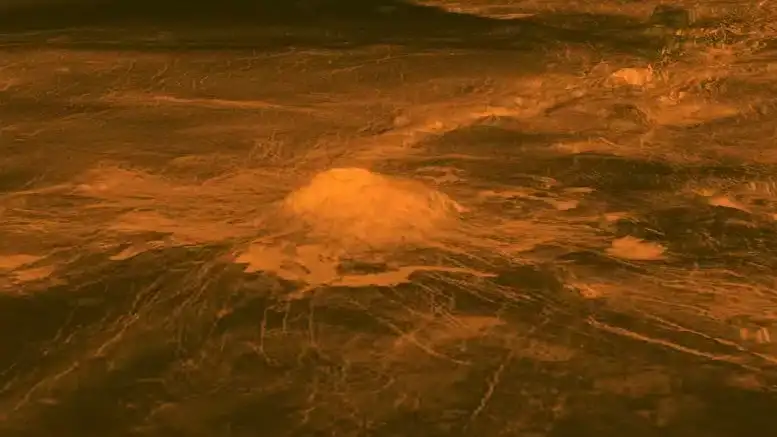
Recent findings indicate that Venus may exhibit far more geological dynamism than scientists have long assumed. Research led by Viatcheslav S. Solomatov and Chhavi Jain introduces the possibility that the planet’s crust experiences continuous convection, a phenomenon generally observed deeper inside planets such as Earth. This groundbreaking insight sheds light on Venus’ extraordinary population of about 85,000 volcanoes, offering a fresh perspective on its geologic evolution. Published in Physics of the Earth and Planetary Interiors, the study proposes that Venus’ outermost layer moves and reforms via convection currents, which transport heat outward and possibly energize its volcanic activity.
Convection Activity in Venus’ Surface Layer
Conventional wisdom held that convection happens primarily in a planet’s lower mantle regions. Yet this new research puts forward that Venus’ surface crust, albeit extremely hot with temperatures soaring to around 870°F, could also sustain convection currents. Lead author Slava Solomatov noted this discovery as revolutionary, explaining, "It's remarkable this mechanism within Venus’ crust has been overlooked. Our models suggest convection isn’t just possible—it’s highly probable."
This process might also dictate the distribution and nature of Venusian volcanoes. NASA’s Magellan mission recently provided radar images that have detailed the surface, enabling the mapping of these numerous volcanoes. The ongoing convection-driven crustal shifts could account for the immense volcanic structures cataloged so far.

Decoding Venus’ Thermal and Volcanic Mechanisms
Despite Venus’ blistering surface conditions, the way internal heat emerges remains a puzzle. This new model positions convection as a crucial element, transferring heat from the planet’s interior toward its exterior layers, thus sustaining volcanic activity. Solomatov emphasized that "convection within the crust might be vital to understanding how Venus remains volcanically vibrant under such harsh conditions."
Upcoming Venus missions aim to capture fine-scale gravity data and temperature profiles. Solomatov asserts that these measurements could detect hotspots and less dense crustal zones, confirming the convection process influencing volcanic activity.
Parallels Between Venus and Pluto’s Surface Patterns
The authors also highlight intriguing similarities with Pluto, a distant icy world at the solar system’s edge. NASA’s New Horizons mission unveiled polygonal features on Pluto’s Sputnik Planitia, mirroring tectonic boundaries on Earth. Solomatov hypothesizes that sluggish convection in Pluto’s icy crust could drive these surface formations, akin to processes now proposed for Venus. He states, “Aside from Earth, Pluto is likely the only other planetary body in our solar system clearly exhibiting convection-influenced tectonics on its exterior.”
Advancing Planetary Science Through Venus Exploration
The research opens new avenues for future explorations. Planned missions to Venus are expected to gather detailed gravity maps and surface thermal images to detect variations in the crust’s density and temperature. These insights will not only illuminate Venus’ geology but may also revolutionize our understanding of crustal convection’s role across diverse planetary environments.
Reflecting on these findings, Solomatov remarked, “Venus harbors secrets about geological activity that remain elusive, and even remote bodies like Pluto could provide crucial clues to expand our grasp of planetary science.” This discovery signals a major shift in how scientists study planetary crust dynamics.
- Categories:
- News











0 comments
Sign in to Comment