
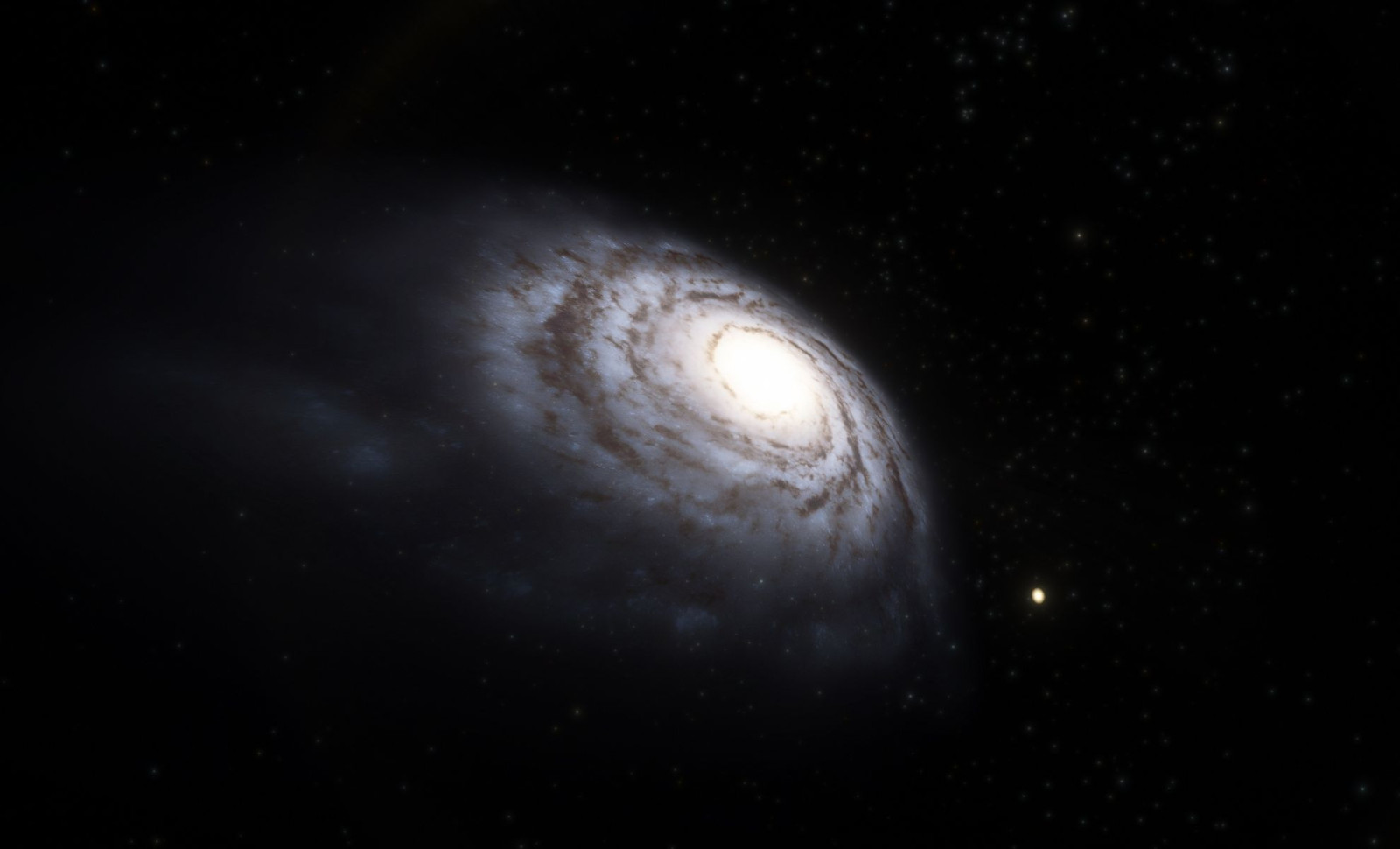
A team of astronomers has uncovered an extraordinary galaxy dominated almost entirely by dark matter. Situated about 300 million light-years away in the Perseus galaxy cluster, this faint celestial object, known as CDG-2, was identified primarily through its sparse grouping of globular star clusters.
Galaxies with very low surface brightness such as CDG-2 prove extremely challenging to spot because they emit minimal light. Unlike typical galaxies teeming with stars, these unusual objects are largely composed of dark matter, making them nearly invisible through conventional observational techniques.
Tracking the Dimmest Galaxies
Locating galaxies with extremely faint brightness levels requires specialized strategies. Such cosmic bodies are usually so weak in light emissions that even the most sensitive telescopes find them elusive. For CDG-2, scientists shifted their focus from direct brightness to globular clusters—these are compact, spherical assemblies of stars gravitationally bound and orbiting larger galaxies.
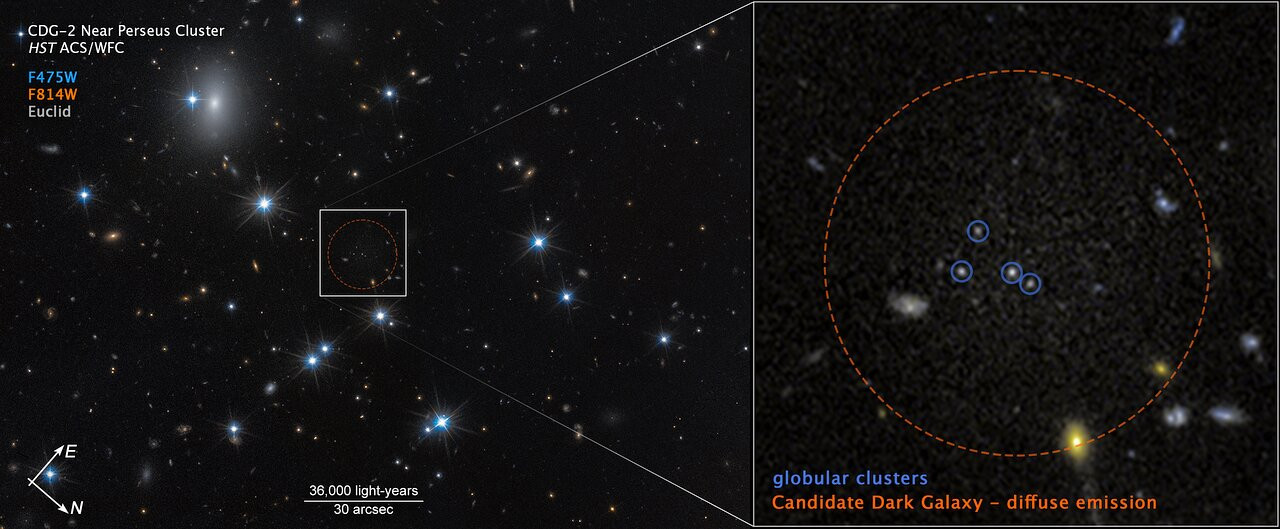
David Li from the University of Toronto explained that these clusters act like astronomical signposts that guide researchers toward overlooked faint galaxies. Applying this innovative approach enabled the discovery of CDG-2 along with several other potential dark matter-rich galaxies.

Using Advanced Telescopes to Verify CDG-2
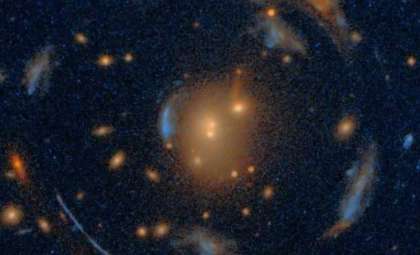
According to research published in The Astrophysical Journal Letters, confirming CDG-2’s presence following the detection of its globular clusters necessitated high-precision imaging tools. Data acquired from NASA’s Hubble Space Telescope, the European Space Agency’s Euclid mission, and the Subaru Telescope in Hawaii provided crucial insights. Hubble captured a delicate, diffused glow enveloping the clusters, confirming the underlying presence of the dim galaxy.
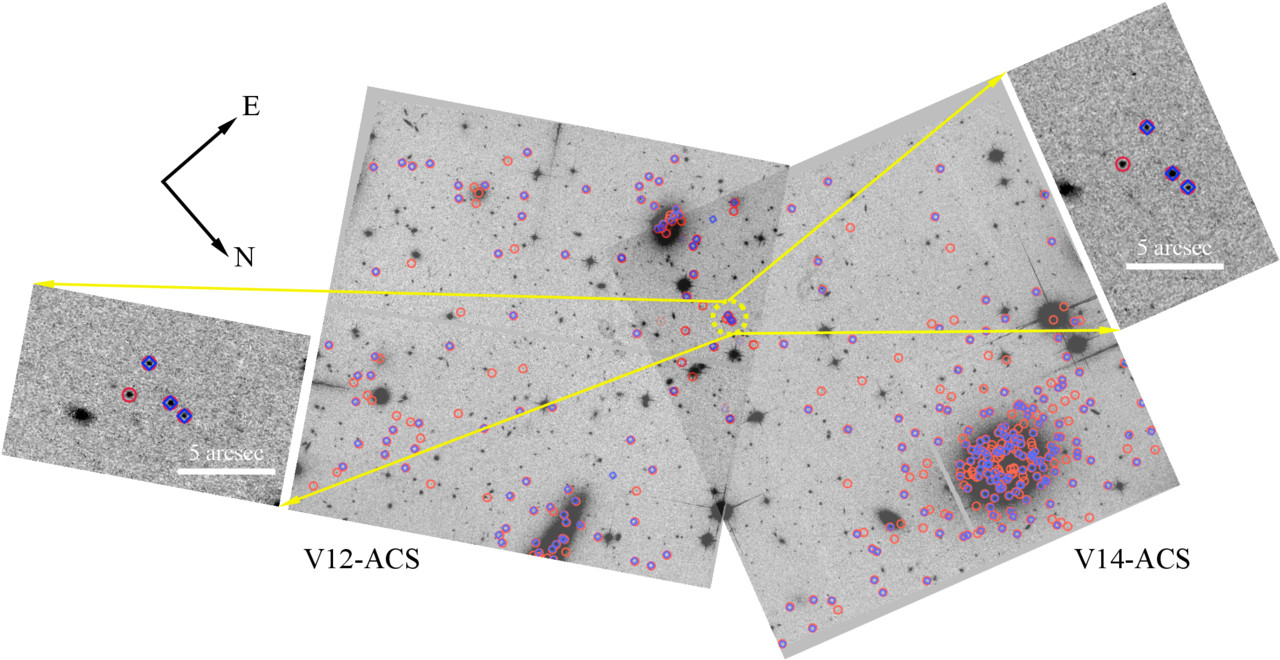
“This is the first galaxy detected solely through its globular cluster population,”Li pointed out. “Under conservative assumptions, the four clusters represent the entire globular cluster population of CDG-2.”
A Galaxy Overwhelmingly Composed of Dark Matter
CDG-2’s most astonishing trait is its composition. Initial calculations indicate that roughly 99% of its mass consists of dark matter, with the remaining 1% made up of observable stars. Its luminosity corresponds to that of approximately six million stars, a relatively low number compared to typical galaxies. The four associated globular clusters contribute about 16% of the visible light. The data suggests that interactions with neighboring galaxies likely stripped away much of the galaxy’s ordinary matter.
The discovery of CDG-2 marks a significant milestone in dark matter research. As astronomical technology and detection techniques progress, it's expected that many more such dim, dark matter-dominated galaxies will be uncovered.
- Categories:
- Astronomy




0 comments
Sign in to Comment