
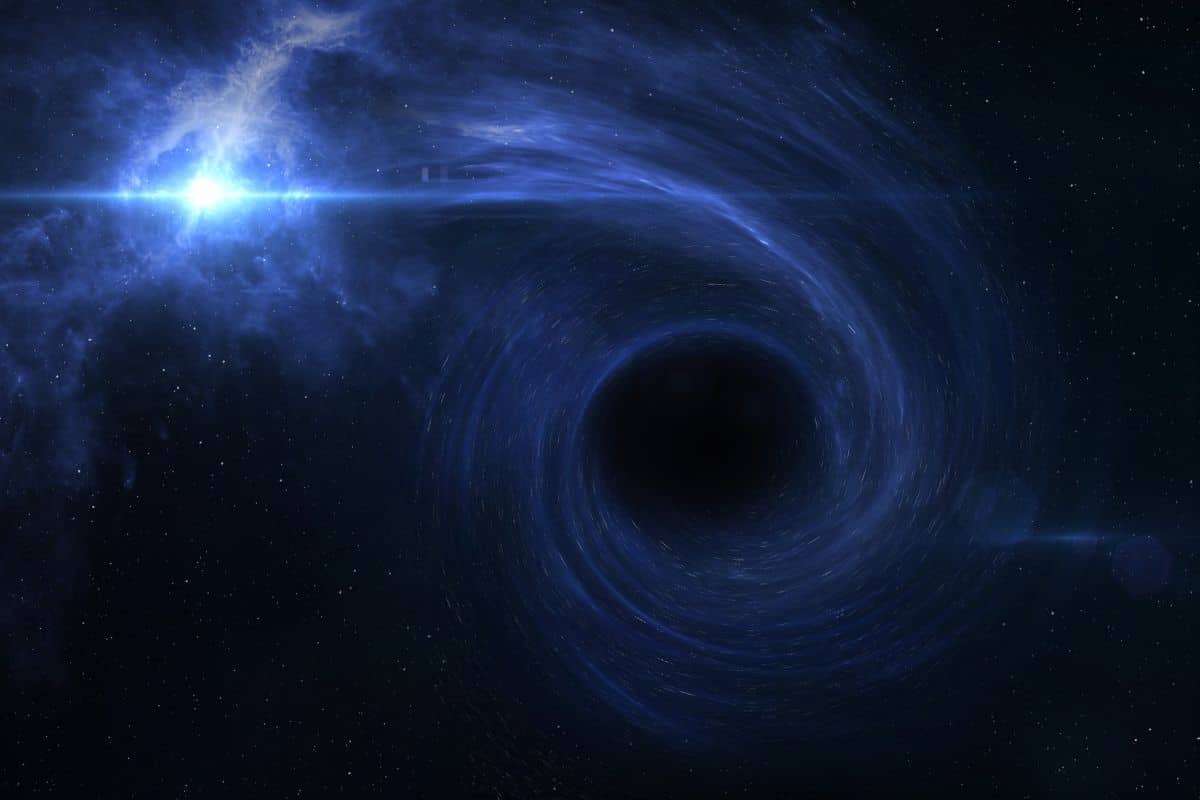
Researchers studying M87*, the pioneering black hole captured in an image, have found that its shadow undergoes variations yearly. The newest data from the Event Horizon Telescope (EHT) reveal that these visual changes stem from turbulence in the hot gas encircling the black hole.
Yearly Variations in M87*’s Shadow
In 2019, the EHT team unveiled the first-ever direct image of a black hole—a glowing ring encircling the shadow of M87*, a supermassive black hole situated approximately 55 million light-years from Earth.
This shadow results from the intense bending of light by gravity near the black hole’s event horizon, with its dimensions helping scientists estimate the black hole’s mass, which is around 6.5 billion solar masses.

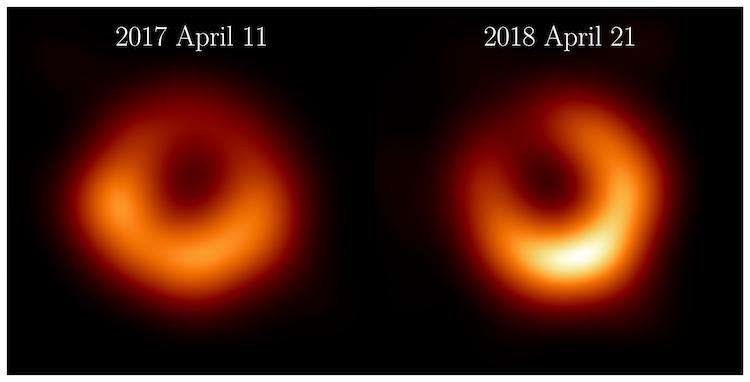
Unexpectedly, when comparing images from 2017 and 2018 taken by the EHT, astronomers observed that the surrounding bright ring had altered position.
Understanding the Shifts in the Image
These apparent displacements in M87*’s shadow are attributed to the highly active accretion disk—an intense swirl of matter and gas spiraling into the black hole. This disk emits vast energy and light, shaped by powerful magnetic fields and relativistic phenomena.
By applying Bayesian statistical methods, the EHT scientists treated the 2017 and 2018 snapshots as separate instances and discovered that turbulence within the hot gas surrounding the black hole causes the bright ring’s fluctuations.
Chaos in the matter’s movement near the black hole, driven by intense gravity and magnetic influences, is responsible for these dynamic changes.
M87*’s Orientation and Relativistic Jet Activity
The luminous ring imaged by the EHT is uneven; one segment shines more intensely due to the relativistic speeds of matter in the accretion disk, which moves close to light speed.
While the 2017 image showed this brightest area slightly offset from predicted positions, by 2018 it realigned as expected, lending support to prevailing theoretical models about matter around black holes.
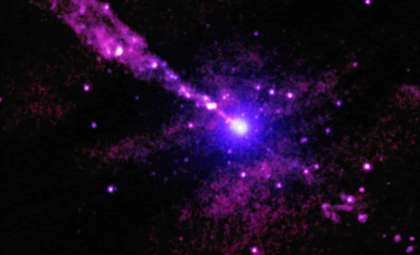
These results, published in Astronomy & Astrophysics, also relate to a significant aspect of M87*: its immense plasma jets stretching thousands of light-years into space. In 2021, EHT observations of light polarization near M87* revealed the presence of strongly magnetized gas.
High-Resolution Black Hole Imaging with a Global Telescope Array
Achieving such detailed black hole views requires linking radio telescopes worldwide. The EHT utilizes very long baseline interferometry (VLBI), connecting observatories across continents including North and South America, Europe, Antarctica, and Asia.
This coordination essentially forms an Earth-sized virtual telescope, capable of resolving features as tiny as a few tens of micro-arcseconds, comparable to spotting a coin on the Moon from Earth.
Key contributors to this research network include the Atacama Large Millimeter Array (ALMA) in Chile, the South Pole Telescope (SPT) in Antarctica, and the James Clerk Maxwell Telescope (JCMT) in Hawaii.
Data gathered from these facilities are combined and analyzed at research centers like the Max-Planck-Institut für Radioastronomie in Germany and the MIT Haystack Observatory in the USA.
Upcoming Advances in Black Hole Studies
Current work by the EHT scientists focuses on examining data from 2021 and 2022 to improve understanding of black hole accretion phenomena. Future research will emphasize observing changes in the polarization of emitted light over time, offering richer insights into extreme gravity, magnetized plasma environments, and jet dynamics near black holes.
- Categories:
- Astronomy






0 comments
Sign in to Comment