
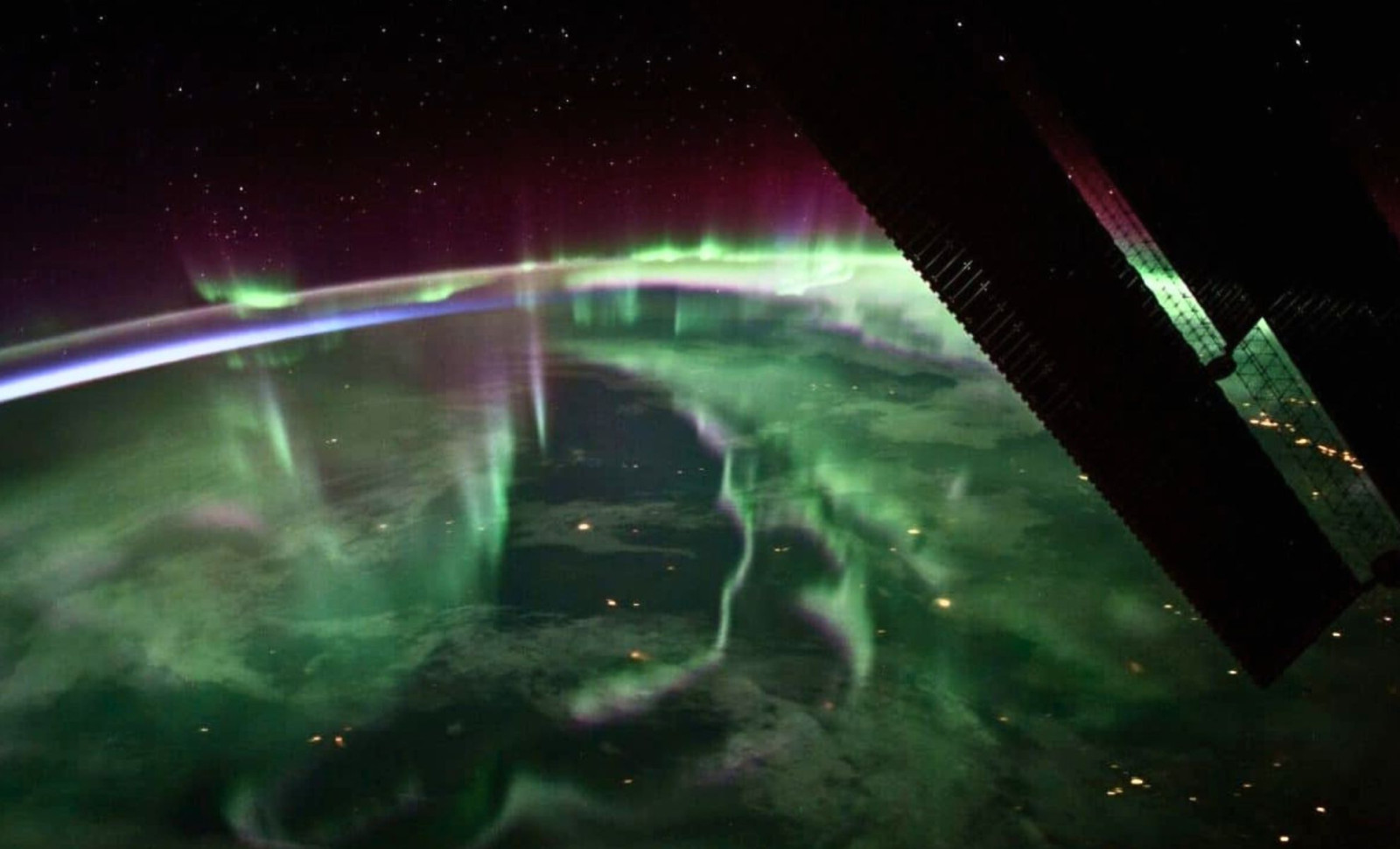
The magnetic north pole of our planet has persisted in its gradual movement towards Siberia, officially crossing into Russian territory as projected for 2025, based on the latest geophysical assessments.
While this gradual displacement remains unnoticed in everyday activities, it introduces significant challenges for high-precision technologies that depend on the alignment between magnetic and geographic coordinates. Sectors such as aviation, maritime navigation, autonomous vehicle operations, and defense systems are especially vulnerable to inaccuracies arising from this magnetic field drift.
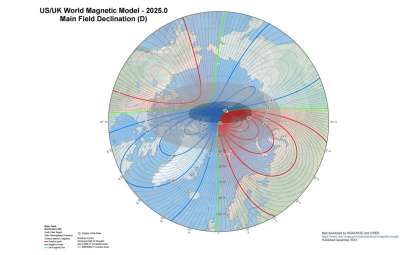
The recently updated World Magnetic Model (WMM2025) along with an enhanced high-resolution version WMMHR2025, created collaboratively by the NOAA National Centers for Environmental Information (NCEI) and the British Geological Survey (BGS), refine the global magnetic field parameters.

These models serve as the gold standard internationally, utilized by NATO countries, the U.S. Department of Defense, and partner organizations to maintain precise directional data for critical navigation and mapping functions.
Unprecedented Movement of the Magnetic Pole
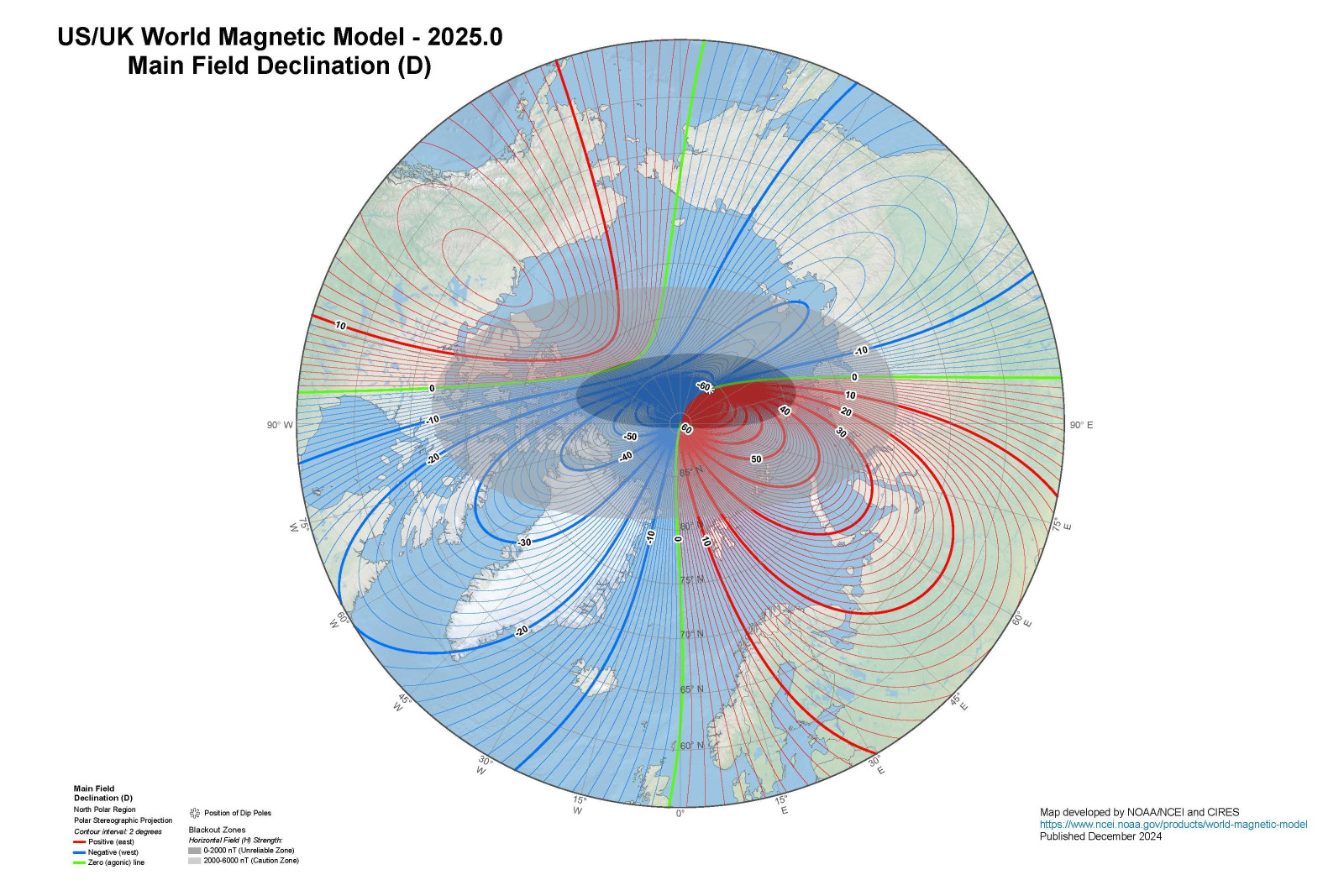
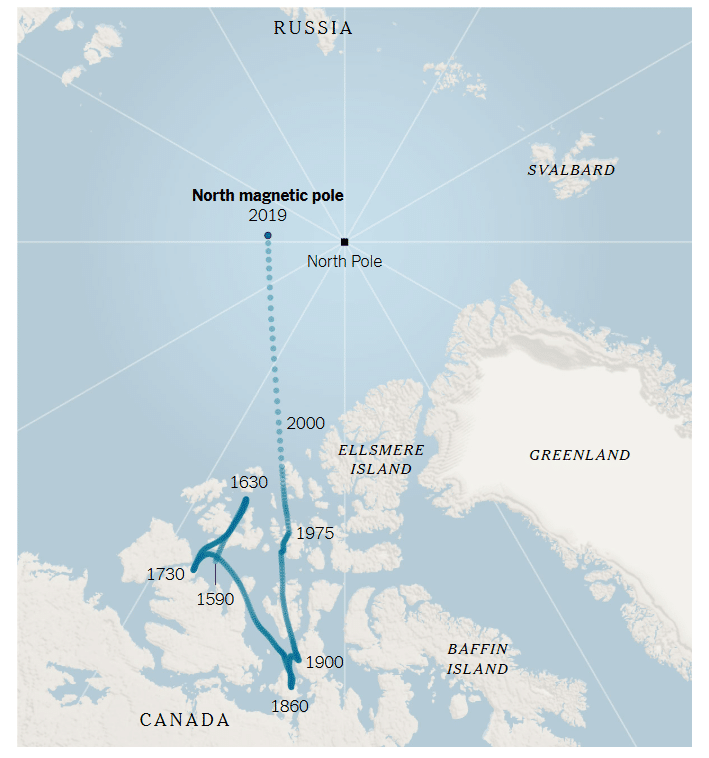
The WMM2025 pinpoints the north magnetic pole at 86.38°N, 164.06°E, marking a position notably nearer to Russia than to Canada. Since the initiation of systematic tracking in the 1830s, the pole has advanced more than 2,200 kilometers, driven mainly by secular variations in the Earth’s core-generated magnetic field.
Between 1990 and 2020, the migration rate of the pole increased sharply, peaking near 60 km per year. Although the 2025 data indicate a slowdown to approximately 35 km per year, this speed remains above long-term averages predating 1990. The pole’s trajectory is shaped by swift alterations in the toroidal and poloidal elements of Earth’s magnetic field, modeled through a spherical harmonic expansion up to degree 12 in WMM2025.
The advanced high-resolution model WMMHR2025 boosts spatial detail from 3300 km down to 300 km at the equator by expanding spherical harmonics to degree 36. This refinement is crucial for satellite navigation and autonomous platforms demanding sub-kilometer precision in magnetic orientation.
Magnetic Blackouts and Navigational Uncertainty
The WMM2025 update also revises the boundaries of geomagnetic blackout zones, areas near the poles where the horizontal magnetic intensity weakens below 2000 nT, impeding compass functionality. These zones affect air routes over polar regions and research missions to the Arctic and Antarctic.
Magnetic declination, the angle difference between true north and magnetic north, remains a dynamic factor that varies considerably at fixed locations, especially at higher latitudes. For instance, parts of Alaska have experienced declination shifts exceeding 10° within the last 20 years, necessitating frequent revisions of aeronautical and marine navigation charts.
To minimize disruptions from such rapid changes, the WMM undergoes an update every five years, coordinated with the U.S. National Geospatial-Intelligence Agency (NGA) and the UK Defence Geographic Centre (DGC). Yet in 2019, an unexpected mid-cycle correction was necessitated due to accelerated pole movement, highlighting the susceptibility of existing models to sudden geomagnetic fluctuations.
Understanding Earth's Deep Core and Magnetic Variations
The driving force behind the pole’s drift lies in the geodynamo mechanism, where convective motions of electrically conductive molten iron in Earth’s outer core, roughly 2,900 kilometers beneath the surface, generate the magnetic field. These flows produce intricate field patterns including the tangent cylinder, flux lobes, and the South Atlantic Anomaly, each contributing to spatial and temporal magnetic variations.
Despite extensive satellite magnetometer data from missions such as Ørsted, CHAMP, and Swarm, understanding the deep mantle processes that influence outer core dynamics remains limited. Consequently, while short-term forecasts spanning 5 to 10 years are highly reliable, projections extending much further remain uncertain.
Importantly, WMM2025 provides no evidence indicating an imminent geomagnetic reversal, an event where Earth’s magnetic poles swap places. These reversals typically occur every 200,000 to 300,000 years, the last full reversal dating back about 780,000 years. In contrast, geomagnetic excursions like the Laschamps event around 41,000 years ago are actively researched for their implications on climate and life.
Legacy Systems Face Growing Demands Amid Magnetic Pole Shift
Currently, WMM2025 supports aerospace and defense sectors by refining inertial navigation, heading sensors, and onboard calibration software. For commercial aviation and maritime industries, regulators mandate updated compass and autopilot calibrations following the newest model guidelines.
Challenges persist in not just model renewal but in ensuring timely implementation and software updates across diverse and aging hardware platforms that depend on magnetic navigation.
Open questions remain about whether the update intervals will be shortened beyond five years, how emerging southern hemisphere magnetic anomalies might affect navigation, and the adaptation of autonomous technologies in approaching geomagnetic blackout regions.
- Categories:
- News








0 comments
Sign in to Comment