
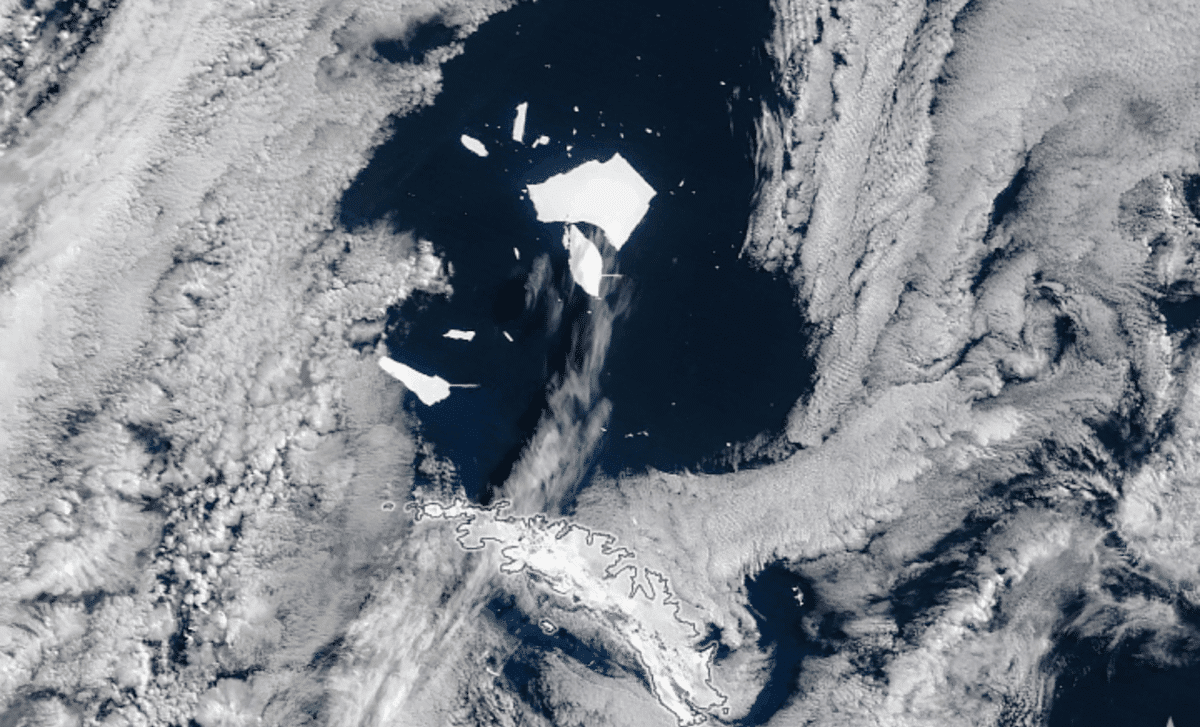
A colossal iceberg, once recognized as the largest worldwide, is steadily breaking apart as it drifts through warming ocean waters. Known as Iceberg A-23A, this massive block detached from Antarctica back in 1986 and has now begun to crumble after years of relative stillness. Scientists globally have been closely observing its fate, including a detailed NASA analysis that chronicles its final voyage.
Tracing Iceberg A-23A’s Path from Antarctica to Fragmentation
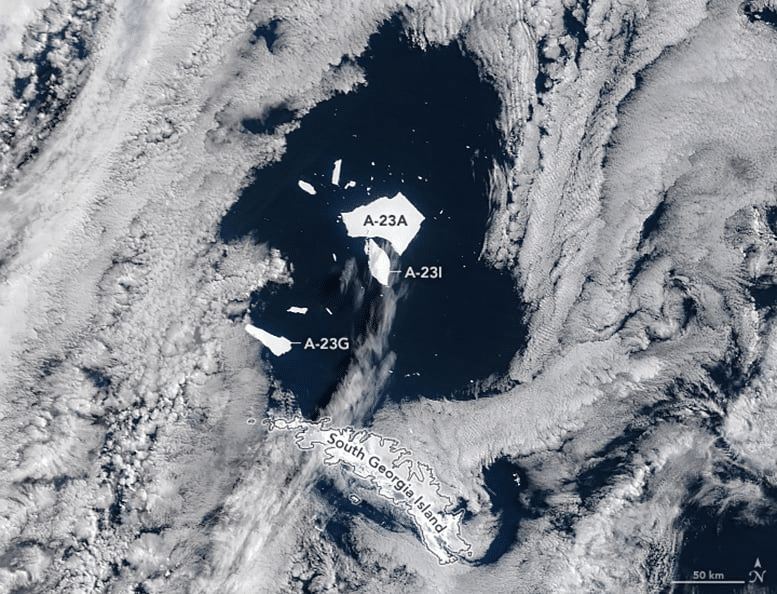
Iceberg A-23A’s story spans nearly 40 years. It originally calved from the expansive Filchner Ice Shelf in Antarctica in 1986. For many years, it rested on the seafloor in the Weddell Sea, staying mostly immobile. But by the early 2020s, it commenced a slow drift toward the north. Along its route, it encountered several obstacles, including becoming caught in swirling ocean currents and becoming lodged near South Georgia Island’s shallow coastal shelf. This movement initiated its slow disintegration, with chunks breaking off, splintering into smallerbergs, and ultimately moving into warmer waters.
In March 2024, Iceberg A-23A’s movement became more unpredictable as it entered a spinning water vortex in the Drake Passage. Eventually, it spun free and floated on seemingly aimless, while climate change continually exerted pressure on its structure.

Satellite Monitoring of A-23A’s Fragmentation
NASA has tracked A-23A’s break-up using its Terra satellite. Through the Moderate Resolution Imaging Spectroradiometer (MODIS) instrument, NASA has captured vivid images as the iceberg slowly deteriorates. By September 2025, the iceberg’s largest remaining segment measured just over 1,500 square kilometers—still vast, yet only about a third of its original scale. The U.S. National Ice Center also keeps tabs on these giants, carefully documenting their dimensions and trajectories.
"Spaceborne sensors give us excellent visibility to observe massive icebergs like A-23A and its fragmented pieces," stated Jan Lieser from the Australian Bureau of Meteorology. Nevertheless, the greatest concerns come from smaller chunks that can drift far and interfere with navigation as well as marine ecosystems.
This continuous breaking apart vividly illustrates the tangible effects of climate change on the Southern Ocean, as warming air and sea temperatures chip away at even the largest ice formations.
The Hazards of Iceberg Fragmentation
Although large segments of Iceberg A-23A are well-monitored, the smaller fragments represent the true threats. NASA’s satellite images reveal both the gradual disintegration of A-23A and the emergence of smaller icebergs. These tiny chunks, sometimes no bigger than a large city block, pose serious risks if carried into busy shipping lanes. Some have already appeared in heavily trafficked maritime zones. These rapidly detaching fragments pose significant challenges for tracking and safety management.
NASA cautions that while large icebergs are relatively straightforward to monitor, the smaller pieces are much harder to detect, especially when they drift far from their origins. The U.S. National Ice Center has warned that the shattering of massive icebergs like A-23A could create unexpected hazards for shipping, which might be overlooked by routine satellite surveillance.
Environmental Consequences of A-23A’s Final Breakup
According to NASA’s Earth Observatory, the eventual fragmentation of A-23A will have significant ecological impacts on the Southern Ocean. As this giant iceberg fractures, it injects a large volume of freshwater into the ocean, potentially affecting local ecosystems and contributing to sea level rise. Yet, these environmental effects go beyond simple changes in ocean height.
The influx of freshwater alters the salinity of nearby waters, which can disturb marine organisms that depend on consistent conditions. Moreover, icebergs often carry trapped marine species within their ice. When the iceberg breaks down, this can shift biological communities, impacting the broader marine environment.
NASA’s ongoing observations of A-23A underscore a larger pattern of accelerating ice melt in Antarctica, highlighting the rapid pace of climate transformation in this critical region.
- Categories:
- News












0 comments
Sign in to Comment