
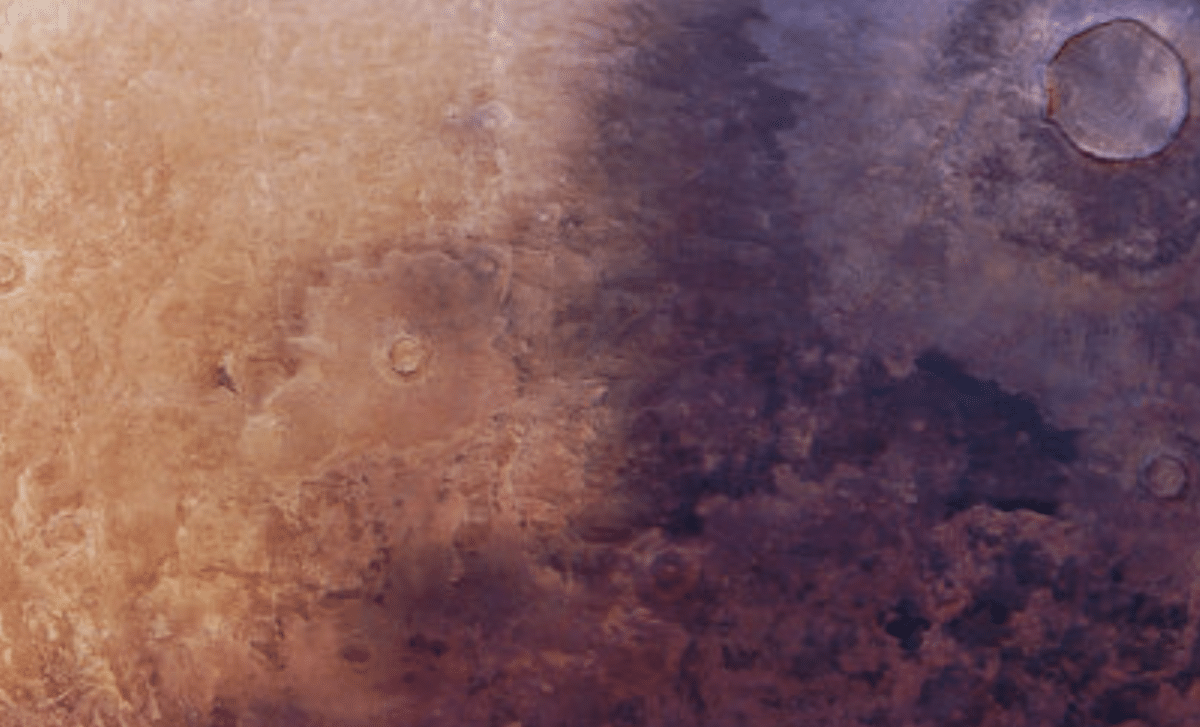
The European Space Agency (ESA) has uncovered compelling new signs of a dark volcanic ash layer progressively extending across Mars. Captured by the Mars Express orbiter’s High Resolution Stereo Camera, this observation reveals ongoing geological dynamics and surface alterations on the Red Planet occurring over a few decades. These findings shed fresh light on Mars’s geological and climatic development, illustrating a vivid portrait of its continuous transformation.
Shifting Landscapes: Dark Volcanic Ash Advancing in Utopia Planitia
Mars typically undergoes slow geological evolution, contrasting with Earth’s rapid landscape changes over mere years. However, recent imagery from ESA’s Mars Express unveils an unexpected phenomenon—the gradual spread of dark volcanic ash across sections of the Martian terrain.
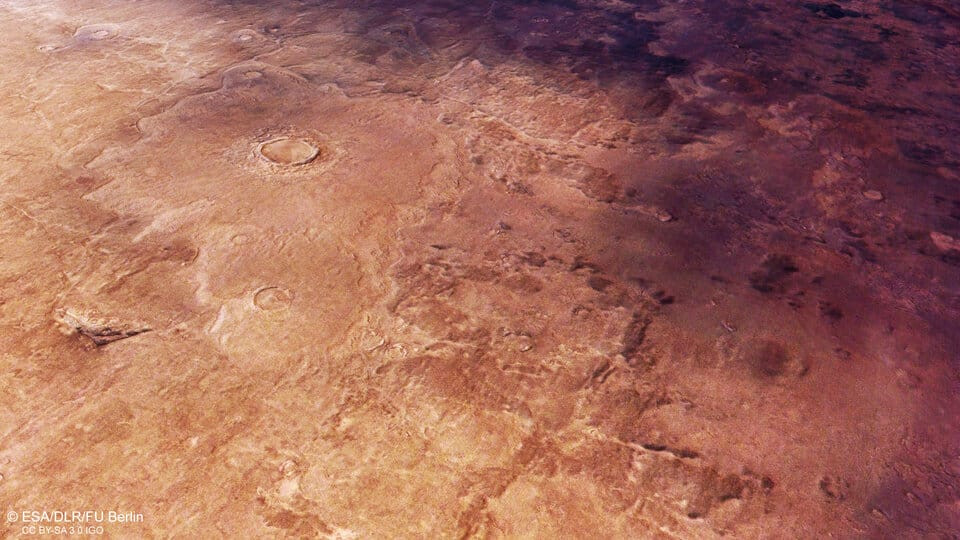
Situated in the Utopia Planitia region, this layer of ash holds clues to Mars’s volcanic legacy. Rich in minerals such as olivine and pyroxene, the ash appears to have either been transported by wind or exposed by aeolian processes, expanding over zones that were significantly lighter in color just a few decades ago. This breakthrough enhances our grasp of Mars’s changing surface, confirming that the planet remains geologically active despite its slow evolution.

This discovery gains further significance when contrasted with images from NASA’s Viking missions in 1976, which showed a narrower extent of volcanic ash. The comparison underscores notable surface transformations within a relatively brief period, highlighting the surprising dynamism beneath Mars’s seemingly inert landscape.
Volcanic Giants and the Silent Activity Beneath Mars’s Surface
Mars hosts the Solar System’s most colossal volcanoes, including Olympus Mons, which surpasses Earth’s tallest peak, Mauna Kea, by over twice its height. The recent detection of volcanic ash prompts inquiries into Mars’s volcanic past and possible ongoing activity. Although active eruptions are not currently observed, the ash’s existence indicates residual volcanic materials still influence the terrain subtly.
These dark ash deposits feature 'mafic' minerals formed at elevated temperatures during volcanic processes. Their presence reveals crucial information about Mars’s volcanic past, implying volcanic phenomena might not have completely ceased on the planet. This opens up the possibility of intermittent or low-level volcanic activity in Mars’s recent history, distinct from the intense eruptions seen on Earth.
According to ESA’s analysis, winds may have contributed to the ash’s displacement or exposure, emphasizing Mars’s volatile environmental conditions. While wind-driven dust movement is well-known on Mars, this expanding volcanic ash deposit serves as concrete evidence of the planet’s evolving surface and atmospheric interplay.
Utopia Planitia: An Icy Basin with Geological Secrets
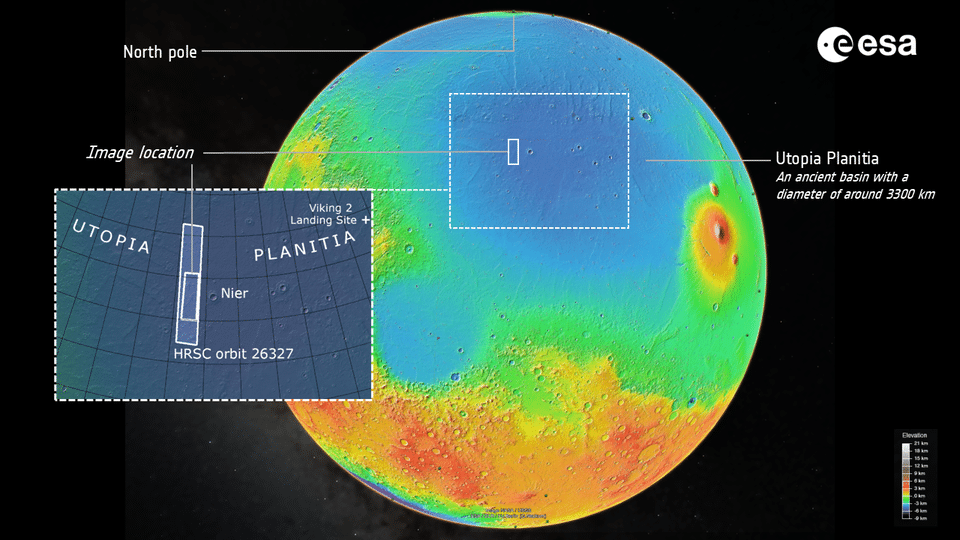
The volcanic ash accumulation’s location is especially noteworthy. Utopia Planitia, an immense, ancient impact basin roughly 3,300 kilometers across, is where Mars Express recorded these intriguing changes. Once suspected to contain a significant body of water, such as a lake or ocean, this basin today is covered in rock and sand, with subsurface ice deposits still preserved beneath.
The ash presence further supports theories regarding water’s influence on the region’s geological features. Prominent "scalloped depressions," typical of periglacial landscapes involving subsurface ice melting or sublimation, suggest that Utopia Planitia experienced periodic freeze-thaw cycles. These findings align with the hypothesis that Mars once supported a much wetter environment.
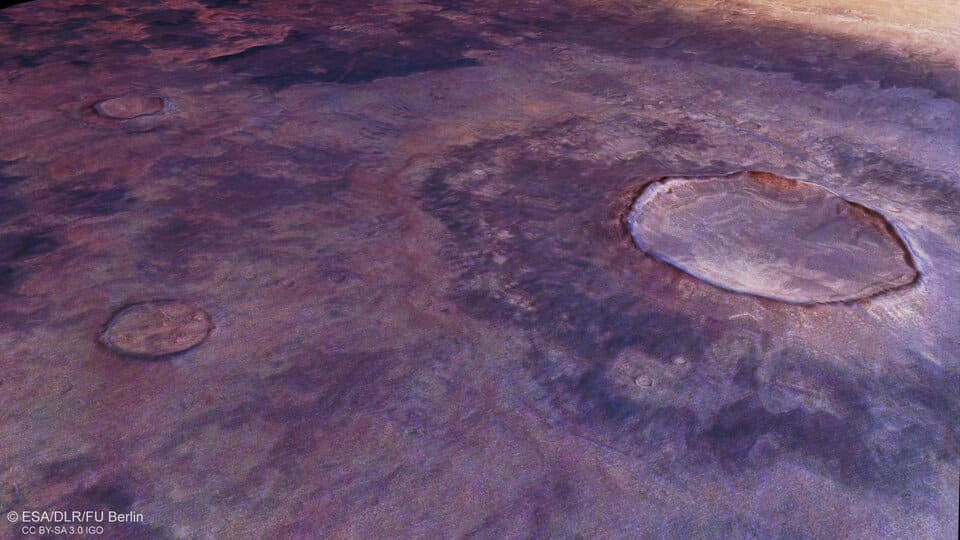
Additionally, researchers discovered an impact crater about 15 kilometers wide embedded within the dark ash. This crater, with its distinct ejecta blanket spread outward from the impact, provides valuable insight into Mars’s violent past shaped by both asteroid impacts and volcanic processes over billions of years.
Two Decades of Mars Exploration with Mars Express
Since its 2003 launch, ESA’s Mars Express spacecraft has played a pivotal role in advancing Martian research, delivering high-resolution imaging and data that have transformed scientists’ interpretation of the Red Planet. The High Resolution Stereo Camera (HRSC) onboard Mars Express enables detailed three-dimensional surface mapping, uncovering features like dried river valleys, ice reservoirs, and volcanic landscapes.
Mars Express’s extensive observations have broadened our knowledge of the planet’s geological evolution, past climate conditions, and habitability potential. The mission continues to provide crucial evidence of how Mars’s environment has changed over time, including insights into volcanic phenomena and historic water presence. ESA’s orbiter remains essential in decoding the mysteries of Mars’s past and present.
This latest ESA research reinforces a view of Mars as a world in flux, with its surface slowly but steadily reshaped. The ongoing spread of volcanic ash underscores that even the quietest planetary neighbors experience persistent change across geological eras.
- Categories:
- Astronomy








0 comments
Sign in to Comment