
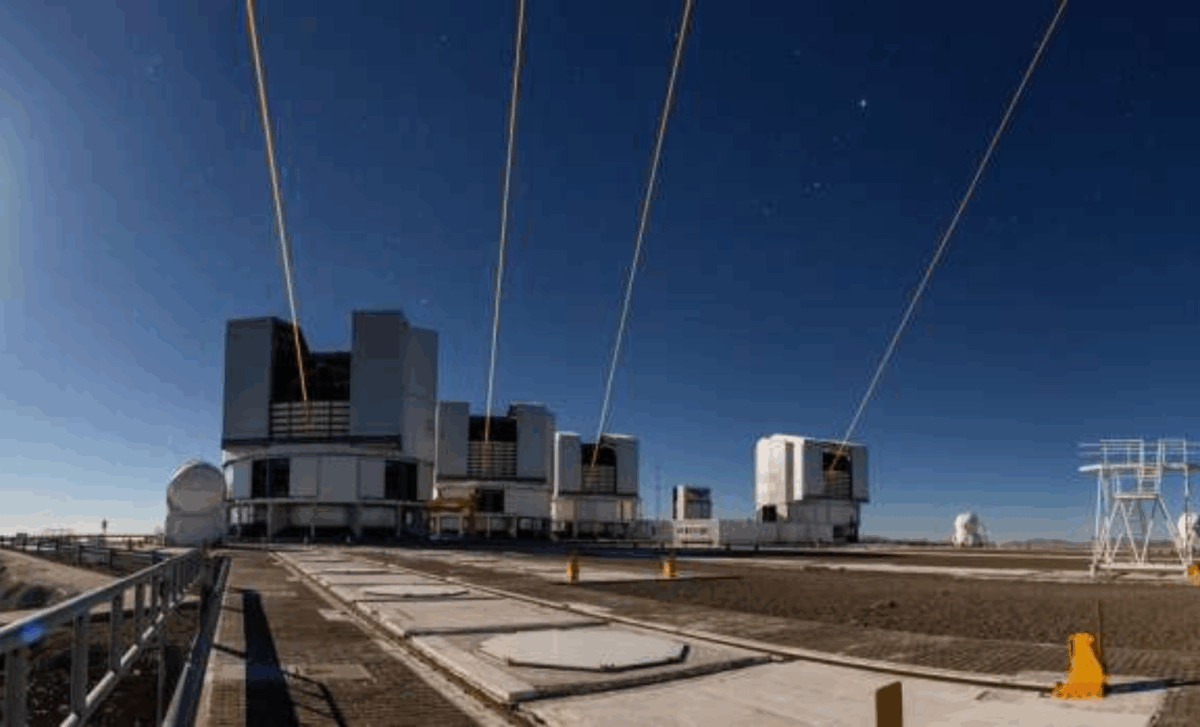
Recent experimental tests involving lasers at the European Southern Observatory (ESO) in Chile represent a pivotal advancement in optical interferometry. By successfully projecting four lasers into the atmosphere, researchers have created artificial reference points that help correct image distortions caused by Earth's turbulent air. This technological breakthrough is set to transform the observation of distant celestial objects. These improvements, part of the GRAVITY+ initiative, will significantly boost the performance of the Very Large Telescope Interferometer (VLTI) and unlock fresh opportunities for astrophysical investigations.
Advancing Optical Interferometry to New Heights
As a cornerstone project, GRAVITY+ introduces a major innovation in combining light from multiple telescopes, enhancing resolution to unprecedented levels. The recent tests conducted at ESO’s Paranal Observatory have brought this advanced approach closer to revolutionizing astronomical research. Lasers are now deployed at each of the VLTI’s eight-meter telescopes, crafting artificial stars above the atmosphere. These guide stars serve as calibration tools to correct atmospheric interference during observations.
Dr. Rebeca Garcia Lopez, a leading researcher in star and planet formation, emphasized the transformative impact of this progress, stating,

“This opens a new era in optical interferometry and it will allow us to understand how solar systems similar to our own form with unprecedented detail.”
Integrating these laser guide stars with the VLTI expands our ability to explore how stars, planets, and galaxies develop, especially those located at vast cosmic distances.
Enhancing the VLTI’s Observational Strength
Renowned for capturing faint and remote cosmic objects, the VLTI has been instrumental in astronomy. The new laser additions from ESO have dramatically bolstered its capacity to mitigate atmospheric distortion, which has conventionally limited observations to specific sky regions. These artificial stars, positioned approximately 90 kilometers above Earth, enable the VLTI to scan the full southern sky, greatly widening its reach.
The GRAVITY+ upgrades also introduce advanced adaptive optics, alongside superior sensors and mirrors. These enhancements elevate the VLTI’s status as the world’s most advanced optical interferometer. According to ESO, the technology opens doors to observe celestial bodies that were previously inaccessible, including active galactic nuclei, star nurseries, and nascent stars. Such progress promises discoveries that were once deemed unattainable.
Exploring the Universe’s Earliest Epochs
With the GRAVITY+ advancement, scientists possess a powerful instrument to delve deeper into cosmic history, revealing insights into the universe’s infancy. Now capable of studying objects just hundreds of millions of years after the Big Bang, the VLTI offers a window into how the first stars and galaxies emerged. This leap facilitates exploration into epochs of cosmic evolution that have remained largely out of reach.
Dr. Taro Shimizu of the Max-Planck Institute for Extraterrestrial Physics (MPE) articulated the significance:
“This opens up the instrument to observations of objects in the early distant universe, less than a few hundred million years after the Big Bang.”
Such capabilities are crucial for decoding the origins of galaxies and solar systems, shedding light on the universe’s formative moments.
Revealing New Wonders: Insights from the Tarantula Nebula
Initial examinations using the new lasers in November focused on the Tarantula Nebula, a vibrant star-forming area within the Large Magellanic Cloud. Previously studied via conventional techniques, the GRAVITY+ upgrade unveiled an unexpected discovery: a bright source, once considered a single massive star, was identified as a binary star system. This finding highlights the transformative detail made accessible by the enhanced VLTI.
The ability to scrutinize intricate star systems represents a monumental breakthrough. According to Professor Frank Einsenhauer, Principal Investigator of the MPE-led consortium,
“The VLTI with GRAVITY has already enabled so many unpredicted discoveries. We are excited to see how GRAVITY+ will push the boundaries even further.”
This progress is expected not only to uncover concealed cosmic structures but also to address fundamental questions about star and planet formation.
Future Prospects for VLTI and GRAVITY+
Looking forward, the VLTI’s potential continues to grow as new upgrades are planned, including enhancements to its spectrograph and observational strategies. These laser trials mark the initial milestone, leading to more comprehensive and detailed cosmic investigations.
The fusion of innovative technology with VLTI will facilitate breakthroughs in understanding black hole behavior, planetary genesis, and stellar evolution. As GRAVITY+ capabilities expand, it holds the promise of providing answers to some of astrophysics’ most profound mysteries.
- Categories:
- Space










0 comments
Sign in to Comment