
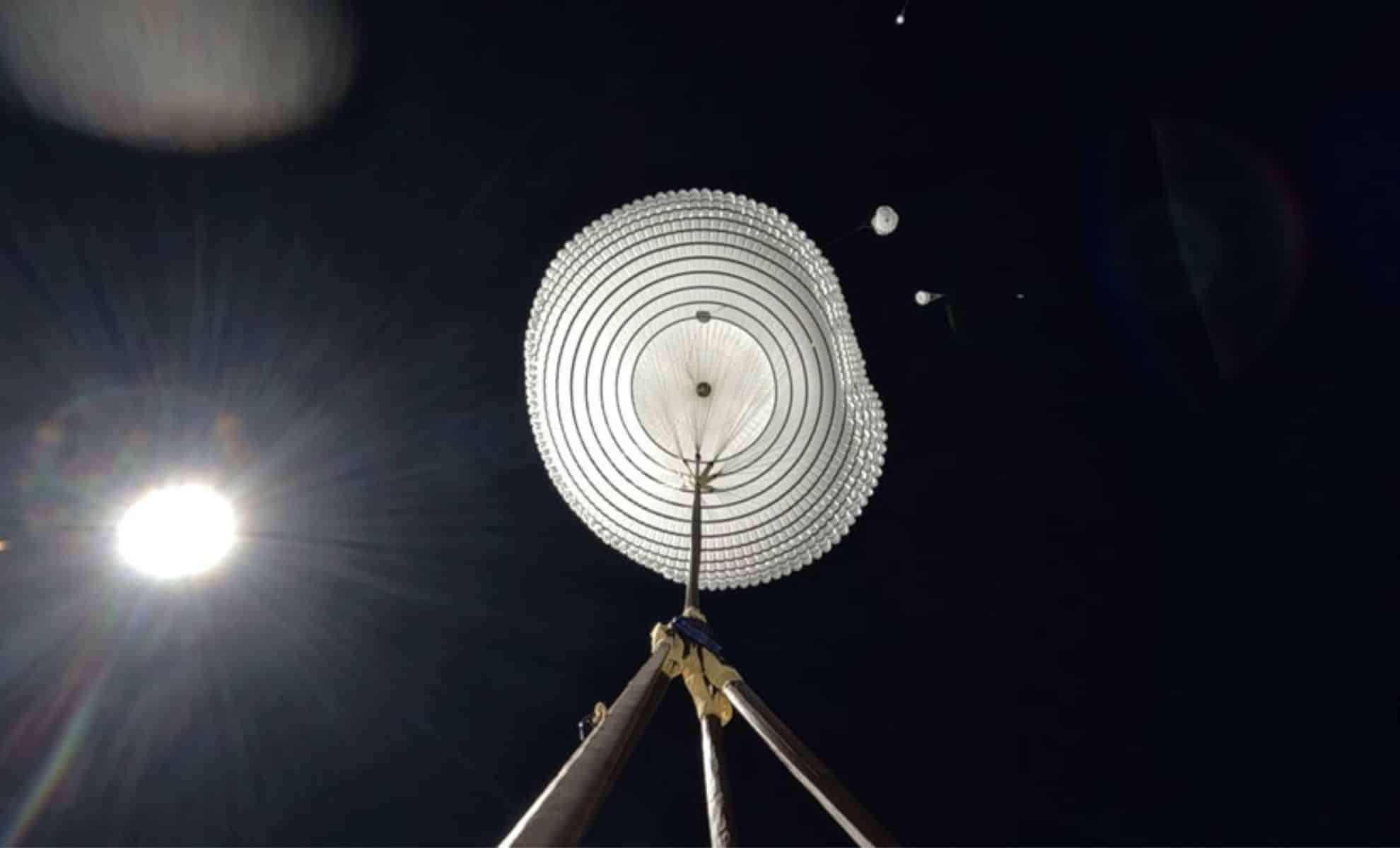
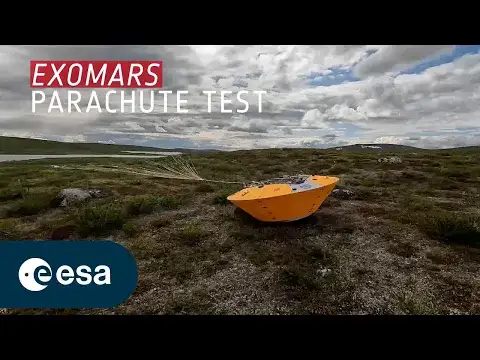
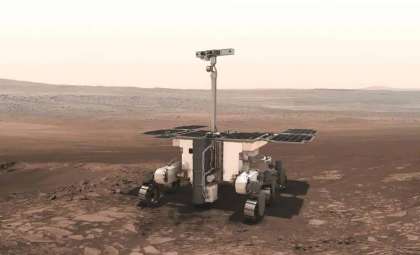
The European Space Agency (ESA) has achieved a crucial breakthrough in its ExoMars mission. The parachute mechanism, vital for securing a safe touchdown of the Rosalind Franklin rover on the Martian surface, has successfully cleared an essential validation. As detailed in ESA's latest statement, the advanced parachute assembly—one of the most sophisticated ever developed—was deployed during a high-altitude trial conducted in Sweden. These parachutes are engineered to handle the distinct conditions of Mars’ atmosphere, playing a critical role in decelerating the rover during its rapid descent through the planet’s thin air. Performed at the Esrange Space Center in Kiruna, this test marks a milestone in mission readiness, confirming the parachute system’s capability to operate reliably in the Martian environment.
High-Altitude Validation Mimics Martian Descent
To emulate the sparse atmosphere of Mars, which has roughly 1% of Earth’s air density, the parachute system was subjected to a rigorous test via a stratospheric helium balloon that lifted an ExoMars descent module mock-up close to 30 kilometers above Earth. This altitude is about three times higher than typical commercial flight elevations. The capsule was then released, free-falling for approximately 20 seconds and accelerating close to Mach 1 before the parachutes deployed in sequence. This critical drop demonstrated the system’s ability to slow the spacecraft to a safe landing velocity under supersonic conditions similar to those expected on Mars.
“We are delighted to validate a parachute design capable of Mars operations – featuring the largest parachute ever flown beyond Earth,” says Luca Ferracina, ESA's ExoMars Entry Descent and Landing Module system engineer. This successful trial provides confidence that the entire parachute assembly will perform flawlessly during the actual Mars landing.

Innovative Two-Stage Parachute Approach
A key feature of the ExoMars landing process is its dual-parachute system, combining different sizes for optimal deceleration. The initial parachute, 15 meters in diameter, manages the supersonic slowdown of the payload and draws on heritage from pioneering missions like Viking and Cassini-Huygens. Following this, a larger 35-meter parachute—recorded as the biggest deployed beyond Earth—engages for the final phase of descent.
John Underwood, principal engineer at Vorticity, the UK firm leading parachute design and testing, elaborates: “The dual parachute concept lets us first use a robust medium-sized parachute to slow the probe through supersonic speeds, then deploy a larger, lightweight parachute to safely complete descent.” This strategy ensures the Rosalind Franklin rover will touch down gently, ready to investigate Mars’ geological and biological history.
Navigating Mars’ Thin Atmosphere
The Martian atmosphere’s low density poses a significant challenge for landing systems, making precise deployment timing critical. Any parachute malfunction could lead to mission failure. Conducting Earth-based tests that simulate the velocity and thin air of Mars offers invaluable assurance that the system will operate flawlessly during entry and descent.
Ferracina explains, “Our test conditions matched Mars’ unique combination of speed and atmospheric density. These trials allow us to verify each component’s functionality before launch.” This thorough preparation mitigates risks inherent in the complex and delicate process of landing on Mars.
Storage Durability and Final Preparations
Ensuring the parachutes remained fully functional after extended storage was another hurdle for ESA. Delays in the mission due to geopolitical issues meant the parachutes spent considerable time in preservation before testing.
“This series of tests confirms our Mars readiness and demonstrates that the parachutes have maintained their performance after long-term storage,” Ferracina notes. Successfully verifying the system’s condition after storage was a vital step towards mission completion.
Comprehensive Data Collection and European Collaboration
Post-test recovery of the parachutes and examination of high-speed imagery provided detailed insights into their deployment dynamics. This approach allows the ESA team to refine the design and troubleshoot any potential issues before the mission. “Testing on Earth enables us to extract extensive data and physically inspect the parachutes post-trial,” says Underwood.
The parachute system is a product of European aerospace expertise, developed collaboratively across nations including the Netherlands, Italy, and Czechia. The Netherlands manufactured essential components like deployment mortars; Italy was responsible for the parachute design, and Czechia produced the parachute containers. Thales Alenia Space in France oversaw the entire test program, guaranteeing the system meets stringent space operation standards.
- Categories:
- News





0 comments
Sign in to Comment