
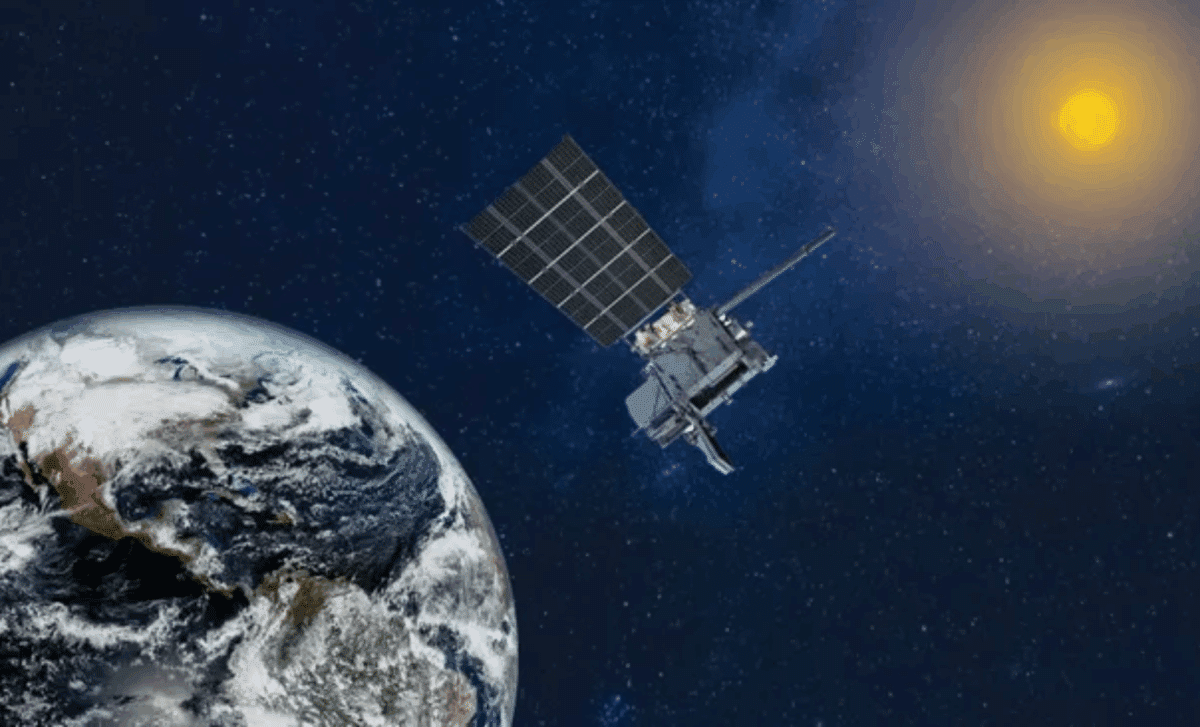
In an extraordinary capture by NOAA’s GOES-19 satellite, Earth unexpectedly appeared framed against the radiant Sun, creating a rare and captivating visual. Designed to observe both terrestrial weather and space conditions, the satellite was initially focused on the Sun’s outer atmosphere. Yet, during this observation, Earth subtly moved into the frame, casting a dark outline against the Sun’s luminous corona. This uncommon occurrence not only aids in instrument calibration but also offers a novel angle on solar studies.
Earth’s Surprise Appearance in Solar Imagery
While taking a standard solar image, NOAA’s GOES-19 satellite unexpectedly caught Earth crossing its field of view. Launched in 2024, the satellite monitors space weather alongside Earth’s atmospheric conditions. In this instance, Earth’s silhouette appeared along the edge of the coronagraph’s perspective, contrasting dramatically with the Sun’s glowing outer layer.
The Sun’s corona, extending millions of miles outward, is generally invisible to the unaided eye and only visible during a total solar eclipse or via special instruments such as the coronagraph installed on GOES-19. The CCOR-1 instrument is tailored to examine these solar outer layers and observe phenomena like solar flares and coronal mass ejections (CMEs), which can disrupt communications and power systems on Earth.

Enhancing Solar Observation Through Earth’s Unexpected Presence
Though unintentional, Earth’s intrusion into the frame serves a valuable scientific role. The unexpected appearance provides NOAA’s Space Weather Prediction Center with crucial data to fine-tune the satellite’s instruments. By observing how the coronagraph manages the bright reflection from Earth, researchers can verify and adjust the device’s accuracy when confronted with intense light sources.
This event also sheds light on how the satellite handles contrast between the Sun’s faint corona and much brighter objects like Earth. Such tests are vital for ensuring that the instrument can differentiate and process varying light intensities, guaranteeing reliable solar observation and data collection.
NOAA’s GOES-19 and Its Crucial Role in Space Weather Surveillance
NOAA’s continuous monitoring of space weather is fundamental to comprehending the Sun’s influence on Earth. GOES-19, among the latest in the Geostationary Operational Environmental Satellite fleet, offers advanced instrumentation including the CCOR-1 coronagraph for detailed solar analysis.
Solar events, like CMEs, pose significant risks to technology-dependent systems including GPS navigation, satellite communications, and power infrastructure. Real-time monitoring of the Sun’s corona by GOES-19 allows NOAA to anticipate and mitigate such impacts, ensuring the resilience of modern technological networks.
Improved forecasting of solar activity empowers governments, industries, and organizations to prepare for potential disruptions. Satellites like GOES-19 and NOAA’s dedicated Space Weather Prediction Center play a pivotal role in safeguarding the technological backbone of contemporary society.
- Categories:
- News






0 comments
Sign in to Comment