

New astronomical findings suggest that our planet Earth may be located within one of the largest galactic formations observed in the visible universe. Researchers have unveiled a gigantic circular assemblage of galaxies that extends billions of light-years, challenging long-standing ideas about the universe’s uniformity. This breakthrough, published in a recent Nature Astronomy article, reveals ultra-large cosmic structures that prompt important questions about how matter is dispersed throughout space. The study sheds light on the vast framework of the cosmos, influencing our comprehension of galaxy formation, cosmic processes, and fundamental cosmological principles.
Unveiling the Enormous Galactic Ring
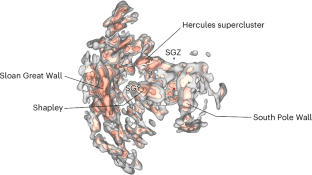
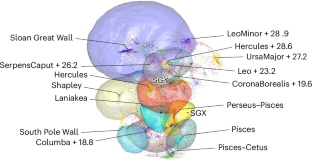
Scientists have identified a massive ring-shaped structure comprised of densely packed galaxies, stretching across an extraordinary cosmic scale. Leveraging comprehensive galactic surveys paired with advanced mapping methodologies, the team spotted this ring as a cluster of concentrated galaxy groups defying previous expectations. Its immense size puts the cosmological principle—which posits uniform matter distribution at the largest scales—into question. The galaxy ring’s span measures billions of light-years, marking it as one of the most extensive coherent structures ever recorded. This finding highlights the necessity for updated theories that can incorporate such vast formations while preserving the core ideas of cosmic uniformity.
What This Means for Cosmology
The presence of these gargantuan structures presents major challenges for established cosmological models. “From current cosmological theories we did not think structures on this scale were possible. We could expect maybe one exceedingly large structure in all our observable Universe. Neither of these two ultra-large structures is easy to explain in our current understanding of the Universe,” said Lopez. Beyond cataloging galaxies, these vast formations could affect how we measure dark energy, the Hubble constant, and the overall cosmic geometry. Experts warn these results might compel revisions in simulations of galaxy clustering and cosmic evolution mechanisms.

Discovery Methods and Technology
Researchers identified the gigantic ring by synthesizing data from diverse galaxy observations, including spectral and redshift analyses, which enable precise distance and density mapping. Utilization of advanced statistical tools helped differentiate authentic large-scale cosmic structures from random noise. Employing three-dimensional cosmic mapping, scientists revealed a nearly continuous ring structure previously hidden due to its vastness and subtle density shifts. This approach showcases how cutting-edge observational technology is key to uncovering structures once beyond detection, emphasizing significant progress in our cosmic exploration tools.
Context Among Other Vast Cosmic Formations
Although this galactic ring’s discovery is groundbreaking, it aligns with the existence of other enormous structures like the Hercules-Corona Borealis Great Wall. These findings add layers of complexity to existing cosmological models, many of which do not predict such enormous formations. Relative comparisons suggest that the newly discovered ring rivals or surpasses earlier known structures in terms of scale and intricacy. These revelations also point to possible directional irregularities in the universe’s matter distribution, underscoring the importance of further deep cosmic studies on matter’s large-scale behavior and evolution.
Transforming Our Cosmic Outlook
Finding this sprawling galactic ring calls for a dramatic change in our cosmic worldview. Rather than a tiny point in a smooth universe, Earth is embedded within a remarkable cosmic web, directly connecting us to vast high-density regions. As Lopez remarks, these structures’ explanation demands fresh theories about cosmic growth and matter arrangement, potentially reshaping core physics and astronomy assumptions. Progressing research on these immense systems promises to uncover the fundamental principles shaping the cosmos and trace new chapters in cosmic evolution’s narrative.
- Categories:
- News







0 comments
Sign in to Comment