

Builder.ai made waves when it debuted in 2016, pledging to transform app creation through cutting-edge artificial intelligence. Backed by prominent investors including Microsoft, it positioned itself as a revolutionary AI platform capable of rapidly delivering software with minimal human input. Its key offering, Natasha, was touted as a neural network that could autonomously design, develop, and launch applications at unprecedented speeds.
For nearly eight years, Builder.ai maintained this narrative, securing upwards of $450 million in investments and achieving a $1.5 billion valuation. It captured the industry’s imagination as a prime example of AI’s promise to automate creative and technical roles traditionally performed by developers. Businesses flocked to the platform anticipating enhanced efficiency and accelerated timelines.
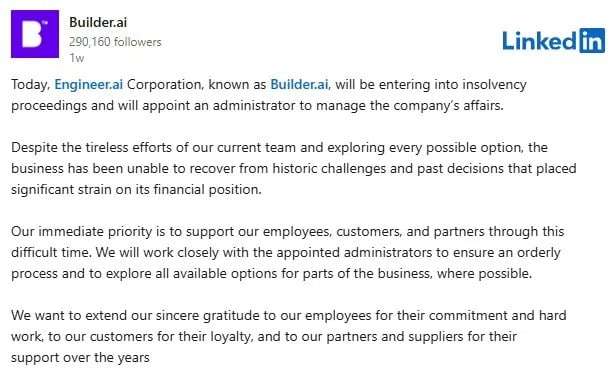
However, in May 2025, the façade crumbled. Builder.ai quietly disclosed it was entering insolvency, attributing the downfall to longstanding difficulties and past strategic errors. While acknowledging its staff and customers in a LinkedIn message, the company failed to reveal a critical truth until later: the AI engine driving its offering wasn’t software at all, but rather a vast team of more than 700 engineers—mostly based in India—manually executing the work behind the scenes.

The People Powering the Illusion of AI
Insider accounts and leaked documents suggest that the platform’s purported neural network was, in fact, a carefully organized workflow system. Rather than relying on sophisticated algorithms, Natasha’s operations involved routing client requests to a dispersed workforce who coded every app feature by hand.
Anonymous former contractors disclosed to media outlets that routine tasks—such as building user interfaces, backend systems, and payment integration—were completed manually, with AI tools only marginally involved for administrative or prototyping functions. As one contractor described it, the process was more akin to “Mechanical Turk” than genuine machine learning.
Despite this, Builder.ai aggressively marketed itself as AI-led, peppering promotional content with terms like “automation” and “machine learning” while glossing over the actual human involvement. Industry observers have labeled this deceptive practice as “AI-washing,” where companies inflate their AI credentials to allure funding and enhance reputations.
Risky Investment Trends Amid AI Frenzy
The Builder.ai failure underscores a larger issue in the tech sector: the overwhelming influx of capital into AI startups with insufficient technical evaluation. Data from 2023 shows that AI-focused ventures globally raised over $50 billion, driven by investor eagerness to find the next breakthrough like OpenAI or Anthropic, often without rigorous due diligence.
“There’s a speculative rush fueling much of the AI space,” noted Dr. Meredith Whittaker, president of the Signal Foundation and former Google AI researcher. “Many investments stem from captivating demos and vague promises rather than solid scientific progress. Genuine AI development remains complex, unpredictable, and time-consuming.”

The company’s downfall also highlights the disconnect between marketing claims and the current capabilities of AI. While generative models like GPT-4 or Claude receive massive attention, truly autonomous software engineering is still far from replacing human expertise. A 2024 study from MIT concluded that code generation models require stringent human supervision and frequently produce errors in complex systems.
Brand Confusion and Industry Fallout
Builder.ai’s collapse also generated unwanted confusion for Builder.io, a similarly named company providing AI-enabled visual development tools. Its leadership publicly distanced themselves after being mistakenly dragged into the controversy following social media backlash.
This episode illustrates the problem of “credibility by association” pervasive in the AI startup landscape, where overlapping names and blurred branding can mislead consumers and investors alike, exacerbated by limited regulatory oversight.
Demanding Greater Openness in AI Ventures
Following these revelations, industry leaders and policymakers are pushing for stricter transparency standards within AI-driven businesses. The European Union’s AI Act prohibits misleading AI advertising, while the U.S. Federal Trade Commission has warned companies against overstating AI capabilities.
Although Builder.ai has not been formally accused of fraud, this scandal sparks broader debate on the blurry line between genuine innovation and hype in today’s AI ecosystem. Beyond one startup’s failure, it raises critical questions about who is truly delivering the “intelligence” behind AI-branded offerings.
An ongoing investigation into Builder.ai’s internal documents aims to clarify how investors were convinced, how operations were concealed, and how an entire industry became swept up in promises of artificial intelligence without scrutinizing the real workforce driving the technology.
- Categories:
- News













0 comments
Sign in to Comment