
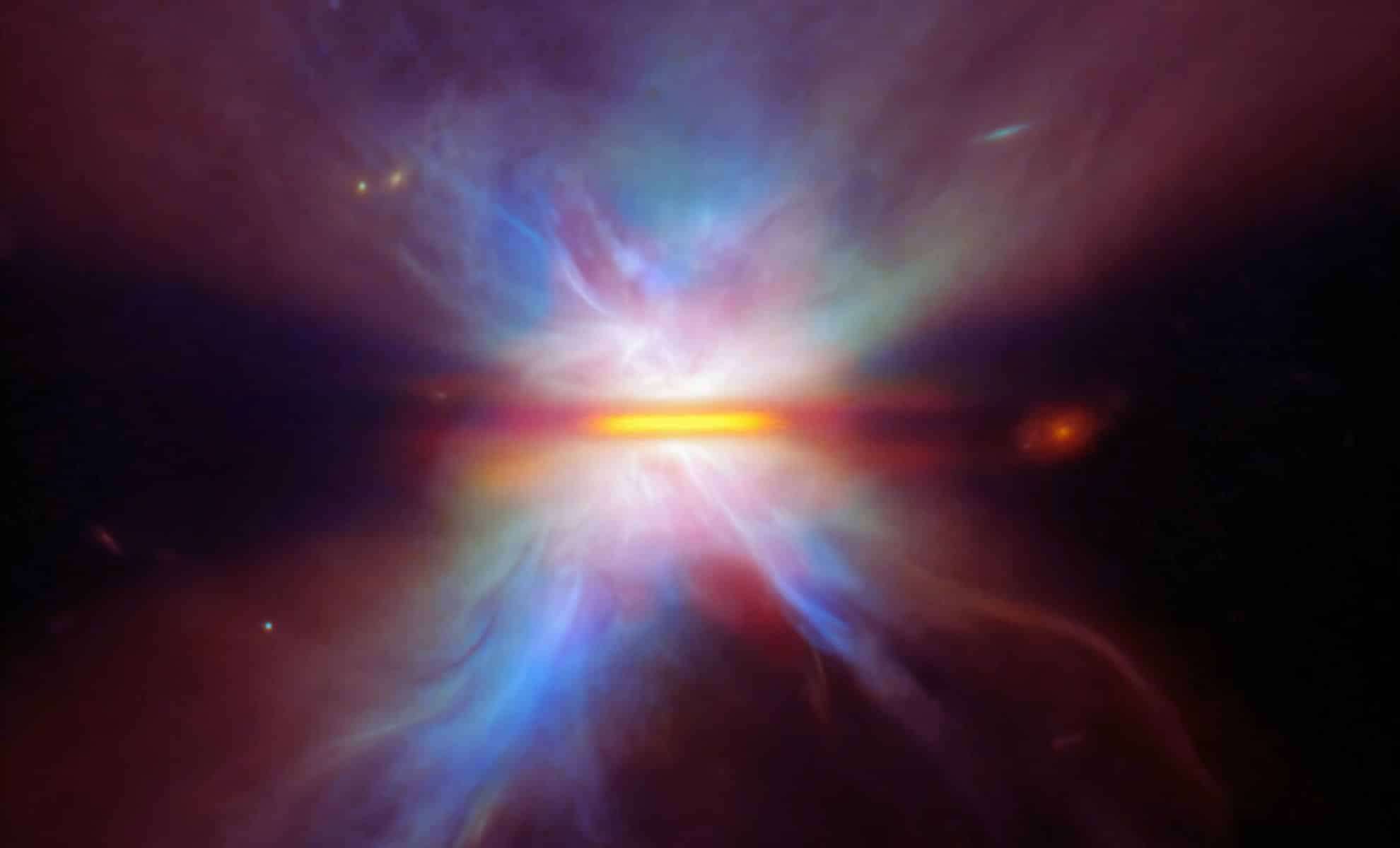
The James Webb Space Telescope has captured remarkable new images showcasing complex dusty patterns that surround a planet in the earliest phases of its development. Released by the European Space Agency (ESA), these observations display delicate dust filaments within the protoplanetary disc of IRAS 04302+2247, a youthful star system situated roughly 450 light-years from our planet. This breakthrough enables astronomers to investigate how nascent planets interact with their birth environments and influence the architecture of their planetary systems over time.
Revealing the Intricacies of Planet-Forming Discs
Protoplanetary discs, made up of gas and dust orbiting young stars, are the sites where planets come to life. Until recently, capturing detailed images of these discs was difficult, limiting our understanding of early planet formation processes. The Webb’s Near-Infrared Camera (NIRCam) has now exposed string-like and curved dust structures extending over dozens of astronomical units, pinpointing areas shaped by the gravity of an emerging planet. These dust patterns are dynamic, possibly tracing spiral waves generated by the planet embedded within. This detailed imagery allows scientists to refine models on how planets create gaps and stir density waves, crucial for comprehending the configuration of planetary systems.
Decoding Dust Characteristics Through Multiple Wavelengths
By observing across a broad range of infrared wavelengths, Webb enables researchers to study the makeup and size distribution of dust grains. Early results indicate the dust is composed of silicates and ice mixtures with varied particle sizes reflecting ongoing coalescence. Fine dust efficiently scatters infrared light, producing the filamentary structures seen, while larger particles tend to settle toward the disc’s central plane, potentially forming kilometer-sized planetesimals. Combining these infrared findings with ESA’s detailed imaging permits scientists to construct three-dimensional representations of disc anatomy, deepening insights into how planets accrue material and modify their surroundings during their formation.

Consequences for Understanding Planet Formation
The discovery of swirling dust filaments and spiral features offers key clues about young planets’ gravitational effects early on. These interactions may explain diverse exoplanet system layouts, from widely spaced to tightly clustered worlds. Moreover, the dust’s movement within the disc hints at how material flows toward growing planets, influencing their chemical makeup. Findings from Webb and ESA imagery advance astronomers’ ability to predict which discs are more likely to yield rocky Earth-like planets versus gas giants, refining concepts about planetary habitability in the cosmos.
James Webb’s Continued Leadership in Exoplanet Exploration
The James Webb Space Telescope is revolutionizing studies of planetary origins. Its sensitivity to faint infrared signals permits the direct observation of emerging planets and their dusty environments, filling in gaps left by previous telescopes. Observing systems like IRAS 04302+2247 offers a unique platform to test theories about planet-disc dynamics, dust growth, and the earliest stages of planetesimal assembly. These insights not only illuminate our solar system’s past but also guide future research into diverse planetary systems that might harbor life-sustaining worlds.
Collaborative Advances in Astronomical Imaging
The partnership between missions such as Webb and ESA demonstrates the value of international collaboration in astronomy. ESA’s high-definition images of IRAS 04302+2247 enrich Webb’s infrared data, enabling comprehensive cross-checking of dust structures and distributions. By merging information from various instruments and wavelengths, astronomers create detailed models of how discs evolve under planetary influence. This cooperative approach accelerates discovery and enhances our understanding of planet formation throughout our galaxy.
- Categories:
- News









0 comments
Sign in to Comment