
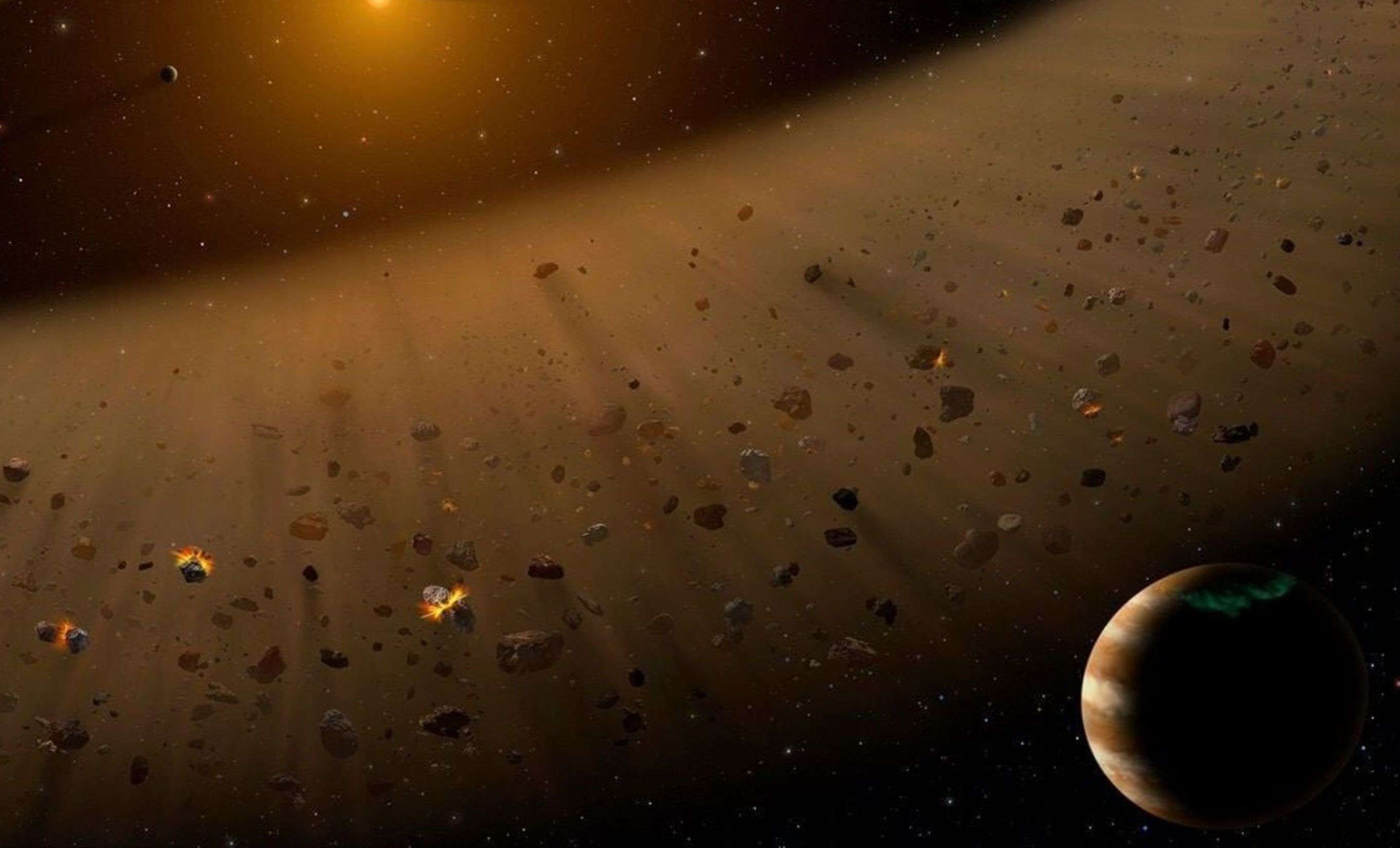
The James Webb Space Telescope (JWST) has recently delivered groundbreaking data on the planetary system orbiting Epsilon Eridani, one of the closest Sun-like stars to our solar system. By harnessing cutting-edge imaging technologies and refined analytical models, researchers have obtained high-definition observations enabling in-depth analysis of planetary atmospheres, orbital mechanisms, and formation processes with exceptional clarity. These discoveries, supplemented by prior theoretical insights available in the arXiv preprint, mark a milestone in exoplanetary science and observational methods.
Exploring the Epsilon Eridani System and Its Importance
Situated around 10.5 light-years away, Epsilon Eridani is notable to astronomers for its youth and resemblance to our Sun. It is known to host at least one proven planet, Epsilon Eridani b, with additional planetary candidates inferred from the structure of circumstellar debris disks and dynamical models. Its closeness and favorable viewing geometry make it a prime subject for direct imaging and atmospheric study, tasks that have traditionally been restricted to only a few exoplanets.
JWST’s Near Infrared Camera (NIRCam) and Mid-Infrared Instrument (MIRI) have empowered the team to detect weak thermal emissions and reflected light from these worlds. By integrating these measurements with advanced data processing, astronomers effectively separate planetary signals from the dominant stellar brightness, overcoming hurdles that limited past ground-based investigations. This approach grants unprecedented precision in assessing planetary dimensions, orbital trajectories, and atmospheric components.

Innovative Methods Fueling New Discoveries
The JWST researchers utilized multiple state-of-the-art methods to optimize information extraction. One crucial strategy is high-contrast imaging, employing complex algorithms to diminish stellar glare and expose the subtle illumination of orbiting planets. Another tool, coronagraphy, physically blocks the star’s light to reveal planets in the infrared, where their heat signature stands out more clearly.
Furthermore, the team conducted multi-epoch observations, observing the system at various intervals to track orbital shifts and improve mass calculations. Combined with spectroscopic examination, this method permits detailed assessment of planetary atmospheres, identifying elements such as clouds, methane, and water vapor. Together, imaging and spectroscopy compose a comprehensive view, unveiling both the spatial and chemical characteristics of these planets.
Revealing Planetary Origins and Development
The insights gained from Epsilon Eridani shed light on how planets form and evolve. Its debris disk, made up of dust and icy particles, hints at continuous processes that influence planetary orbits. JWST data have uncovered subtle irregularities in the disk's shape, suggesting gravitational effects from yet-to-be-detected planets, aligning with recent theoretical forecasts cited in arXiv:2508.08463.
Moreover, the atmospheric chemistry observed points to the planets’ developmental pathways. For example, planets nearer the star may exhibit greater metal enrichment, while those further away retain more volatile substances. These chemical markers, now observable thanks to JWST, enable scientists to reconstruct the system's formation chronology and the conditions during planet birth with remarkable detail.
Obstacles and Upcoming Opportunities
Despite these impressive advances, characterizing exoplanetary systems continues to present significant challenges. Detecting smaller or more remote planets, even with JWST, demands prolonged exposures and meticulous noise management. Variations in stellar activity also add complexity to data analysis, requiring repeated measurements and careful comparisons with theoretical frameworks.
Looking forward, collaboration between JWST findings and forthcoming projects like the Nancy Grace Roman Space Telescope will broaden the hunt for exoplanets in our cosmic vicinity. Ongoing enhancements in imaging algorithms and spectroscopic methods promise to uncover finer details, potentially exposing atmospheric dynamics, seasonal cycles, and even surface properties of the nearest exoplanets.
- Categories:
- News








0 comments
Sign in to Comment