
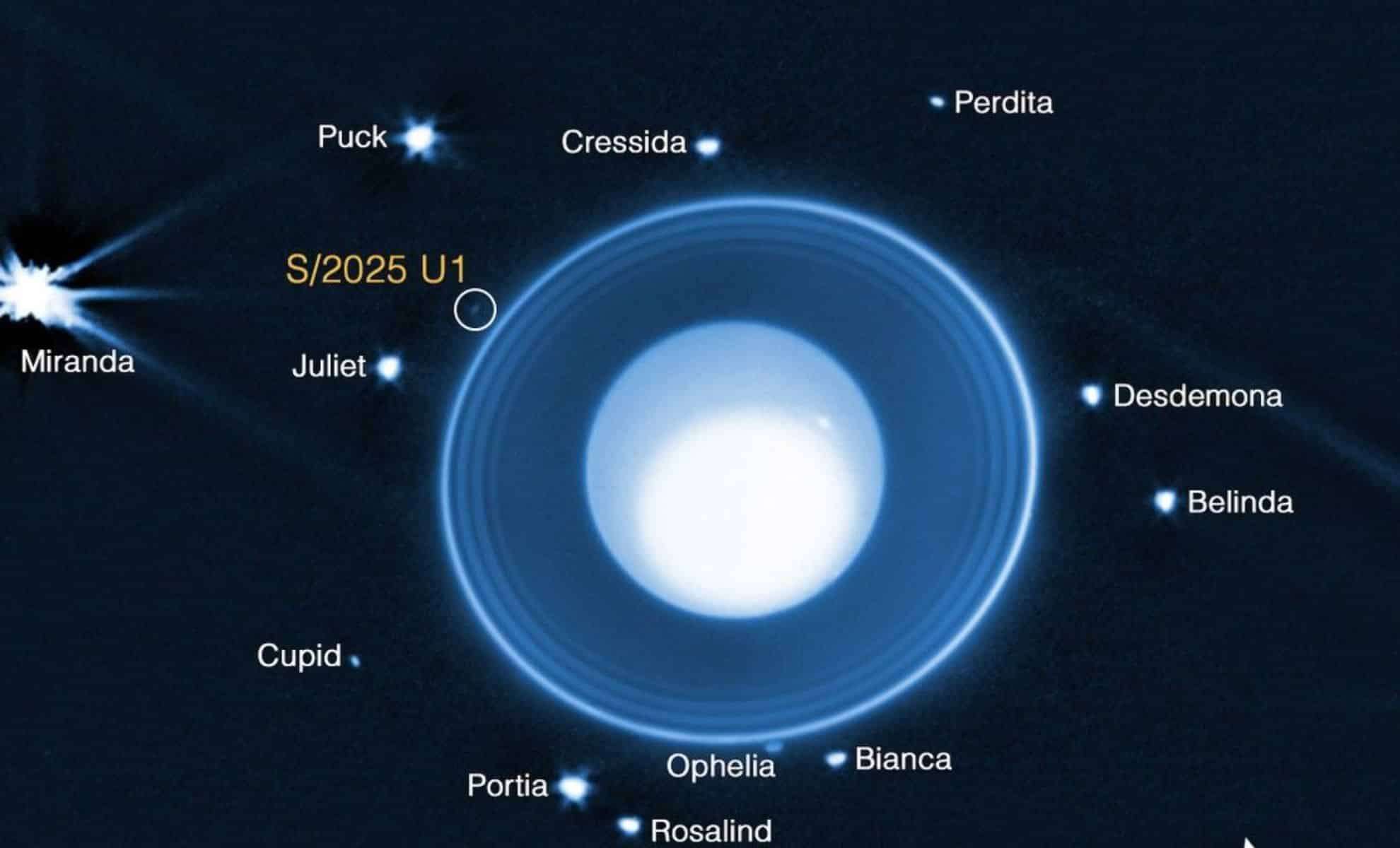
A recent update from NASA has announced that the powerful James Webb Space Telescope (JWST) has identified a new moon orbiting Uranus, enriching our knowledge of the planet’s intricate system of moons and rings. This newly spotted satellite, temporarily dubbed S/2025 U 1, was captured in observations made earlier this year by Webb’s NIRCam instrument. This discovery marks a major advancement in exploring the ice giant’s environment, nearly 40 years on from the legendary Voyager 2 flyby of 1986. It also showcases Webb’s exceptional ability to examine faint, distant objects and hints at further secrets lurking in the solar system’s outer realms.
Small Yet Significant: Identifying S/2025 U 1
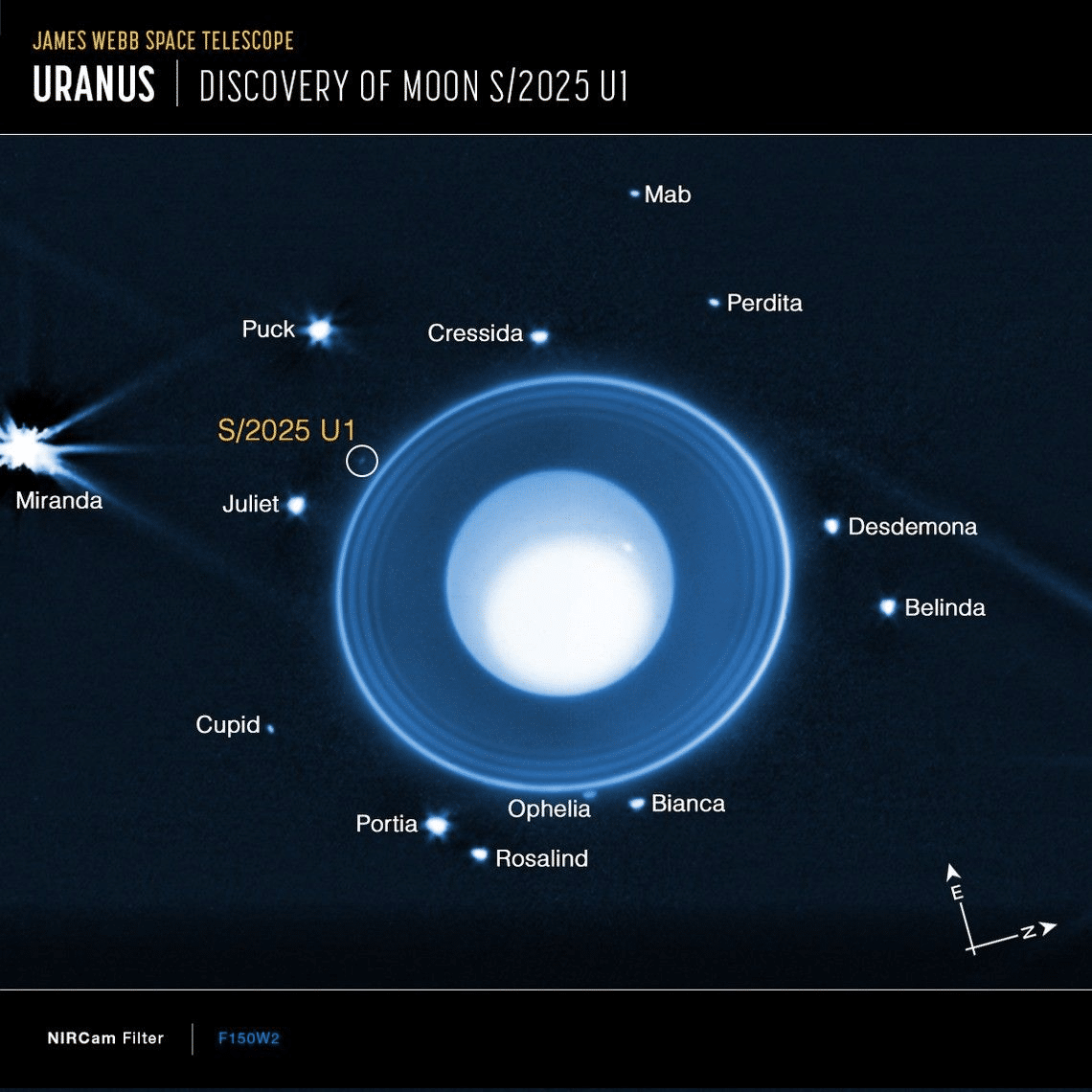
The newly discovered moon S/2025 U 1 is modest in size, measuring just around 8 to 10 kilometers across, far smaller than many other satellites of Uranus. Still, its position, roughly 56,250 kilometers from Uranus’s center, nestled between the orbits of Ophelia and Bianca, makes it particularly interesting. It lies deep within Uranus’s vibrant inner region, where distinctions between moons and rings are increasingly intertwined.
Matthew Tiscareno from the SETI Institute, part of the discovery team, explained, “No other planet has more small inner moons than Uranus, and their interactions with the rings suggest a turbulent past that blurs the line between moons and rings.” This dynamic environment may reflect ancient collisions or gravitational effects, illustrating a system in constant flux. Tiscareno added, “This newly found moon is smaller and much dimmer than previously known inner satellites, implying even more hidden complexity awaits discovery.”

Building on Past Missions: Voyager 2 to James Webb
Understanding this discovery requires recognizing its place in the ongoing exploration of Uranus. The last close-up data came from Voyager 2, which passed Uranus on January 24, 1986, revealing the planet’s unusual sideways tilt, faint rings, and some of its moons. Since then, Uranus has remained largely unvisited, leaving many of its features mysterious. Now, the General Observer program on the James Webb Space Telescope gives astronomers such as Maryame El Moutamid of the Southwest Research Institute the tools to study these distant and dim objects in new detail.
El Moutamid said, “With its advanced instruments, Webb is opening fresh perspectives on the outer solar system. This discovery is part of Webb’s General Observer programs, which empower scientists worldwide to utilize its state-of-the-art capabilities. Thanks to NIRCam’s superior resolution and infrared sensitivity, we can detect objects too faint and distant for previous telescopes,” emphasizing how JWST continues to exceed expectations over even the renowned Hubble Space Telescope for certain observations.
She added, “This find highlights how modern astronomy builds on legacies like Voyager 2, extending the frontier nearly four decades after that mission, with Webb pushing our reach farther than ever.”

The Technology Behind the Breakthrough
How did the team spot such a faint satellite so close to Uranus’s bright rings? The key was the use of Webb’s Near-Infrared Camera (NIRCam), which combined ten 40-minute exposures taken in February 2025 during observation program #6379. These extended exposures were crucial for isolating the light from S/2025 U 1, which would otherwise be lost in the glare from Uranus and its rings. The resulting image combines three separate filters, allowing scientists to differentiate atmospheric features, rings, and satellites in a single view.
This technical feat reflects a shift in planetary exploration strategies. Detecting minute, dim moons amidst bright, crowded orbital regions demands instruments with both exceptional resolution and infrared sensitivity — capabilities where Webb excels. This innovation not only sets a new standard for studying Uranus but also enhances the prospects of finding similar faint moons around Neptune and other outer planets.
- Categories:
- News




0 comments
Sign in to Comment