
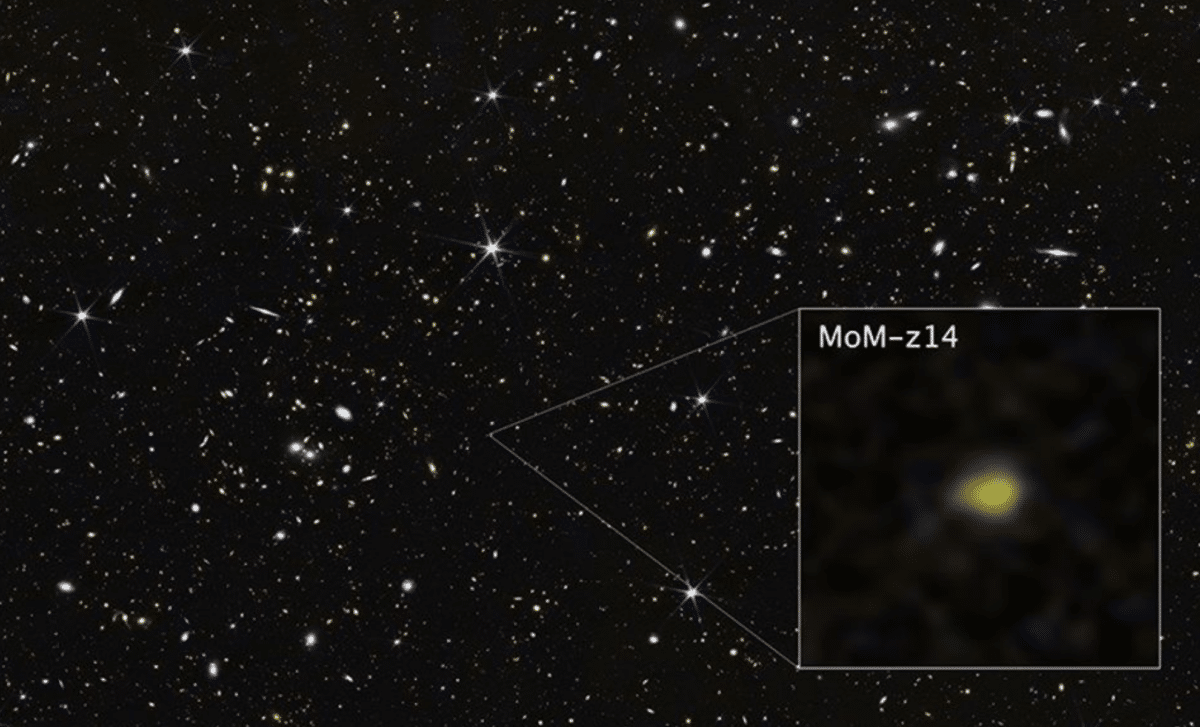
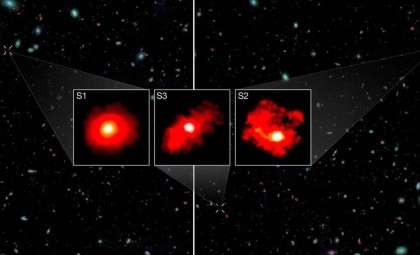
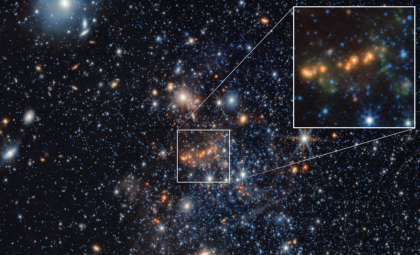
The James Webb Space Telescope has pushed the frontiers of space exploration once again. A recent NASA Science report details the discovery of galaxy MoM-z14, a remarkably luminous and chemically enriched galaxy that formed merely 280 million years following the Big Bang. This discovery represents one of the earliest galaxies ever detected and prompts critical reconsideration of star formation, cosmic reionization, and the universe’s infancy.
A Galaxy That Defies Expectations: MoM-z14
Using Webb’s NIRSpec (Near-Infrared Spectrograph), researchers identified that MoM-z14 has a redshift of 14.44, indicating its light has traveled nearly 13.5 billion years through expanding space. This timeframe places the galaxy just beyond the cosmic dawn—the epoch when the earliest stars and galaxies broke through the primordial hydrogen haze left by the Big Bang.
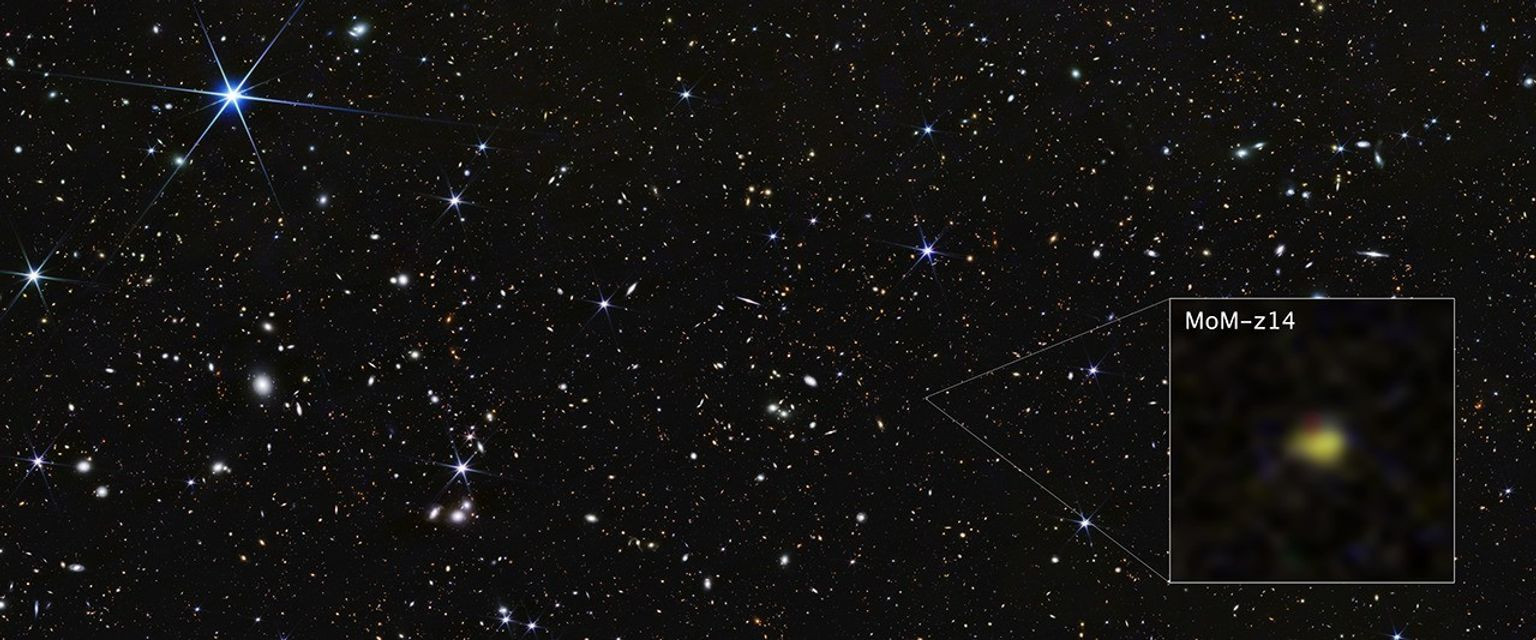
MoM-z14 stands out not just for its age, but due to its extraordinary brightness and chemical richness, traits scientists did not anticipate in such an early galaxy. “Webb allows us to peer deeper than ever before, revealing something beyond our predictions, which is both a challenge and an exciting opportunity,” explains Rohan Naidu, lead researcher from the Massachusetts Institute of Technology’s Kavli Institute.

This finding could mean prevailing theories surrounding the genesis of galaxies in the universe’s earliest stages may be missing important factors, particularly about when and how stars began forming and enriching their surroundings with heavier elements.
Bridging The Gap Between Theory and Reality
According to the NASA Science report, objects like MoM-z14 are compelling scientists to reassess long-held astrophysical models. As Jacob Shen, a co-author and MIT postdoc, states, “An increasing divergence between predictions and observations of the primordial universe raises fascinating questions for future investigation.”
This galaxy’s unexpected existence with prominent nitrogen signatures—typically linked to multiple cycles of stellar development—contradicts previous timelines. It suggests that the early cosmos may have forged supermassive stars capable of quickly producing heavier elements.
“We can take a page from archeology and look at these ancient stars in our own galaxy like fossils from the early universe, except in astronomy we are lucky enough to have Webb seeing so far that we also have direct information about galaxies during that time. It turns out we are seeing some of the same features, like this unusual nitrogen enrichment,” added Naidu.
Proving Distances With Spectroscopy
The key to firmly identifying MoM-z14 was the use of detailed spectroscopic techniques. While past surveys estimated galactic distances relying on photometric methods, Webb’s advanced instruments enabled scientists to accurately determine the galaxy’s distance.
“We can estimate the distance of galaxies from images, but it’s really important to follow up and confirm with more detailed spectroscopy so that we know exactly what we are seeing, and when,” said Pascal Oesch of the University of Geneva, co-principal investigator of the survey.
These precise distance measurements are essential for constructing a timeline of reionization—the era when the first light sources ionized the dense hydrogen fog that once engulfed the cosmos. MoM-z14 seems to be actively contributing to this pivotal cosmic transformation, offering new perspectives on how galaxies shaped the universe so swiftly.
Looking Forward: Thousands of Early Galaxies Await Discovery
In the coming years, the Nancy Grace Roman Space Telescope is predicted to dramatically increase the known population of distant galaxies. Its expansive infrared imaging will enable astronomers to locate thousands more galaxies from the same epoch, contextualizing the unique features observed in MoM-z14.
“To figure out what is going on in the early universe, we really need more information, more detailed observations with Webb, and more galaxies to see where the common features are, which Roman will be able to provide,” said Yijia Li, graduate student at Pennsylvania State University and part of the research team. “It’s an incredibly exciting time, with Webb revealing the early universe like never before and showing us how much there still is to discover.”
These future investigations will refine our understanding of how the first stars and galaxies formed, and may unveil new cosmic phenomena that shaped the universe we observe today.
- Categories:
- Space


0 comments
Sign in to Comment