
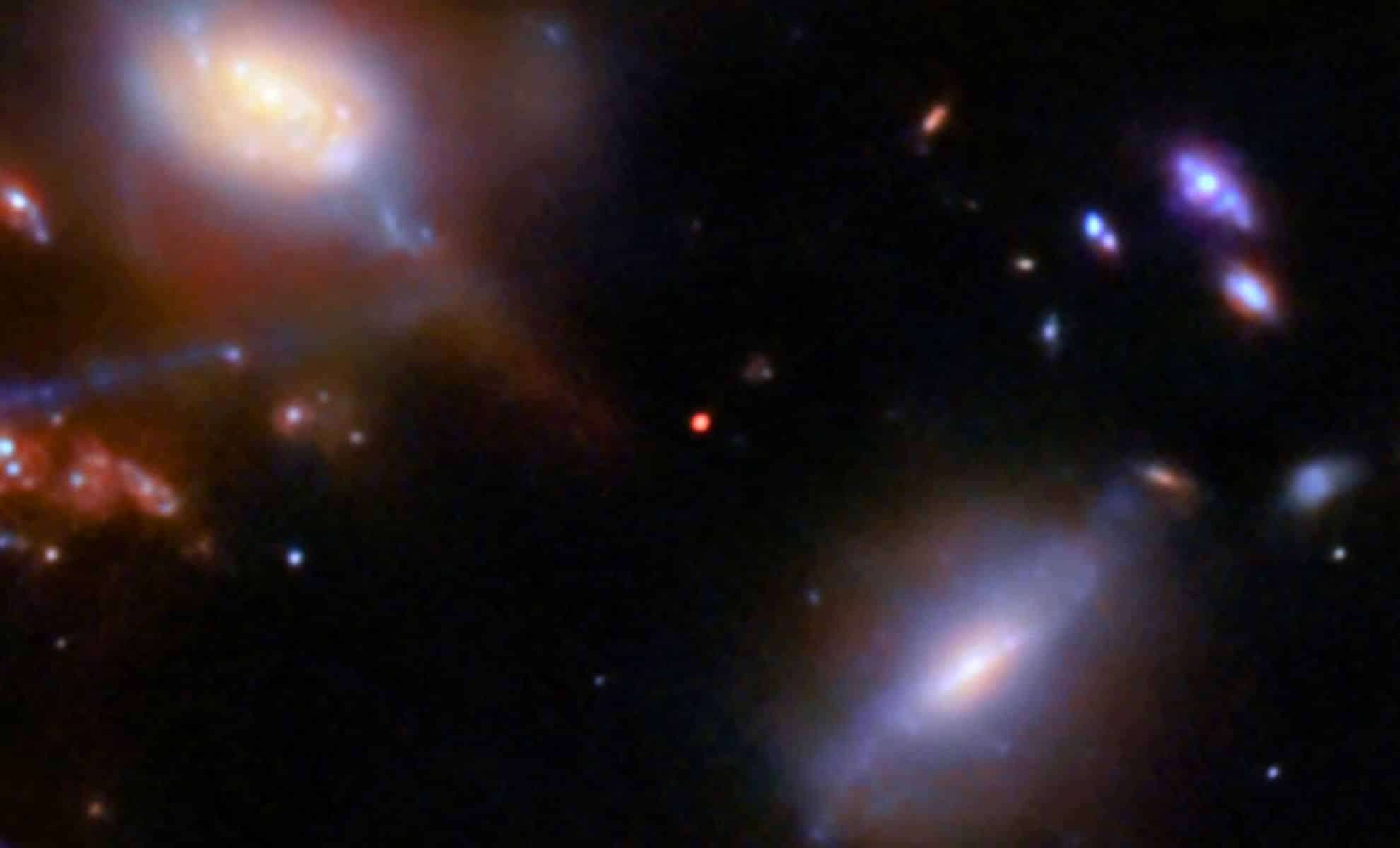
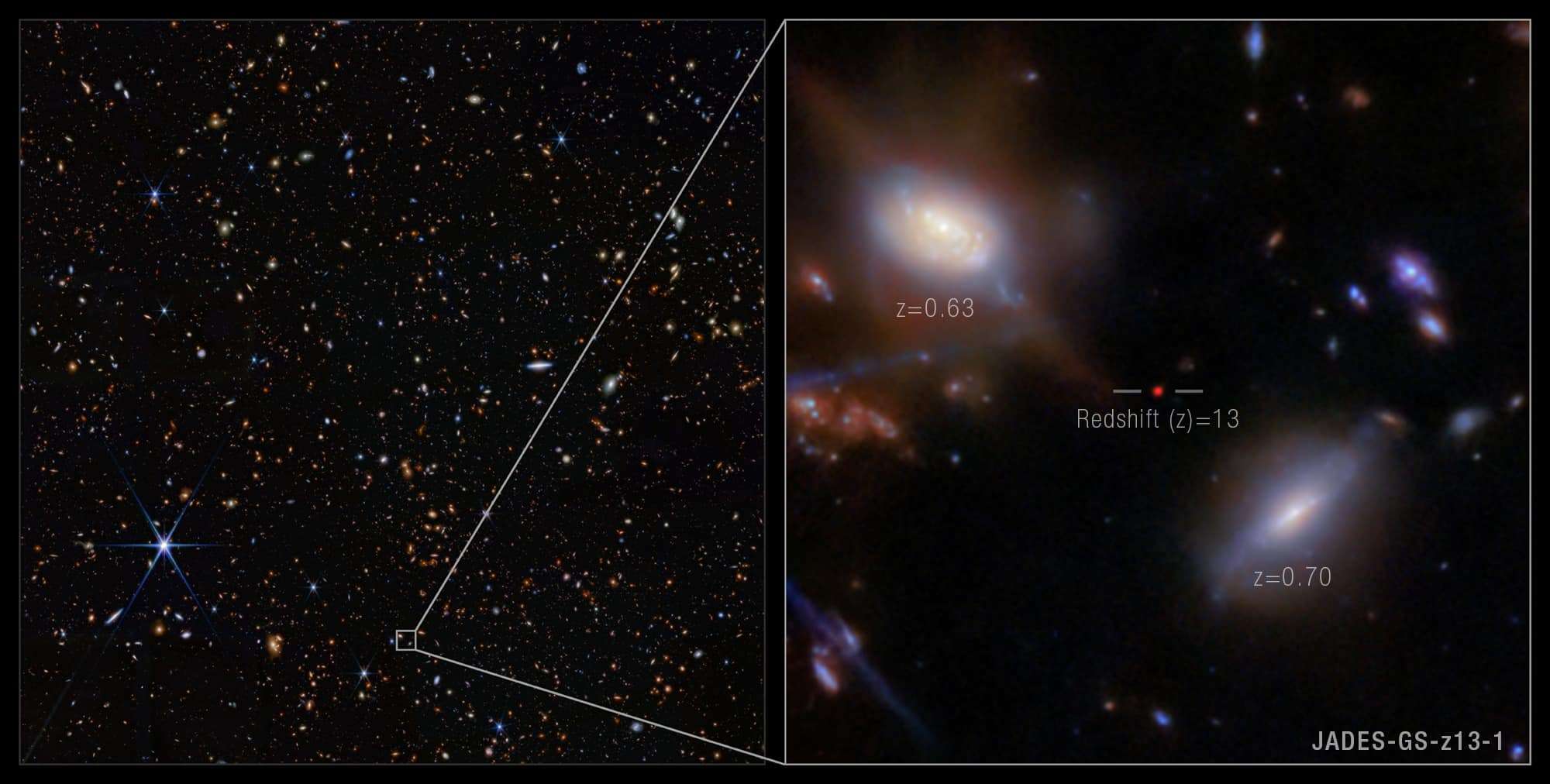
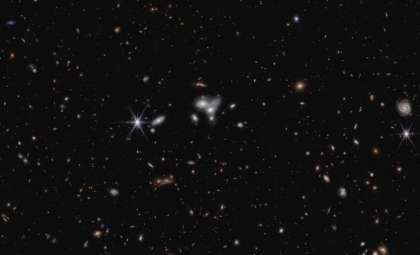
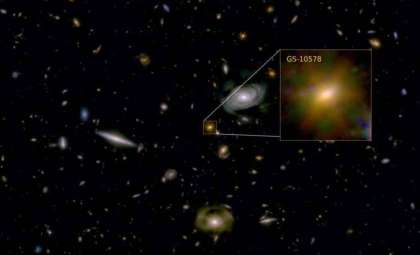
The remarkable galaxy identified by the James Webb Space Telescope (JWST) compels astronomers to revisit fundamental ideas about the universe’s infancy. Known as JADES-GS-z13-1, this galaxy appears a mere 330 million years post-Big Bang, yet it emits strong ultraviolet radiation that, according to existing theories, should have been obscured by the intergalactic gas prevalent at that time.
A Galaxy Too Luminous Too Early
This finding comes from the JWST Advanced Deep Extragalactic Survey (JADES), utilizing Webb’s Near-Infrared Camera (NIRCam) to look far back in cosmic history. At a redshift of z=13.05, JADES-GS-z13-1 ranks among the most remote galaxies observed, and its intense brightness in the Lyman-α ultraviolet emission line, often linked to vigorous star formation or an active galactic core, is genuinely unexpected.
Why is this surprising? At this era—just a few hundred million years after the Big Bang—the cosmos was thought to be filled with dense neutral hydrogen, creating an opaque blanket that should have obstructed ultraviolet Lyman-α photons. However, JADES-GS-z13-1 shines unmistakably through, challenging these assumptions.

The Expected Timeline of the Early Universe
According to the prevailing cosmological framework, roughly 380,000 years post-Big Bang, the universe became transparent during the recombination epoch, forming atoms and releasing the cosmic microwave background (CMB).
What followed was the so-called “dark ages,” a period dominated by neutral gas that contained no luminous objects. Only after hundreds of millions of years did gravitational forces bring about the formation of the earliest stars and galaxies.
The energetic radiation from these first celestial bodies initiated the epoch of reionization, gradually ionizing the neutral hydrogen and permitting ultraviolet light to traverse space. JADES-GS-z13-1 appears to be situated precisely at this transitional phase—too early and too bright given prior expectations.
Significance of the Lyman-α Emission
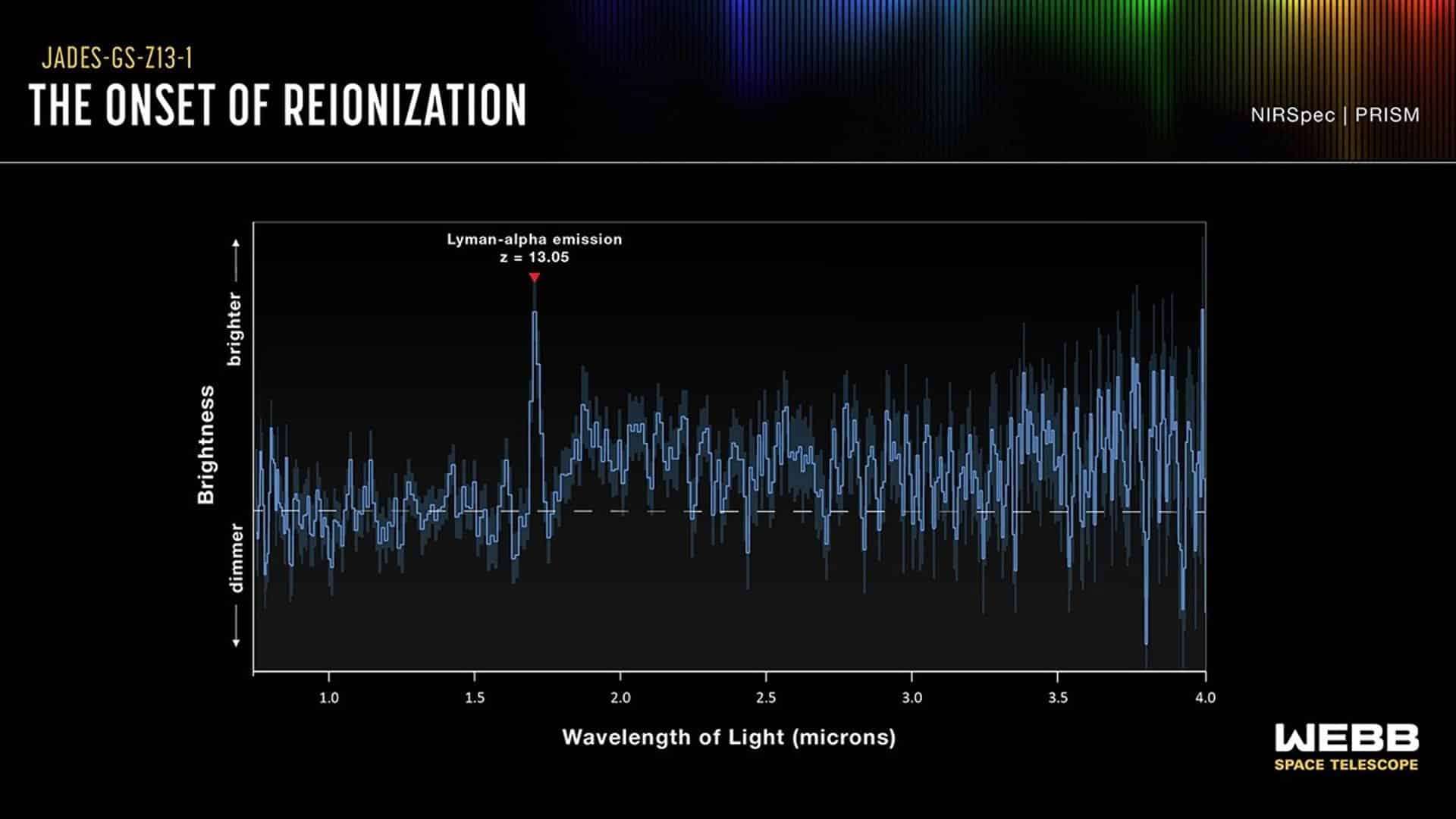
Lyman-α emission in JADES-GS-z13-1 was authenticated through spectroscopic analysis, confirming a redshift of z = 13.05. Discovered in 1906 by Theodore Lyman, this spectral line typically indicates intense starburst activity or the presence of a supermassive black hole.
JWST’s infrared detectors captured the UV photons that have been stretched into the near-infrared due to the expansion of the universe over billions of years.
Nevertheless, at this nascent cosmic stage, the Lyman-α photons should have been scattered or absorbed by neutral gas—unless an ionized zone had already formed around the galaxy.
Scientific Community’s Reaction: “This Detection Was Unexpected”
The revelation has left many astrophysicists astounded. In an ESA press release, lead investigator Kevin Hainline from the University of Arizona commented:
“We really shouldn’t have found a galaxy like this, given our current understanding of how the universe evolved. Imagine the early universe wrapped in a thick fog, making it extremely hard to detect strong beacons shining through it. Yet here we see this galaxy’s beam piercing through the veil.”
Roberto Maiolino from Cambridge University and University College London shared the astonishment:
“This result, totally unexpected based on theories of early galaxy formation, has astonished astronomers.”
Possible Origin: Primordial Star Generations?
The research group led by Joris Witstok (University of Cambridge and the Cosmic Dawn Center, Denmark) proposes a plausible explanation. This galaxy might be enveloped by a significant ionized region, possibly created by unusual stellar populations:
“These stars may have been far more massive, hotter, and more luminous than those formed later. They could be Population III stars, the hypothetical first stars ever formed in the universe.”
Alternatively, the observed luminosity may stem from a primordial active galactic nucleus (AGN) powered by an emerging black hole. Regardless, this indicates extraordinary phenomena at play in this early epoch.
Peter Jakobsen from the Cosmic Dawn Center at the University of Copenhagen reflected:
“It was clear that Webb would discover ever more distant galaxies. But as the case of GS-z13-1 shows, what it would reveal about newborn stars and black holes at the edge of cosmic time would be full of surprises.”
Consequences for Cosmological Models
This groundbreaking finding is prompting some experts to question the ΛCDM model (Lambda Cold Dark Matter), which has long guided our understanding of cosmic structure creation.
It raises the possibility that new physics might be necessary. Alternative frameworks such as Modified Newtonian Dynamics (MOND), variable dark energy, or reimagined star formation scenarios are gaining fresh attention. While it may not overturn the Big Bang paradigm, these anomalies demand a reevaluation of our timelines and models of galaxy growth and reionization.

Looking Ahead: Deeper Investigations
Upcoming observations targeting JADES-GS-z13-1 will aim to clarify the origins of its potent Lyman-α emission and determine whether Population III stars or early black holes are responsible.
The ESA summed up the excitement:
“Whatever this galaxy is hiding, it will certainly open a new frontier in cosmology.”
As the James Webb Telescope continues unveiling the faint light of the universe’s first objects, it is also revealing profound mysteries that may ultimately transform our understanding of cosmic beginnings.
- Categories:
- Space



0 comments
Sign in to Comment