
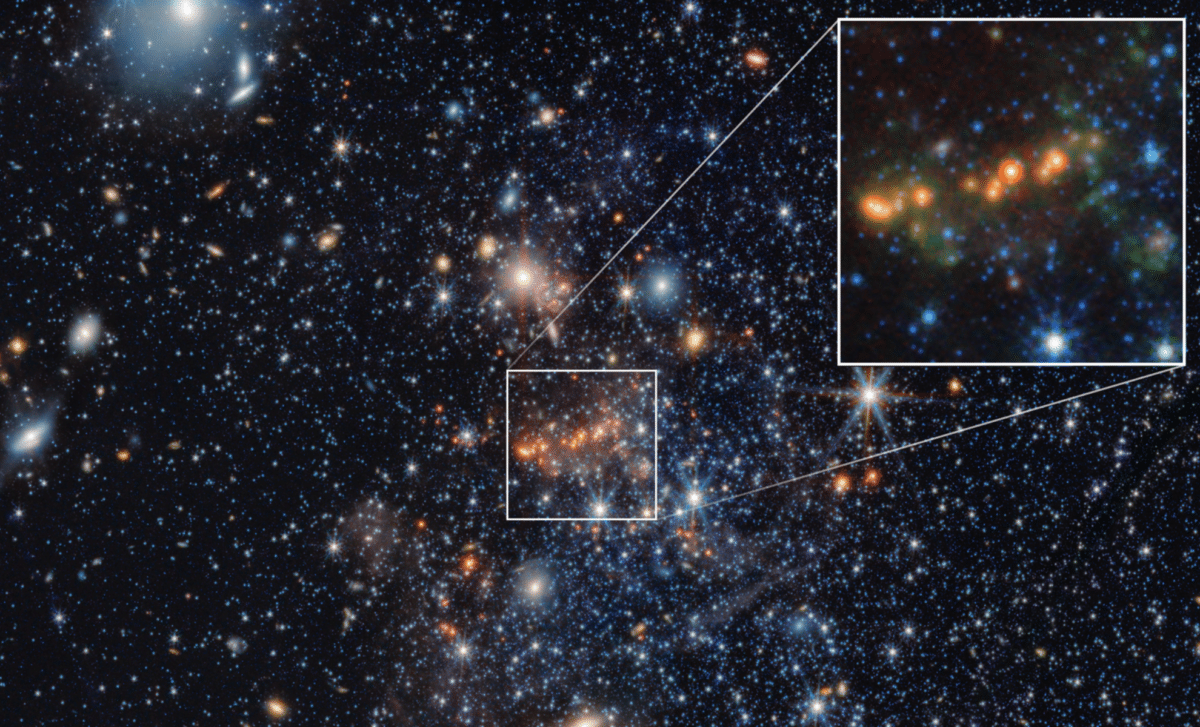
Using NASA’s James Webb Space Telescope, researchers have unveiled new details on dust production in some of the universe’s earliest galaxies. Their investigation centers on the dwarf galaxy Sextans A, a nearby galaxy notable for its extremely low metal content. Contrary to previous assumptions, Sextans A is actively producing complex dust particles, challenging long-held views about cosmic dust formation in the early cosmos. This breakthrough offers fresh perspectives on galaxy evolution and the origins of planetary systems and life’s fundamental elements.
Revealing the Secrets of Dust Creation in Ancient Galaxies
Located roughly 4 million light-years away, Sextans A provides a snapshot of conditions present in the early universe, well before galaxies like the Milky Way existed. Recent research, detailed on NASA’s official website, highlights that Sextans A contains only 3 to 7 percent of the metallicity found in the Sun. Despite its sparse metal content, scientists once thought it improbable that such environments could form abundant dust. However, observations from the James Webb Space Telescope reveal the galaxy is synthesizing complex dust particles like metallic iron and silicon carbide even amid these restrictions.
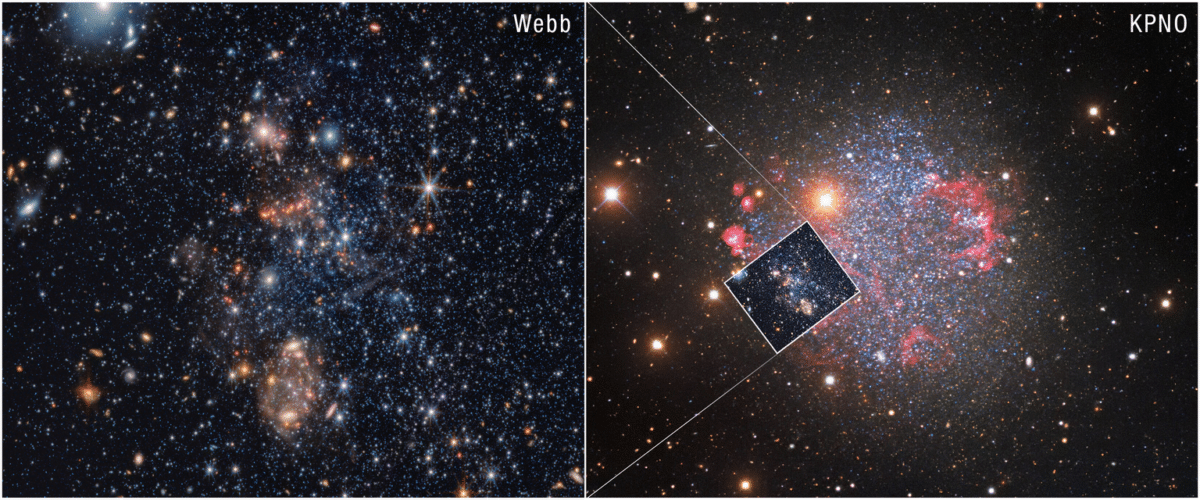
“Sextans A is giving us a blueprint for the first dusty galaxies,” said Elizabeth Tarantino, postdoctoral researcher at the Space Telescope Science Institute and lead author of one of the studies. “These results help us interpret the most distant galaxies imaged by Webb and understand what the universe was building with its earliest ingredients.”
Add Cosmo Herald as a Preferred Source

This breakthrough delivers vital clues on how primordial galaxies may have forged dust through novel processes, even lacking conventional elements like silicon and magnesium.
Discovery of Iron-Dominated Dust in Metal-Poor Stars
An unexpected highlight of the study was the presence of iron-based dust within stars of Sextans A, where metal scarcity led astronomers to anticipate minimal dust formation. Specifically, a massive asymptotic giant branch (AGB) star was found to be generating dust grains predominantly composed of iron, a phenomenon never before seen under such conditions.
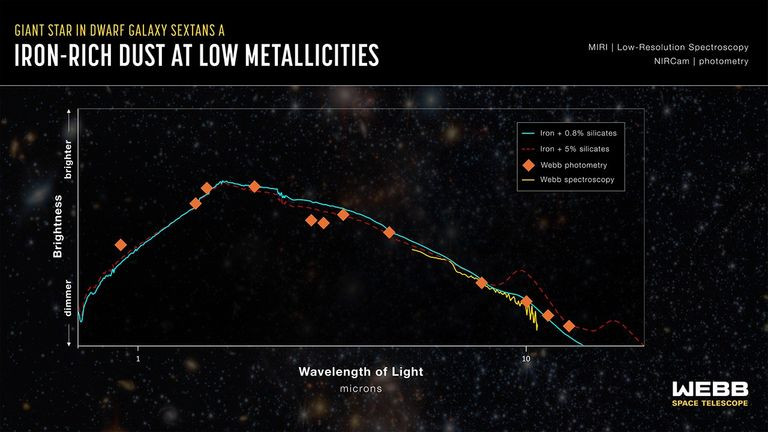
Previously, low-metallicity stars were thought to be nearly dust-free, but Webb observations overturned this assumption.
“One of these stars is on the high-mass end of the AGB range, and stars like this usually produce silicate dust. However, at such low metallicity, we expect these stars to be nearly dust-free,” said Martha Boyer, associate astronomer at the Space Telescope Science Institute. “Instead, Webb revealed a star forging dust grains made almost entirely of iron. This is something we’ve never seen in stars that are analogs of stars in the early universe.”
This finding suggests early universe stars could produce solid materials despite lacking typical dust-forming elements.
The Role of PAHs in Planet Formation
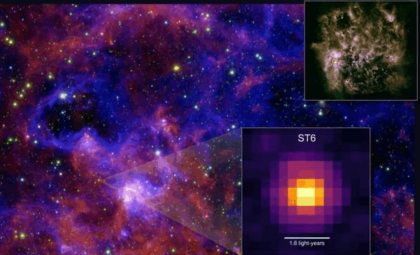
Sextans A also harbors polycyclic aromatic hydrocarbons (PAHs), intricate carbon-based molecules recognized as some of the smallest dust grains and markers of stellar birth. Infrared imaging from the James Webb Space Telescope has detected PAHs clustered within dense pockets of the galaxy, revealing that these carbon structures can arise even in galaxies with extremely low metallicity.
“Webb shows that PAHs can form and survive even in the most metal-starved galaxies, but only in small, protected islands of dense gas,” said Tarantino.
These isolated regions create ideal environments for PAHs to develop and endure, overturning the belief that such molecules could not exist in metal-deprived galaxies. This discovery expands our knowledge of how carbon-based precursors to life could have originated in primitive cosmic settings.
Complex Dust Creation Redefines Early Universe Theories
Collectively, these findings challenge conventional models of dust formation during early galaxy evolution. For years, it was assumed that the infancy of galaxies saw straightforward dust creation patterns, but Webb’s data illustrate a far more resourceful universe.
Notably, the formation of iron-rich dust and PAHs within pockets of dense gas confirms that even ultra metal-poor galaxies could synthesize intricate materials essential for planet building and possibly life's beginnings.
“Every discovery in Sextans A reminds us that the early universe was more inventive than we imagined,” said Boyer. “Clearly stars found a way to make the building blocks of planets long before galaxies like our own existed.”
These new insights into dust production offer astronomers critical understanding of how stars, planets, and life-essential components emerged amid the universe’s earliest environments.
- Categories:
- Space



0 comments
Sign in to Comment