
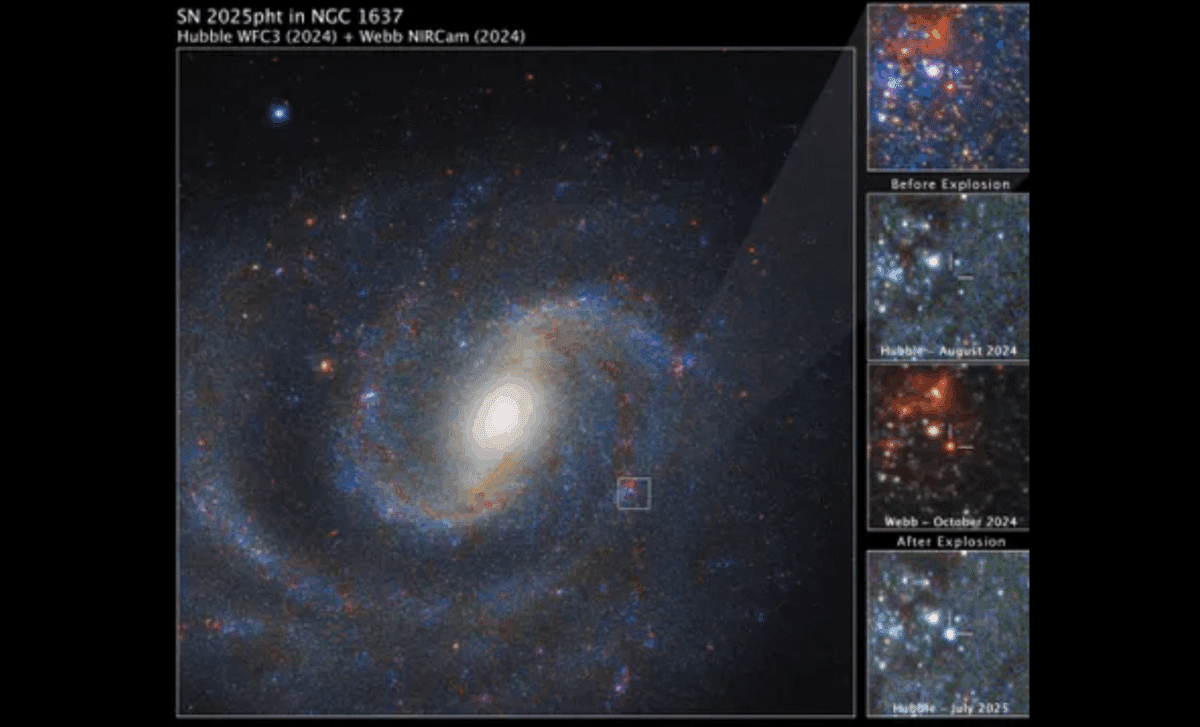
Using the James Webb Space Telescope (JWST), researchers have made a groundbreaking observation: they have captured an image of a red supergiant star moments before it exploded in a supernova. This star resides in the spiral galaxy NGC 1637 and was previously shrouded in dust, making it invisible to earlier telescopes. JWST’s infrared capabilities have now revealed this elusive star, providing fresh perspectives on the closing phases of massive stars’ lifespans. These findings are detailed in the Astrophysical Journal Letters.
Identifying the Concealed Star
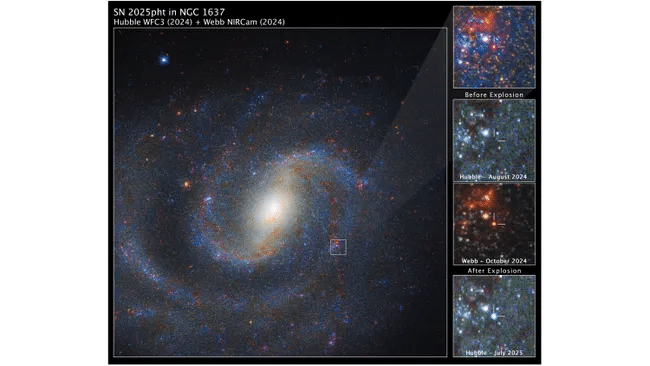
The origin star responsible for supernova SN 2025pht was pinpointed through comparing archival data gathered by JWST and the Hubble Space Telescope, which has monitored the area over multiple decades. By aligning the images precisely using 36 reference stars, astronomers established an exact positional match. The JWST pre-supernova image displayed a bright, isolated point source that perfectly aligned with the site of the supernova explosion, confirming it as the progenitor.
Lead researcher Charlie Kilpatrick from Northwestern University remarked, “We’ve anticipated this moment—capturing the explosion of a star in a galaxy JWST has already examined. Thanks to JWST's infrared data quality, we can now accurately classify the red supergiant that detonated and understand its immediate surroundings.” This pivotal observation helps resolve longstanding questions about the apparent lack of massive red supergiants in pre-supernova imagery.

Features of the Dust-Encased Star
This progenitor exhibited an exceptionally red hue due to a dense veil of surrounding dust. Although it shined with roughly 100,000 times the Sun’s brightness, its visible light was heavily obscured, reduced by over a factor of 100 because of dust absorption. Co-author Aswin Suresh noted, “This represents the reddest, dustiest red supergiant we’ve ever observed to explode as a supernova.”
The findings imply that numerous massive stars previously considered missing might actually be veiled by dust, escaping detection through optical wavelengths. Kilpatrick further explained,
“That tells us that previous explosions might have been much more luminous than we thought because we didn’t have the same quality of infrared data that JWST can now provide.”
This insight significantly revises the understanding of historical observations concerning supernova progenitors.
Consequences for Our Understanding of Star Life Cycles
Red supergiants, like SN 2025pht’s progenitor, are giant stars in their final evolutionary stages. Upon depleting their nuclear fuel, gravitational forces cause their cores to collapse, triggering a supernova that leaves behind either a neutron star or a black hole. This discovery confirms that these colossal stars conclude their lives through these dramatic explosions, validating long-standing models of stellar evolution.
Interestingly, the dust surrounding SN 2025pht was found to contain a high concentration of carbon, a deviation from the typical silicate-rich dust observed around red supergiants. This could indicate that vigorous convection currents inside the star brought carbon from its core to its outer layers during its last years, altering its chemical makeup just before its fiery end. These observations open new avenues for exploring the processes driving stellar death.
Revolutionizing Supernova Research
Pinpointing the progenitor of a supernova so clearly showcases the strength of infrared astronomy in revealing stars hidden by dust. Such discoveries are set to refine astrophysical models related to both stellar development and explosive deaths. Upcoming instruments, such as the Nancy Grace Roman Space Telescope, are anticipated to build upon these advances. Kilpatrick highlighted that with JWST and future observatories, “this period marks a thrilling era for examining massive stars and their explosive final acts,” surpassing data quality from the last thirty years.
- Categories:
- News



0 comments
Sign in to Comment