

A comprehensive 47-year investigation completed in 2025 by scientists at the Karolinska Institutet in Sweden has reshaped our understanding of when the human body begins to experience declines in physical performance. Their data reveal that deterioration in fitness and strength emerges much earlier than traditional aging benchmarks suggest, beginning well before standard clinical or public health indicators detect it.
Using ongoing evaluations of a nationally representative group born in 1958, researchers monitored physical capabilities from youth through early old age. Consistent patterns were seen across measures such as aerobic fitness, muscular endurance, and explosive strength. Peak physical ability was generally achieved in the early to mid-thirties, followed by a slow but progressively accelerating decline thereafter.
These findings have major implications for understanding conditions like sarcopenia. Although aging-related loss appears biologically driven, the team identified several lifestyle factors capable of significantly modifying the pace and severity of decline. This study provides a crucial new reference point for assessing functional aging in the general populace.

Early Onset of Decline and Increasing Loss With Age
The Swedish Physical Activity and Fitness (SPAF) research followed 427 subjects—nearly 50% women—who underwent five physical tests at ages 16, 27, 34, 52, and 63. Assessments included submaximal aerobic exercises on a bicycle ergometer, muscular endurance via fixed-weight bench press repetitions, and vertical jump height to measure muscle power.
Aerobic fitness peaked between 35 and 36 years for both genders, with a slow decline under 1% annually initially, which accelerated after age 45 to above 2% yearly by the early 60s. By 63, average aerobic capacity fell by 33% in men and 30% in women, as described in the detailed report published in The Journal of Cachexia, Sarcopenia and Muscle.
Adjusting for body mass, relative aerobic capacity showed an earlier peak—age 26 in men and 31 in women—with decline rates rising from about 1.1% at 40 years to over 2.2% by 63. Overall relative decreases reached 40% for men and 37% for women.
Muscular endurance, assessed via bench press repetition counts, peaked around 36 years of age. Initial annual decreases were under 1%, escalating to 2.5% by study’s end, totaling losses of 35% in men and 32% in women.
Muscle power, measured through vertical jump performance, experienced the steepest reduction. Peak values appeared at age 27 for men and 19 for women. By 63, women lost 48% and men 41% of their maximum jump height, with decline rates accelerating from about 1% at 40 to 2.2% at 63 years.
Despite consistently higher baseline levels in men, the research observed no gender differences in the rate of physical decline across any tested domain.
Impact of Education, Activity, and Lifelong Differences
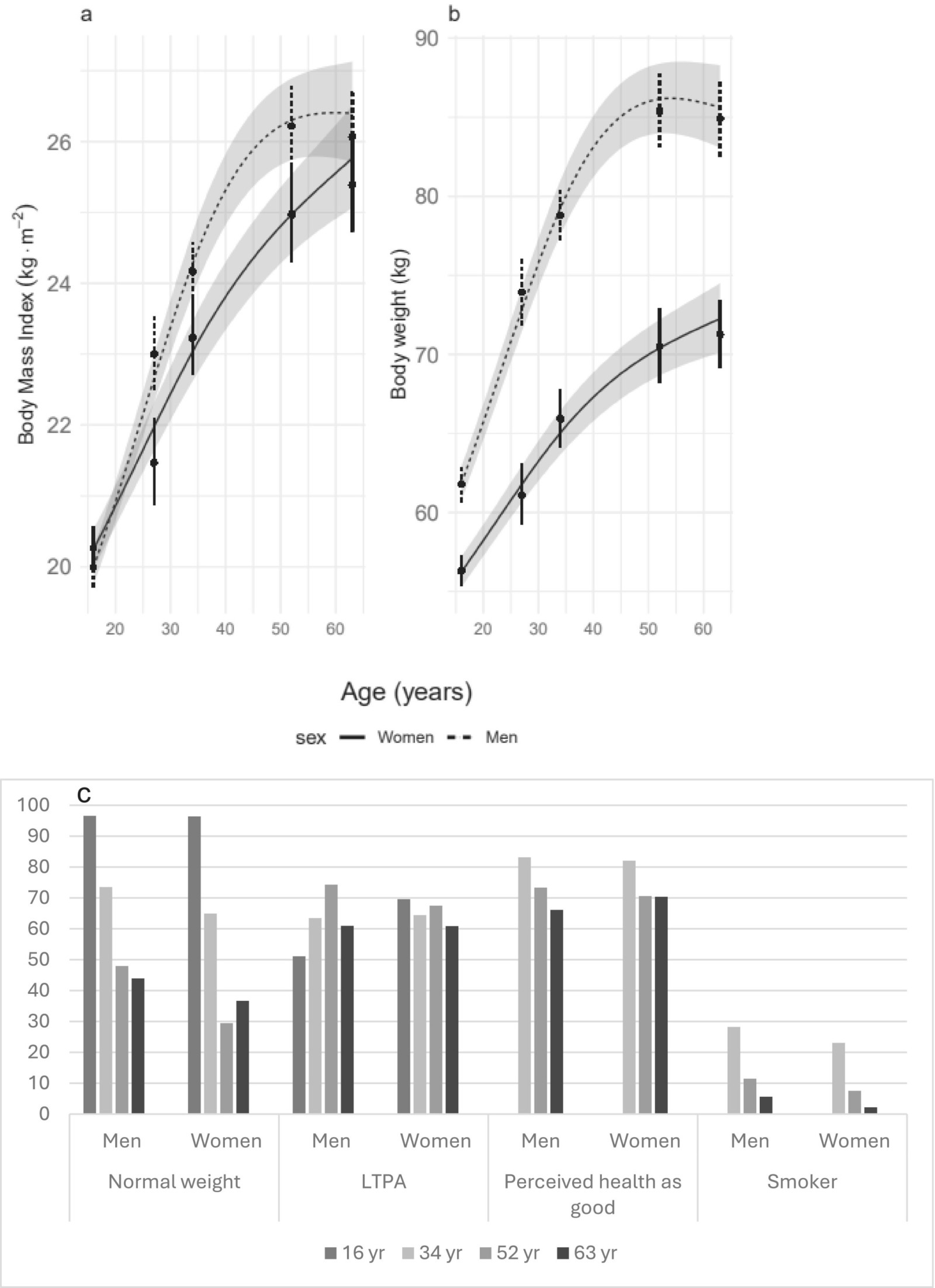
Examining social and behavioral factors, the study found that regular leisure-time physical activity was the strongest predictor of superior performance across all areas. Those active during adolescence maintained higher fitness through adulthood compared to inactive peers.
Moreover, participants who began exercising in adulthood showed notable improvements—between 6% and 11% depending on the fitness measure—indicating that starting physical activity later still provides meaningful benefits. These effects remained significant after accounting for age, sex, and BMI.
Higher educational levels correlated with enhanced aerobic and endurance capabilities, with university graduates consistently outperforming others. This advantage did not extend to muscle power.
The study also revealed that disparities in physical performance widened markedly as the cohort aged, with variance increasing 25-fold for relative aerobic capacity, almost five times for jump height, and tripling for endurance. This suggests that while young adults show similar fitness levels, aging introduces diverse outcomes influenced by accumulated factors.
ScienceDaily summarized the findings emphasizing sustained physical activity’s role throughout life—even if started in midlife—in yielding measurable improvements.
Statistical analysis indicated that approximately 30% to 50% of long-term fitness variations derive from stable individual traits rather than chance, highlighting early-life physical aptitude as a strong predictor of future functional capacity.
A Biological Threshold and Limits of Physical Decline
The team differentiated two key aspects of physical aging: the age at peak performance, largely biologically fixed, and the rate of subsequent decline, heavily influenced by lifestyle and activities.
While exercise reduced decline speed, it did not delay the initial onset of deterioration. This aligns with previous work on elite athletes, who also begin to lose capacity in their mid-30s despite ongoing training. Yet, in the general population, declines were more pronounced, with study subjects retaining only 60% to 65% of peak performance by 63 years compared to over 80% in master athletes.
The results suggest that early neuromuscular changes—such as lowered mitochondrial function, reduced recruitment of motor units, and accumulation of connective tissue fibrosis—likely begin decades before visible clinical symptoms, driving early declines in fitness well before age 40.
“Physical activity can slow the decline in performance, even if it cannot completely stop it,” said lead author Maria Westerståhl in her statement, emphasizing the value of remaining active regardless of age.
These patterns reveal a disconnect between biological aging trajectories and current clinical screening which typically starts in the 50s or 60s, potentially missing a critical earlier period when prevention efforts could be most effective.
- Categories:
- News













0 comments
Sign in to Comment