

A recent investigation published in Geology by Thomas M. Gernon, Sascha Brune, Thea K. Hincks, and Derek Keir unveils a massive thermal anomaly deep below New England, characterized by an unusually hot and buoyant region within the Earth’s mantle.
This structure, called the Northern Appalachian Anomaly (NAA), spans roughly 400 kilometers in diameter and is situated approximately 200 kilometers beneath the surface within the asthenosphere, the partially molten section of the upper mantle.
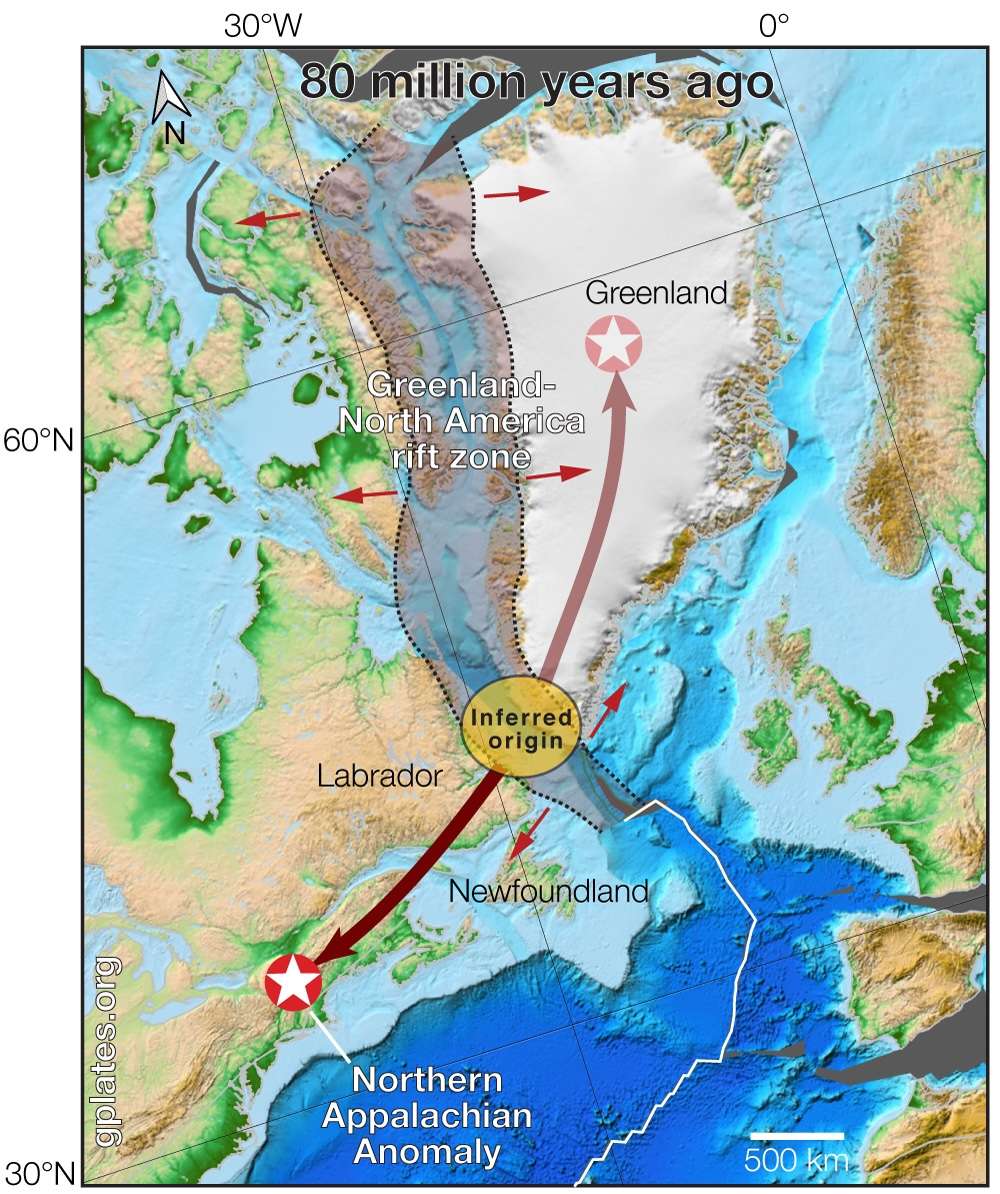
Utilizing sophisticated mantle convection models and tectonic plate reconstructions, the researchers propose that this anomaly is a long-lasting vestige of the Labrador Sea’s rifting episode that took place around 85–80 million years ago, during the late Cretaceous.

The team suggests that the anomaly’s current approach toward the New York metropolitan area is part of a slow-moving, large-scale mantle migration initiated by the separation of North America and Greenland.
An Enduring Mantle Instability in Motion
For years, geoscientists attributed the NAA to edge-driven convection, where temperature differences between oceanic and continental regions induce mantle flows. Yet this explanation falls short, as the Atlantic passive margin along eastern North America has remained largely tectonically inactive for nearly 180 million years, exceeding the lifespan of such convection cells.
The newly presented research advances an alternative hypothesis: the anomaly is a Rayleigh–Taylor instability—a process where a buoyant, less dense mantle region ascends through denser, cooler layers above. This instability likely began when the lithosphere thinned due to rifting during the Labrador Sea’s continental separation.
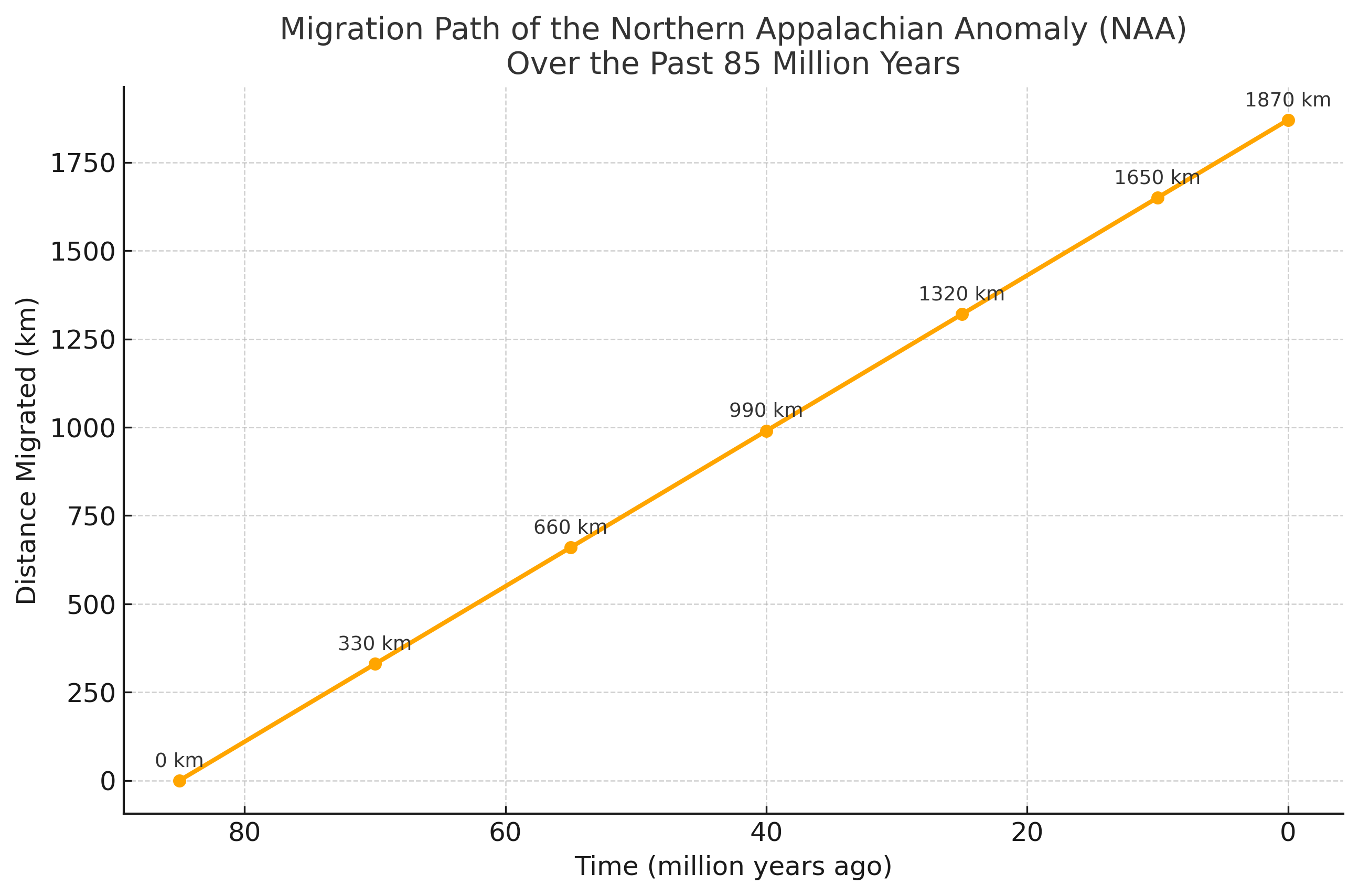
Once this mantle upwelling formed, it became a self-perpetuating phenomenon, migrating west-southwest at approximately 22 kilometers per million years. This rate aligns well with predictions from global mantle convection simulations, implying the movement is governed by deep mantle dynamics rather than random variation.
Corresponding Mantle Feature Under Greenland
Key evidence linking the anomaly to the Labrador Sea rifting stems from seismic observations beneath north-central Greenland. Scientists have identified a mirror-image mantle anomaly comparable in size, depth, and seismic signature to the NAA, believed to have originated from the same tectonic event.
This symmetry indicates both anomalies result from a vast mantle upwelling spanning the rift system. While the Greenland feature remains near its origination point, the NAA has steadily traveled across the North American plate, moving thousands of kilometers over tens of millions of years.
The research also identifies the Central Appalachian Anomaly, located further south, as a potential earlier phase of the same migratory process. If this is confirmed, mantle instabilities may occur in sequential chains, marking the deep mantle’s flow over geological time.
Implications for Geological Stability
Though the NAA poses no immediate threat to populations above, its discovery challenges the traditional perception of eastern North America as a tectonically stable region. The possibility of migrating mantle plumes undermines the assumption of geologic quiescence beneath this area.
Over millions of years, such mantle upwellings can weaken the crust, influence volcanic activity, and in some cases trigger continental rifting—the very mechanism that fragmented the supercontinent Pangaea. Co-author Sascha Brune describes the NAA and related features as remnants of ancient continental breakups, emphasizing their role in Earth’s extended geodynamic narrative.
Understanding the mechanisms behind these anomalies’ movement is crucial for forecasting future changes in continental interiors as mantle convection interacts with tectonic processes and volcanic hotspots.
- Categories:
- News











0 comments
Sign in to Comment