
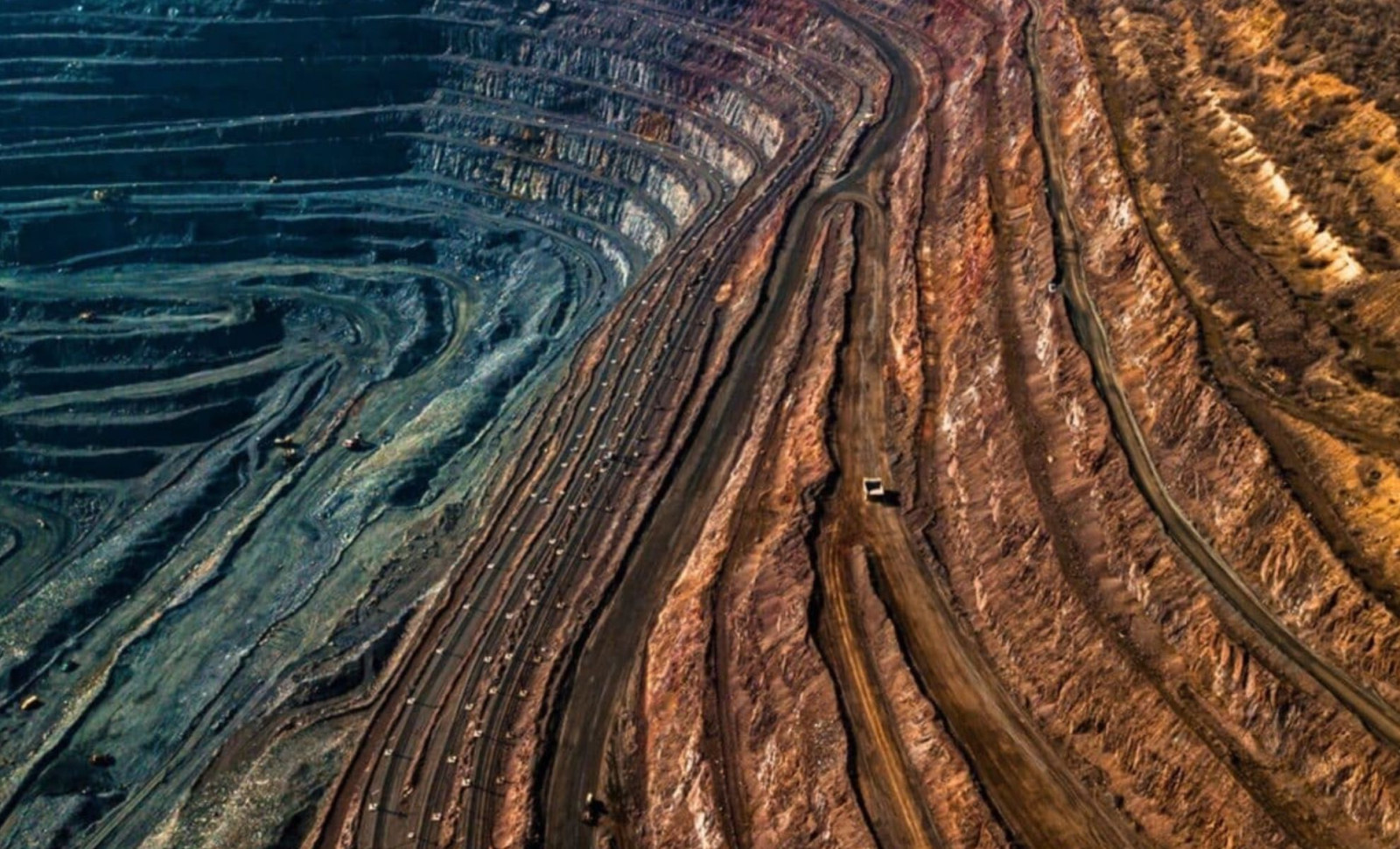
Central Kazakhstan’s expansive grasslands have long been a source of coal, oil, and copper, but until now, they haven’t been known for supplying the critical rare earth metals essential to today’s cutting-edge technology.
In a significant announcement made in April 2025, just before a high-profile summit involving leaders from Europe and Central Asia in Samarkand, Kazakh officials revealed new exploration findings from the Karagandy region. If these findings hold up after extensive drilling and evaluation, they could elevate Kazakhstan to the ranks of countries possessing some of the world’s largest rare earth mineral deposits.
Symbolically, the deposit has been named “New Kazakhstan.”

Unveiling the Deposit
Prospecting efforts in Karagandy commenced in 2022, with results submitted to governmental bodies by October 2024. Kazakhstan’s Ministry of Industry and Construction disclosed that four promising zones contain estimated reserves of 935,400 metric tons of rare earth oxides, including notable elements like cerium, lanthanum, neodymium, and yttrium. According to Euronews, preliminary models indicate the deposit could amount to 20 million tons, extending up to depths of 300 meters, with average concentrations around 700 grams per ton.
If validated, these figures would position Kazakhstan behind only China and Brazil in terms of global rare earth stockpiles. The most recent U.S. Geological Survey report from 2023 estimates China’s reserves at 44 million tons and Brazil’s at 21 million tons, with no other nation surpassing 7 million tons.
It’s important to note that the term “reserves” entails particular technical criteria that have yet to be fully met in this announcement. Georgiy Freiman, chair of the Professional Association of Independent Mining Experts, explained at the 2025 MINEX Kazakhstan conference that thorough analysis of all relevant factors—including geological, hydrogeological, economic, and market considerations—is necessary before classifying a find as a formal deposit.
“Only after comprehensive evaluation and economic modeling can a discovery be officially declared a deposit; otherwise, it remains speculative,” Freiman emphasized.
The Journey from Find to Production
Kazakhstan’s mining laws have seen major reforms aimed at enticing international investment. Since 2018, the country has granted 2,906 exploration permits and 111 production licenses based strictly on application order. In early 2024, compliance with the KAZRC Code became mandatory, bringing Kazakhstan’s resource reporting standards in line with global CRIRSCO frameworks. Government sources credit these adjustments with drawing increased foreign financing.
Between 2020 and 2025, major mining companies including Fortescue, Rio Tinto, Barrick Gold, BHP, and First Quantum collectively funneled over $1 billion into geological surveys. Additionally, the Korea Institute of Geoscience and Mineral Resources has partnered with state firm Tau-Ken Samruk on joint explorations in the Aral region.
The Karagandy discovery will require significantly more funding to advance beyond exploration. Arthur Poliakov, executive chairman of the MINEX Forum, projected at the 2025 meeting that development could span 10 to 12 years, with initial investments of around $10 million. This estimate excludes the substantial costs for processing facilities and separation plants, which Kazakhstan currently lacks.
Logistical challenges further complicate matters. As a landlocked nation, Kazakhstan’s rare earth exports will rely on effective transport corridors. Poliakov highlighted the necessity of enhancing the Middle Corridor trade route, which connects Central Asia with European markets via the Caspian Sea and Caucasus regions. “The EU and Kazakhstan are geographically distant, making Middle Corridor improvements vital,” he noted.
The Critical Role of Rare Earth Metals
Seventeen rare earth elements are crucial for over 200 modern products. The American Geosciences Institute describes their use in military hardware like guidance systems, lasers, radar, and sonar, as well as consumer tech including smartphones, electric vehicles, flat-panel displays, and hard drives. Though individual devices use small quantities, these metals are indispensable to their operation.
Global rare earth production remains heavily dominated by China, which controls roughly 70% of mining and exceeds 85% of refining capacity, per the U.S. Geological Survey. This concentration has sparked concerted efforts by many governments to diversify sourcing.
Kazakhstan’s role was specifically cited in the European Union’s 2025–2026 strategy for Central Asian cooperation focused on raw materials diversification. In April 2025, EU Ambassador to Kazakhstan Aleška Simkić remarked on how the Karagandy announcement enhanced Kazakhstan’s profile. “This development was perfectly timed, reinforcing Kazakhstan’s significance in critical materials discussions,” she said. “It has effectively put Kazakhstan on the EU’s map.”
The Road Ahead for Karagandy
Karagandy has yet to receive formal classification as an official deposit. Ongoing studies aimed at confirming ore content, extraction viability, and commercial potential are expected to continue through late 2026. Tau-Ken Samruk has not yet disclosed related licensing or offtake arrangements.
Given the typical timeline for complex mineral projects in landlocked countries, moving from discovery to full-scale mining can take over ten years. Poliakov’s estimate of 10 to 12 years aligns with established industry standards for rare earth developments requiring new infrastructure and specialized processing.
While Kazakhstan’s mining reforms and international partnerships lay vital groundwork, significant effort remains before the Karagandy find can translate into operational production.
- Categories:
- News




0 comments
Sign in to Comment