
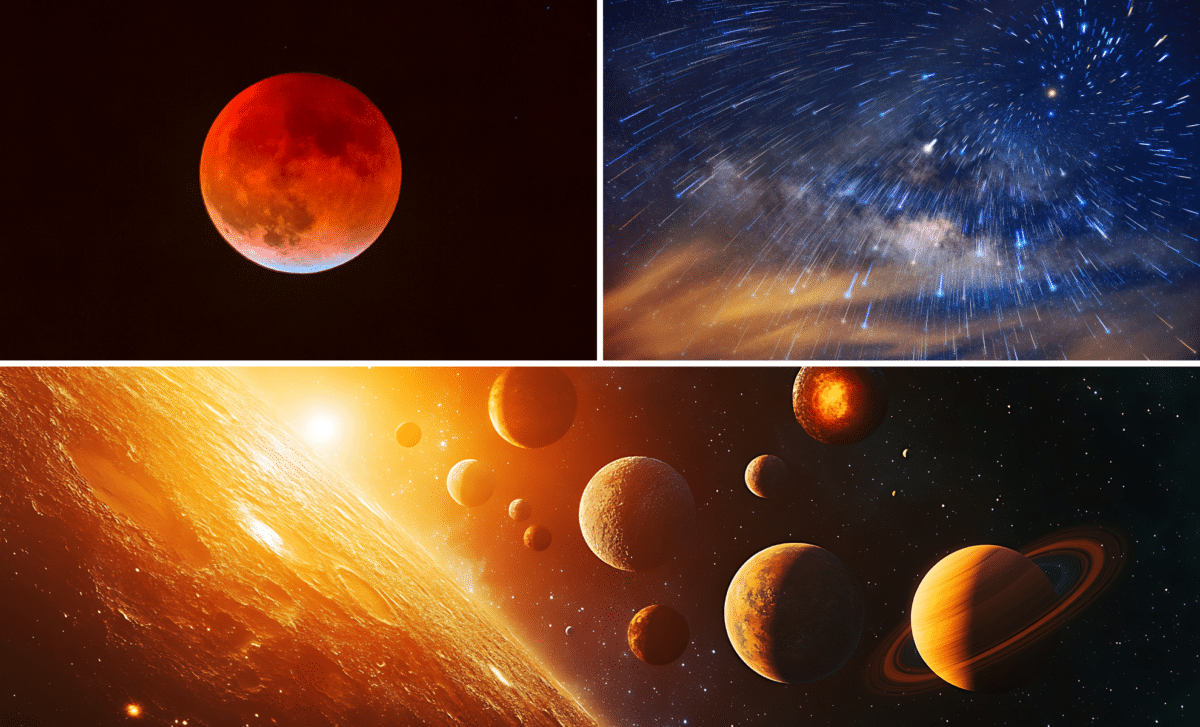
The year 2026 promises to be packed with spectacular celestial events that will captivate both dedicated astronomers and star enthusiasts. From stunning planet alignments and total lunar eclipses to dazzling meteor showers and striking supermoons, the night sky will offer numerous opportunities for direct observation. NASA’s Watch the Skies series presents a calendar featuring extraordinary cosmic phenomena destined to inspire awe and deepen our understanding of the universe.
February’s Cosmic Gathering: Six Planets Share the Night
On February 28, sky lovers can look forward to an exceptional lineup as Mercury, Venus, Neptune, Saturn, Uranus, and Jupiter all appear together shortly after sunset. Observers with sharp vision should be able to spot Venus, Jupiter, Saturn, and Mercury without any optical aid, while binoculars or small telescopes might reveal the more distant and dimmer Uranus and Neptune.
Planetary gatherings of this scale are rare, making this event a stellar attraction for anyone fascinated by the mechanics of our solar system’s dance. These planets will offer a stunning spectacle that highlights the delicate gravitational ties holding them in their orbits.

Total Lunar Eclipse Lighting Up The Western Skies in March
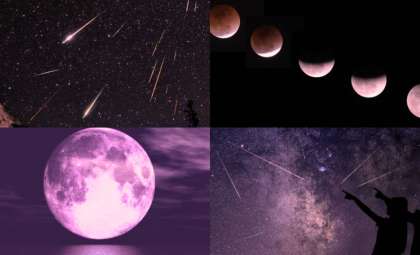
On March 3, a total lunar eclipse will cast its shadow primarily over North America, particularly along the western seaboard. As detailed by NASA, this dramatic event takes place just before dawn, turning the Moon a deep reddish tone as it slips into Earth’s shadow. Total lunar eclipses occur when Earth aligns precisely between the Sun and Moon, providing researchers with a chance to analyze how Earth’s atmosphere filters sunlight.
For observers, it’s a unique occasion to witness the Moon’s transformation and enjoy the heightened brilliance of stars in the softened lunar glow.
Summer’s Spectacular: Blue Moon, Planetary Pairing, and Meteor Shower Peaks
The later months of spring into summer bring a variety of impressive sky phenomena. On May 31, a Blue Moon—the second full moon of the same calendar month—will illuminate the night. Although it doesn’t actually appear blue, this event marks a rare 13th full moon within a year’s span.
Shortly thereafter, on June 8 and 9, the two brightest planets, Venus and Jupiter, will come together in a breathtaking conjunction. To casual viewers, the planets will seem separated by roughly the width of a pinky held at arm’s length, and no telescope is needed to enjoy this cosmic pairing. August will then showcase the famous Perseids meteor shower, with dark skies assured by a New Moon, perfect for observing a spectacular cascade of meteors.
December’s Celestial Grand Finale: Supermoon and Geminids
As the year concludes, December offers two standout highlights. On December 13 and 14, watch for the Geminids meteor shower, renowned for its vibrant green streaks. Then, on December 24, the night sky will be graced by a Christmas Eve Supermoon—a full moon appearing larger and more luminous due to its proximity to Earth.
Throughout 2026, NASA’s observatories will monitor these extraordinary events, providing invaluable data to enhance humanity’s grasp of our cosmic surroundings. Meanwhile, these events invite everyone to gaze upward, rekindling our connection to the vast universe above.
- Categories:
- News

0 comments
Sign in to Comment