
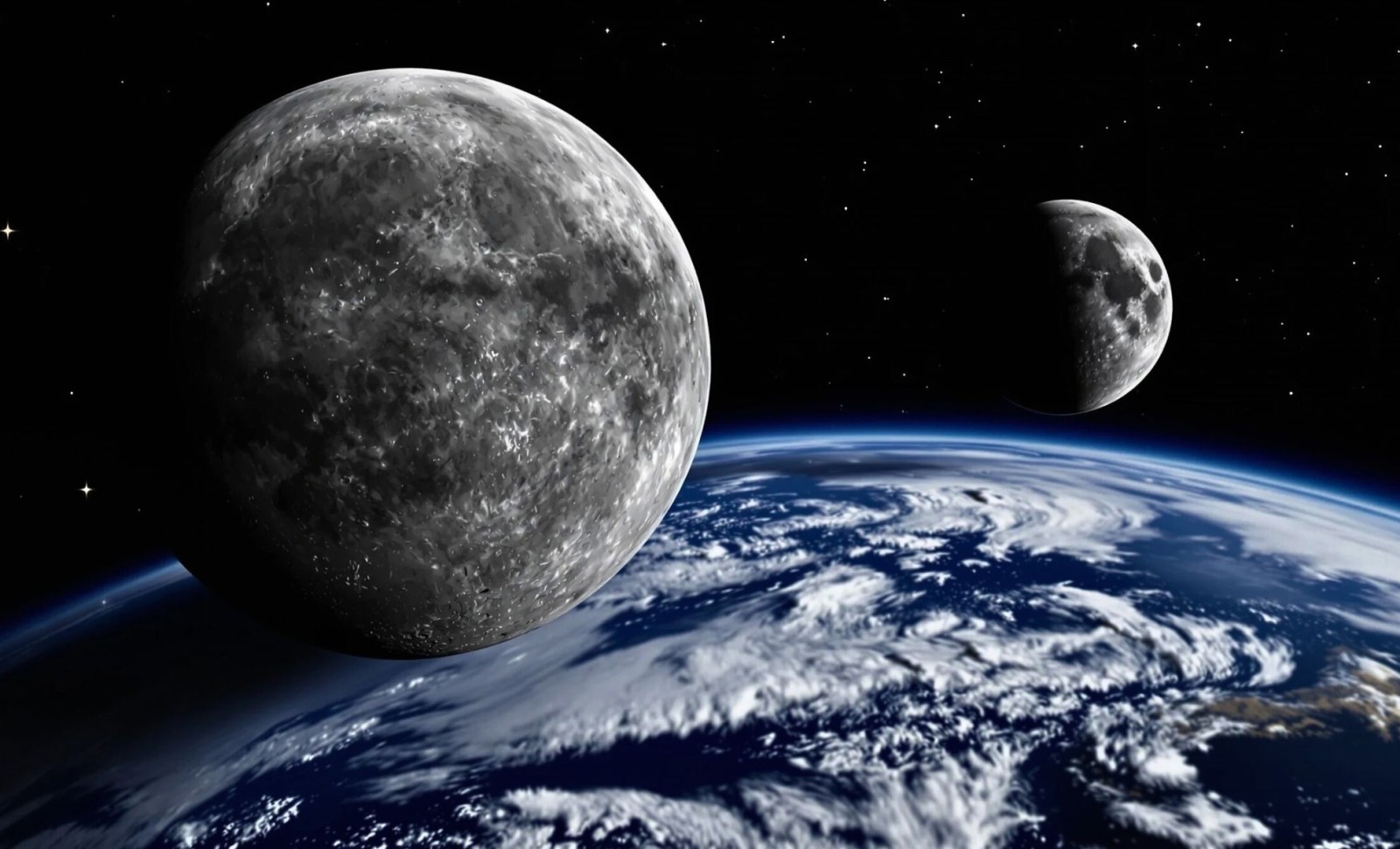
Earth has gained an unusual companion for the coming decades. A modest asteroid, known as 2025 PN7, has been verified as a quasi-satellite, a rare class of near-Earth objects that share Earth’s solar orbit but are not gravitationally captured by our planet.
Unlike the familiar Moon, this celestial body will not brighten our night sky or influence tides. However, its distinctive synchronized orbital pattern makes it an intriguing subject for scientific research and could serve as a valuable target for future space missions. This discovery highlights how much remains undiscovered within Earth’s orbital vicinity and the increasing importance of these subtle companions in space exploration.
First detected in August 2025 by astronomers operating the Pan-STARRS telescope in Hawaii, 2025 PN7 initially showed up as a faint, sluggish light. Subsequent tracking and trajectory analysis led the Minor Planet Center to officially confirm its orbital path.

NASA’s orbital catalog now lists 2025 PN7 as a near-Earth asteroid maintaining a quasi-orbit configuration with Earth until about 2083, which is an unusually long tenure for such an object.
Not a True Moon, but a Unique Orbital Companion
Objects like 2025 PN7, known as quasi-moons, do not directly orbit Earth. Instead, they revolve around the Sun with a matching orbital period close to one year while staying near Earth due to a gravitational relationship termed mean motion resonance.
This arrangement causes the asteroid to appear as if it slowly spirals around Earth from our viewpoint. In actuality, Earth and the asteroid are both circling the Sun almost in lockstep.
According to the Earth.com article, 2025 PN7 measures around 62 feet (19 meters) across and travels in a near-circular path with a low tilt of less than 2°. It possesses an eccentricity of 0.1075 and approaches Earth’s orbital path as closely as 0.0024 AU—approximately 360,000 kilometers.
These orbital characteristics make it one of the most stable Earth co-orbitals discovered to date. While similar quasi-moons tend to come and go over months or a few years, models predict 2025 PN7 will stay by our side for at least fifty years.
A Valuable Test Subject for Space Science and Missions
Though small and faint—its absolute magnitude is 26.36—2025 PN7 offers a rare chance to study orbital mechanics, strategies for planetary defense, and spacecraft navigation under natural conditions.
As it is not gravitationally tethered to Earth, its movement is influenced by subtle forces, including solar radiation pressure, perturbations from other planets, and the Yarkovsky effect, which is caused by heat emitted from its surface. Examining these influences aids researchers in improving trajectory forecasts for small bodies near planets.
The Minor Planet Center’s bulletin details how 2025 PN7’s orbit was reconstructed from observations spanning 2014 to 2025, using data from Maunakea and Haleakalā observatories.
This stability makes quasi-moons like PN7 excellent candidates for robotic mission testing. Their slow relative speed to Earth simplifies rendezvous and sample-return missions or resource extraction trials. They also allow for calibration of navigation systems, study of small particle behavior in weak gravity, and sensor trials before deploying instruments on more distant asteroids.
Detection Challenges, Safety, and Blind Spots in Our Observations
Despite orbiting relatively nearby, 2025 PN7 is not visible without powerful telescopes due to its size and low reflectivity. Its faintness and gentle motion across the sky kept it hidden from detection until recently.
Crucially, there is no risk of impact with Earth. The NASA CNEOS database reports that the asteroid’s orbit is well understood, and none of the modeled trajectories predict Earth entry. It should also be noted that 2025 PN7 is not a transient satellite caught in Earth’s gravity, but a long-term resonant companion.
This discovery highlights the gaps in our current space surveillance. Even with modern telescopes, there may be dozens or hundreds of similar small objects following Earth’s path yet to be found.
As the focus on planetary defense grows, asteroids like 2025 PN7 provide both peace of mind through safe observation and exciting prospects for testing asteroid interaction methods or experimenting with resource extraction.
- Categories:
- Space







0 comments
Sign in to Comment