

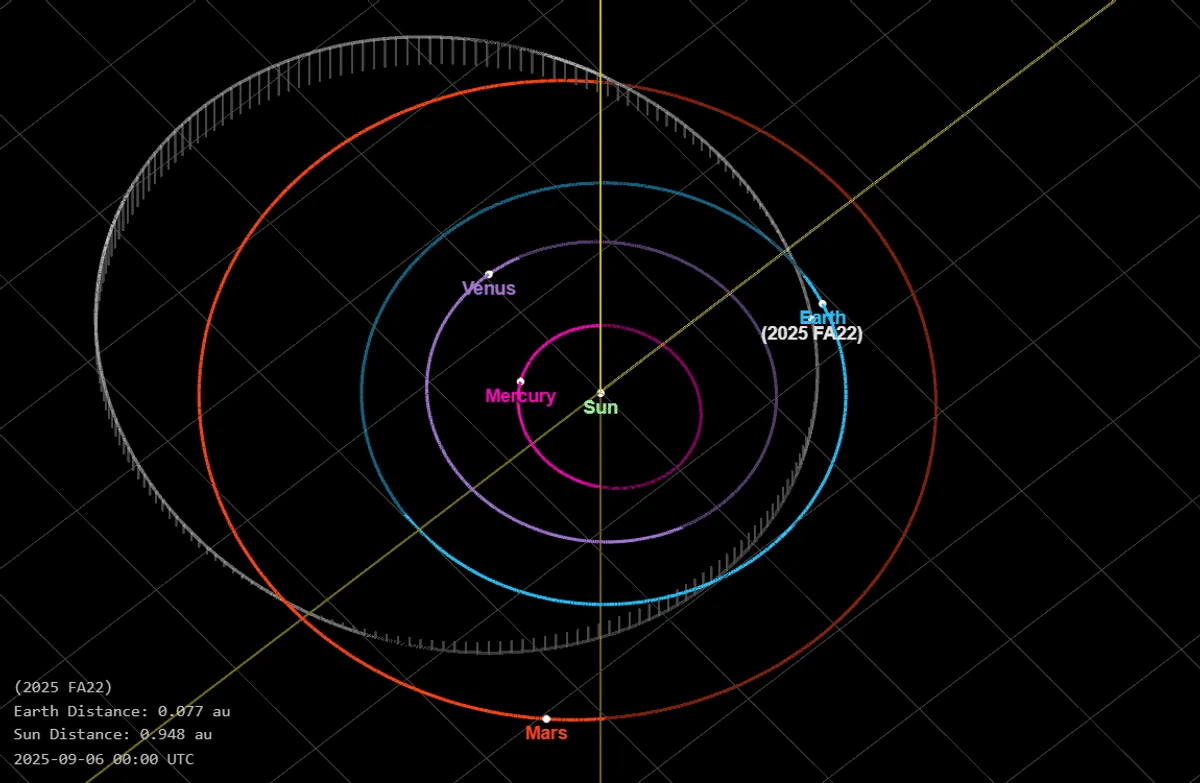
This September, asteroid 2025 FA22 is set for a rare close passage near Earth, an event that happens about once every ten years. Discovered at the Pan-STARRS 2 observatory in Hawaii on March 29, 2025, this large asteroid is drawing international interest for its role in enhancing planetary defense efforts. Although it poses no collision risk, NASA’s asteroid tracking tool identifies this as a valuable chance to observe the asteroid as it zooms past at a distance slightly more than 841,000 kilometers, visible to both experts and amateur skywatchers alike.
Understanding Asteroid 2025 FA22
Asteroid 2025 FA22 is a substantial near-Earth object with an estimated diameter between 120 and 280 meters (394–919 feet), placing it in the category of potentially hazardous asteroids (PHAs). These objects warrant close examination by NASA and global space agencies because of their considerable size and possible impact threats. While not the largest to approach our planet, its size combined with its close trajectory makes 2025 FA22 a significant focus for researchers around the world.
The asteroid’s initial detection came from the Pan-STARRS 2 observatory in Hawaii, a key player in spotting near-Earth objects that could present risks. Since this initial discovery, ongoing observations aim to clarify the asteroid’s orbit, makeup, and hazard level. As it nears Earth, both professionals and enthusiasts are gearing up to track this noteworthy celestial visitor.

Assessing Impact Probability
Despite its impressive size, asteroid 2025 FA22 is not projected to collide with Earth. Right after its discovery, the asteroid briefly received a Torino Scale rating of 1, indicating a minimal probability—about 1 in 100,000—of impact in 2089. As NASA details, “Shortly after discovery, 2025 FA22 briefly reached Torino Scale 1 with a 10-5 chance of Earth impact in 2089.” However, as more data was collected, the chances of collision were effectively ruled out. Precovery images from the Pan-STARRS 1 telescope taken in 2014 and 2012 narrowed down uncertainties in orbital calculations, confirming a safe path.
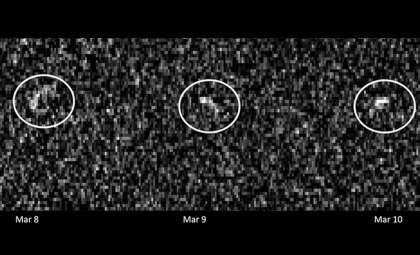
“Precovery observations reported from Pan-STARRS 1 in 2014 and 2012 have reduced the orbital uncertainties substantially and pointing uncertainties with solution 24 are now small enough to support radar observations,” NASA explained. This enhanced information has enabled researchers to predict the asteroid’s trajectory with greater accuracy, assuring no danger despite its close approach.
Global Collaboration and Observation Efforts
Even though the threat is minimal, the near passage of asteroid 2025 FA22 offers an unparalleled chance to boost planetary defense research. The International Asteroid Warning Network (IAWN) has organized a worldwide observation initiative involving space agencies and observatories to monitor the asteroid’s physical properties, trajectory, and behavior throughout its flyby.
“2025 FA22 will be the target of a coordinated, world-wide observing campaign for planetary defense under the auspices of the International Asteroid Warning Network [IAWN],” the IAWN stated. This collaborative effort not only strengthens current research but also advances tools and methods for tracking future asteroid threats. For training purposes, IAWN will treat 2025 FA22 as a hypothetical impactor, simulating a potential impact event on September 19, 2089.
Viewing Opportunities for Amateur Astronomers
As 2025 FA22 makes its approach, it will be visible to amateur astronomers as well. This event represents a rare chance for the public to observe a potentially hazardous asteroid. The asteroid is predicted to reach a brightness of magnitude 13 around September 18 and 19, 2025, making it detectable with modest telescopes and accessible to stargazing enthusiasts worldwide.
Observations using optical recovery methods will commence around September 17, when the asteroid’s position is favorable for Earth-based viewing. The IAWN’s planned effort will enhance orbital data accuracy and further insights into the asteroid’s dynamics during this period.
Future Directions in Planetary Defense
The upcoming flyby of asteroid 2025 FA22 highlights the critical nature of ongoing planetary defense initiatives. Although it currently presents no hazard, the close encounter allows scientists to refine detection and tracking techniques. Studying this asteroid’s structure and trajectory aids in deepening our understanding of such objects, potentially improving our ability to respond to future threats. The IAWN’s global observation campaign will continue gathering data to improve predictive capabilities and readiness for any asteroid events ahead.
- Categories:
- News











0 comments
Sign in to Comment